
Judge, 1932-06-25 · page 20 of 37
Judge — June 25, 1932 — page 20: what you’re looking at
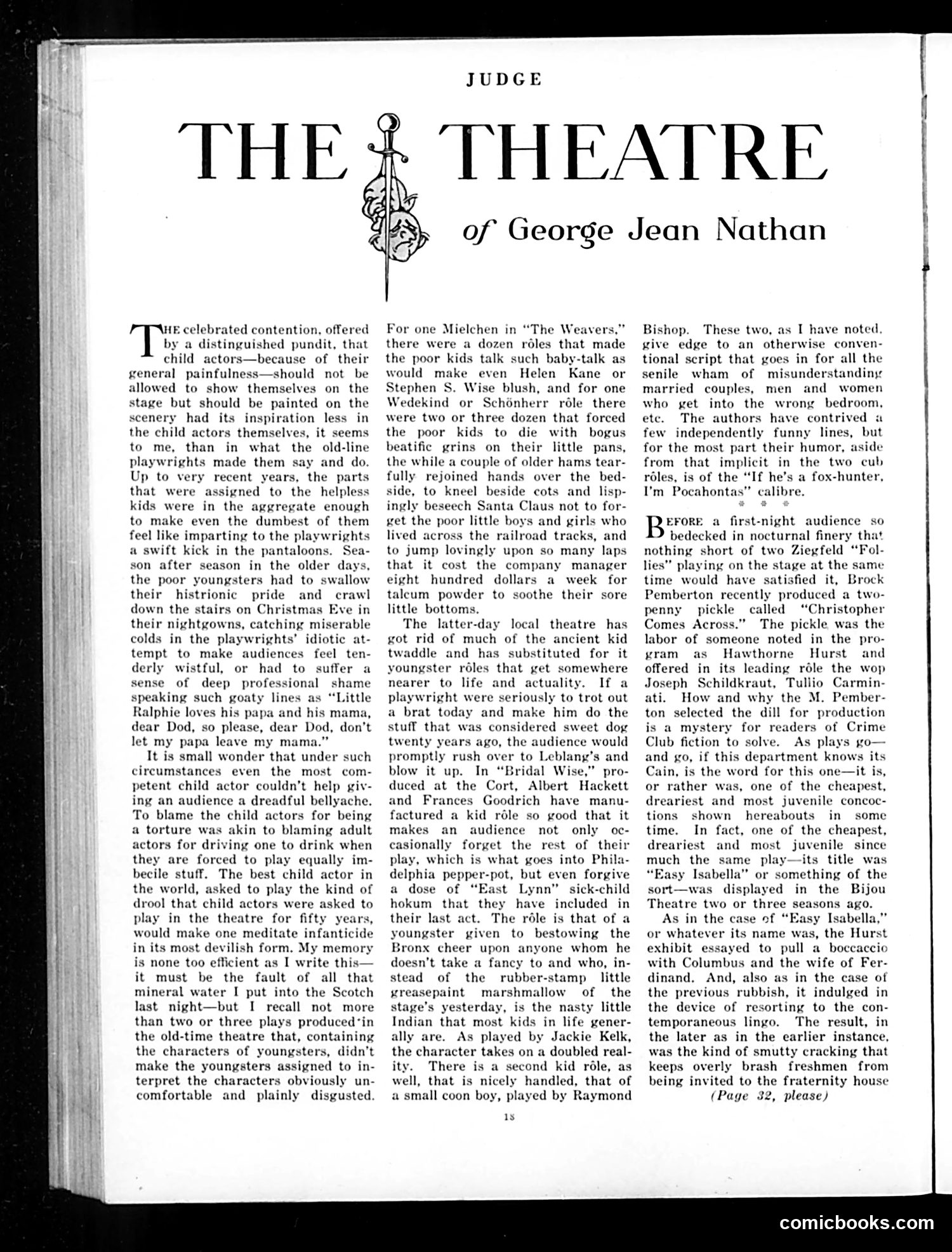
A restored page from Judge, 1932-06-25. Page through the whole issue in the reader above.
📄 Transcribed text from this page (OCR, searchable)
Machine-transcribed from the original scan — historical spelling and the odd misread are preserved.
"Tis celebrated contention, offered by a distinguished pundit, that child actors—because of their general painfulness—should not be allowed to show themselves on the stage but should be painted on the scenery had its inspiration less in the child actors themselves, it seems to me, than in what the old-line playwrights made them say and do. p to very recent years, the pz that were signed to the helple: kids were in the aggregate enough to make even the dumbest of them ting to the playwrights a swift kick in the pantaloons. Sea- son after season in the older days, the poor youngsters had to swallow their histrionic pride and crawl down the stairs on C mas Eve in their nightgowns, catching miserable colds in the playwrights’ idiotic at- tempt to make audiences feel ten- derly wistful, or had to suffer a sense of deep professional shame speaking such goaty lines as “Little Ralphie loves his papa and his mama, dear Dod, so please, dear Dod, don’t let my papa leave my mama.” It is small wonder that under such circumstances even the most com- petent child actor couldn’t help giv- ing an audience a dreadful bellyache. To blame the child actors for being a torture was akin to blaming adult actors for driving one to drink when they are forced to play equally im- becile stuff. The best child actor in the world, asked to play the kind of drool that child actors were asked to play in the theatre for fifty would make one meditate in in its most devilish form, My memor, is none too efficient as I write this— it must be the fault of all that mineral water I put into the Scotch last night—but I recall not more than two or three plays produced‘in the old-time theatre that, containing the characters of youngsters, didn’t make the youngsters assigned to in- terpret the characters obviously un- comfortable and plainly disgusted. JUDGE THEATRE of George Jean Nathan For one Mielchen in “The Weavers,” there were a dozen réles that made the poor kids talk such baby-talk as would make even Helen Kane or Stephen S. Wise blush, and for one Wedekind or Schénherr role there were two or three dozen t forced the poor kids to die with bogus beatific grins on their little pan: the while a couple of older hams tez fully rejoined hands over the bed- side, to kneel beside cots and lisp- ingly beseech Santa Claus not to for- yet the poor little boys and girls who lived across the railroad tra and to jump lovingly upon so many laps that it cost the company manager eight hundred dollars a week for talcum powder to soothe their sore little bottoms. The latter-day local theatre has got rid of much of the ancient kid twaddle and has substituted for it youngster réles that get somewhere nearer to life and actuality. If a playwright were seriously to trot out a brat today and make him do the stuff that was considered sweet dog twenty y go, the audience would promptly rush over to Leb #’s and blow it up. In “Bridal V duced the Cort, Albert Ha and Frances Goodrich have manu- factured a kid réle so good that it makes an audience not only oc- casionally forget the rest of their play, which is what goes into Phila- delphia pepper-pot, but even forgive a dose of “East Lynn” sick-child hokum that they have included in ast act. The réle is that of a youngster given to bestowing the Bronx cheer upon anyone whom he doesn’t take a fancy to and who, in- stead of the rubber-stamp little greasepaint marshmallow of stage’s yesterday, is the Indian that most kids in life gener- ally are. As played by Jackie Kel the character takes on a doubled real- ity. There is cond kid réle, as well, that is nicely handled, that of a small coon boy, played by Raymond 1s Bishop. These two, as I have noted. give edge to an otherwise conven- tional script that goes in for all the senile wham of misunderstandiny married couples, men and women who get into the wrong bedroom, etc. The authors have contrived a few independently funny lines, but for the most part their humo: de from that implicit in the two cub roles, is of the “If he’s a fox-hunter, I'm Pocahontas” calibre. EFORE a first-night audience so bedecked in nocturnal fini that nothing short of two Ziegfeld “Fol- lies” playing on the stage at the same time would have satisfied it, Brock Pemberton recently produced a two- penny pickle called “Christopher Comes Acro: The pickle was the labor of someone noted in the pro- gram Hawthorne Hurst and offered in its leading réle the wop Joseph Schildkraut, Tullio Carmin- ati. How and why the M. Pember- ton selected the dill for production is a mystery for readers of Crime Club fiction to solve. As plays go— and so, if this department knows its s the word for this one—it is, ther was, one of the cheapest, st and most juvenile concoc- tions shown hereabouts in some time. In fact, one of the cheapest, dreariest and most juvenile since much the same play—its title was ” or something of the in the Bijou SONS ago. y Isabella,” or whatever ame was, the Hurst exhibit essayed to pull a boccaccio with Columbus and the wife of Fer- dinand. And, also as in the case of the previous rubbish, it indulged in the device of resorting to the con- temporaneous lingo. The result, in the later as in the earlier instance, was the kind of smutty cracking that keeps overly brash freshmen from being invited to the fraternity house (Page 32, please) in the ge re comicbooks.com