
Judge, 1932-06-18 · page 4 of 36
Judge — June 18, 1932 — page 4: what you’re looking at
What you’re looking at
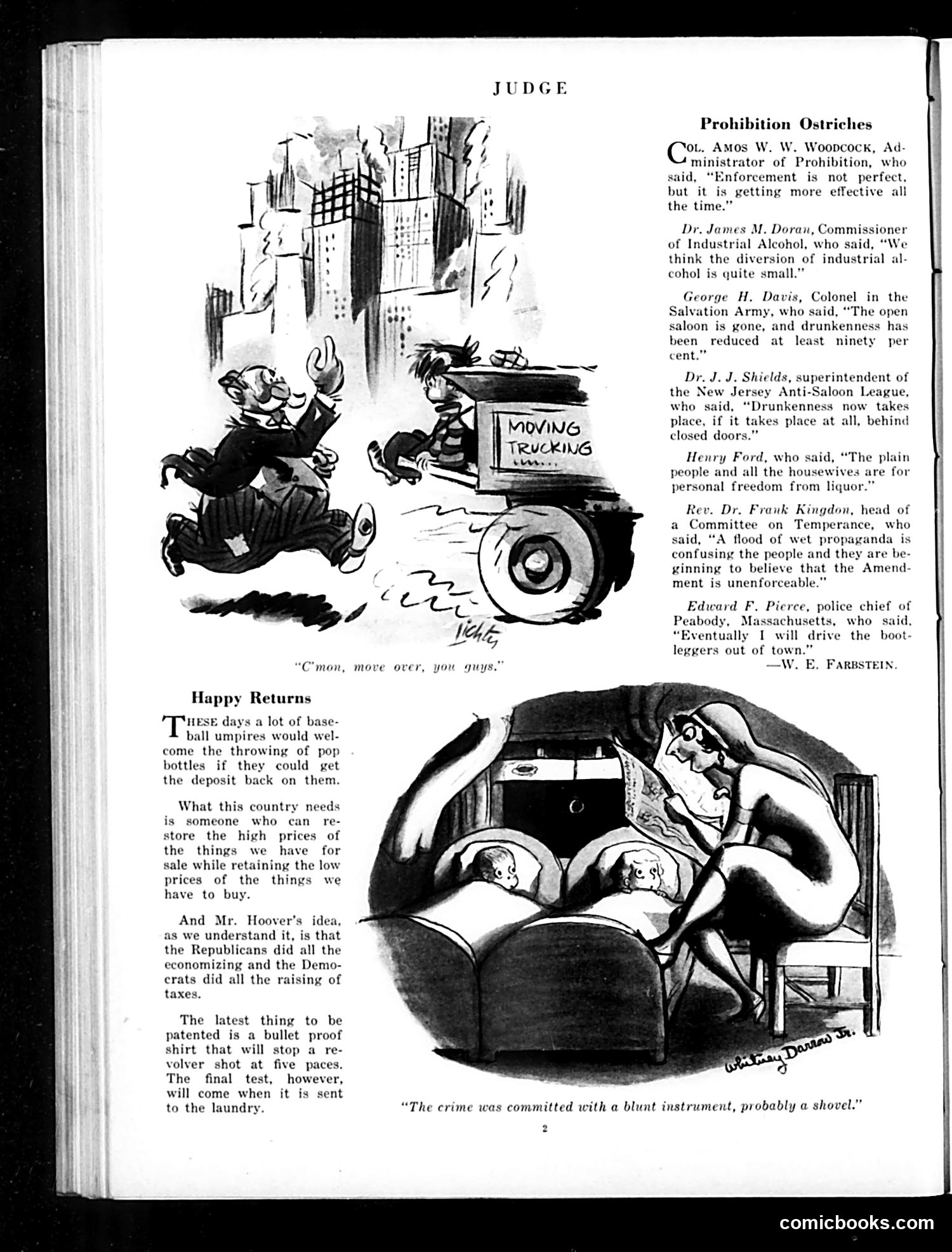
# Analysis of Judge Magazine Page **Top Cartoon ("C'mon, move over, you guys"):** This depicts Prohibition enforcement, showing an ostrich-like figure hiding its head (symbolizing denial) while a "Moving Trucking" vehicle—likely representing illegal alcohol distribution—operates nearby. The satire mocks how Prohibition enforcement was ineffective; bootleggers continued operating despite the law. **Testimonials Section ("Prohibition Ostriches"):** Various officials and religious leaders claim Prohibition's success (reduced drunkenness, closed saloons). The "ostriches" metaphor suggests they're burying their heads in sand, refusing to acknowledge widespread violation and bootlegging. **Bottom Cartoon ("The crime was committed with a blunt instrument"):** A detective examines what appears to be a domestic crime scene involving infants, likely satirizing absurd detective work or sensationalist crime reporting. The page overall critiques Prohibition's failure and hypocrisy.
📄 Transcribed text from this page (OCR, searchable)
Machine-transcribed from the original scan — historical spelling and the odd misread are preserved.
“C'mon, Happy Returns HESE days a lot of base- ball umpi would wel- come the throwing of pop bottles if they could get the deposit back on them. What this country needs is someone who can_ re- store the high prices of the things we have for sale while retaining the low prices of the things we have to buy. And Mr. Hoov idea, as we unde nd it that the Republicans did all the economizing and the Demo- crats did all the raising of taxes, The latest thing to be patented is a bullet proof shirt that will stop a re- volver shot at five pac The final test, however, will come when it is sent to the laundry. JUDGE Prohibition Ostriches ‘oL. AMOos W. W. Woopcock, Ad- ministrator of Prohibition, who said, forcement is not perfect, but it is getting more effective all the time.” Dr. James M. Doran, Commissioner of Industrial Alcohol, who said, “We think the diversion of industrial al- cohol is quite small.” George H. Davis, Colonel in the Salvation Army, who said, “The open saloon is gone, and drunkenness has been reduced at least ninety per cent.” Dr. J. J. Shields, superintendent of the New Jersey Anti-Saloon League, who d, “Drunkenness now takes place, if it takes place at all, behind closed doors.” Henry Ford, who said, “The plain people and all the housewive. for personal freedom from liquor. Rev. Dr. Frank Kingdon, head of a Committee on Temperance, who said, “A flood of wet propaganda is confusing the people and they are be- ginning to believe that the Amend- ment is unenforceable.” Edward F. Pierce, police chief of Peabody, Massachusetts, who said, “Eventually I will drive the boot- leggers out of town.” —W. E. FAaRBSTEIN “The crime was committed with a blunt instrument, probably a shovel.” comicbooks.com