
Judge, 1932-06-18 · page 26 of 36
Judge — June 18, 1932 — page 26: what you’re looking at
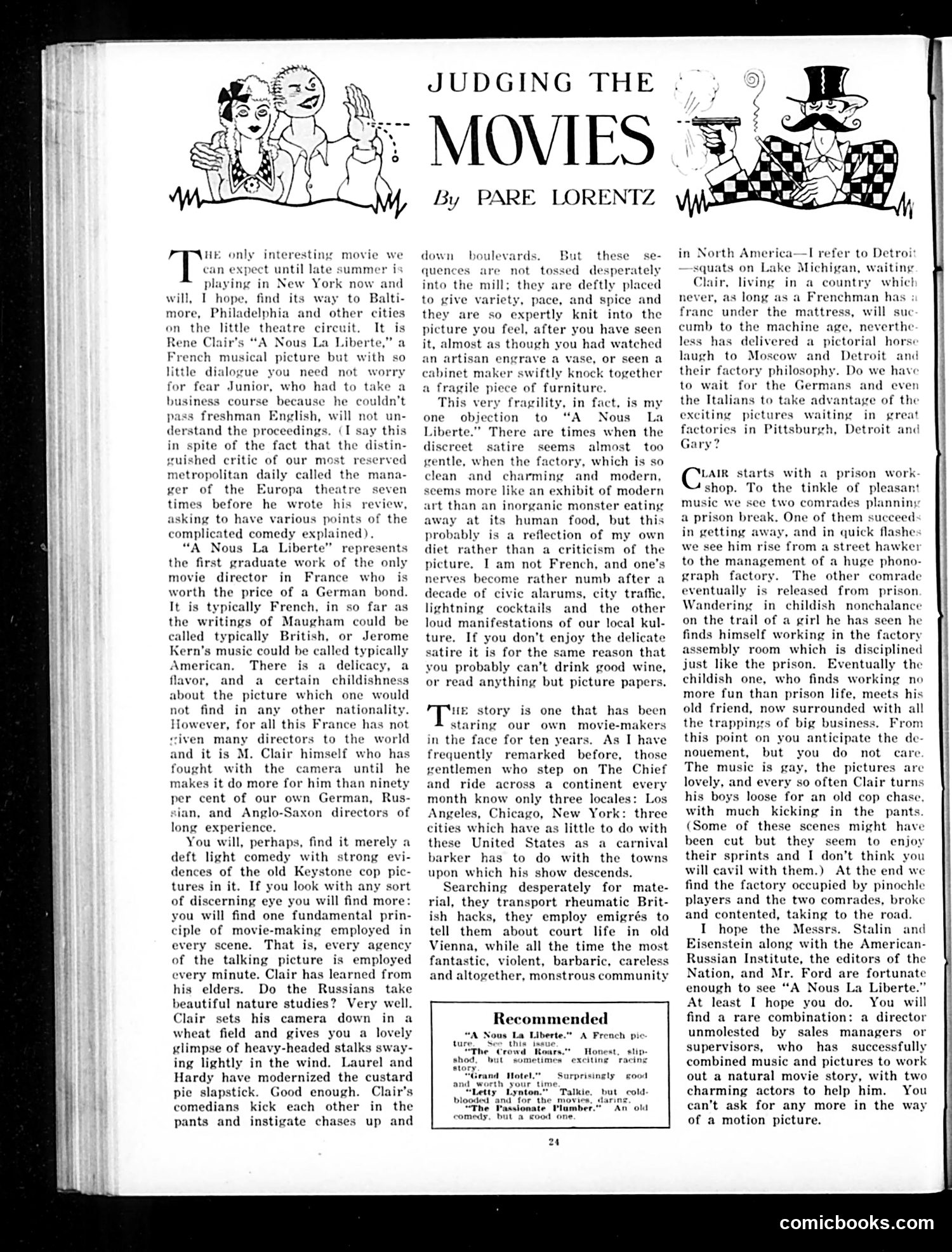
A restored page from Judge, 1932-06-18. Page through the whole issue in the reader above.
📄 Transcribed text from this page (OCR, searchable)
Machine-transcribed from the original scan — historical spelling and the odd misread are preserved.
HE only interesting movie we | ect until late summer is playing in New York now and will, I hope, find its way to Balti- more, Philadelphia and other cities on the little theatre circuit. It is Rene Clair’s “A Nous La Liberte,” a French musical picture but with so little « ye you need not worry for fear Junior, who had to take busin course because he cov pass freshr English, will not un- derstand the proceedings. (I say this in spite of the fact that the distin- sruished critic of our most reserved metropolitan daily called the mana- wer of the Europa theatre seven times before he wrote his review, asking to have various points of the complicated comedy explained). “A Nous La Liberte” represents the first graduate work of the only movie director in France who is worth the price of a German bond. It is typically French, in so far as the writings of Maugham could be called typically British, or Jerome Kern's music could be called typically American, There is a delic flavor, and a certain childishness about the picture which one would not find in any other nationality. However, for all this France has not ven many directors to the world and it is M. Clair himself who has fought with the ne until he makes it do more for him than ninety per cent of our own German, Rus- ian, and Anglo-Saxon directors of long experience. You will, perhaps, find it merely « deft light comedy with strong ev dences of the old Keystone cop pic- tures in If you look with any sort of discerning eye you will find more: you will find one fundamental prin- ciple of movie-making employed in every scene. That is, every agency of the talking picture is employed every minute. Clair has learned from his elders. Do the Russians take beautiful nature studies? Very well. lair sets his camera down in a wheat field and gives you a lovely glimpse of heavy-headed stalks sway ing lightly in the wind. Laurel and Hardy have modernized the custard pie slapstick. Good enough. Clair’s comedians kick each other in the pants and instigate chases up and By PARE down boulevards. quences are not tossed desperately into the mill; they are deftly placed to give variety, pace, and spice and they are so expertly knit into the picture you feel, after you have seen it, almost as though you had watched se, or seen a cabinet ms swiftly knock together a fragile piece of furniture This very fragility, in one objection to “A Liberte.” There are times when the discreet satire seems almost too srentle, when the factory, which is so clean and charming and modern, seems more like an exhibit of modern art than an inorganic monster eating at its human food, but this reflection of my own than a criticism of the . Tam not French, and one’s prves become rather numb after a Je of civic alarums, city traffic, lightning cocktails and the other loud manifestations of our local kul- ture. If you don't enjoy the deli satire it is for the same reason that you probably can’t drink good wine, or read anything but picture pape But these se- et, is my Nous La HE story is one that has airing our own in the face for ten As I have frequently remarked before, thos gentlemen who step on The Chief and ride across a continent every month know only three locales: Los Angeles, Chicago, New York: three cities which have as little to do with these United States as a carnival barker has to do with the towns upon which his show descends. Searching desperately for mate- rial, they transport rheumatic Bri ish hacks, they employ emigrés to tell them about court life in old Vienna, while all the time the most fantastic, violent, barbaric, careless and altogether, monstrous community been movie-makers Recommended Nous La Liberte." A French pic Se tt . . slip: racing Surprisingly good but cold: ‘An’ old in North America—I refer to Detroi squats on Lake Michigan, waiting ir, living in a count whicl never, as long as a Frenchman hi franc under the mattress, will suc cumb to the machine age, neverth¢ less has delivered a pictorial hors« laugh to Moscow and Detroit and their factory philosophy. Do we have to wait for the Germans and even the Italians to take advantage of the pictures waiting in great es in Pittsburgh, Detroit i shop. To the tinkle of pleasan music we see two comrades planniny a prison break. One of them succeed in getting and in quick fl we see him rise from a street hawker to the management of a huge phono- graph factory. The other ntually is released from Wandering in childish none’ on the trail of a girl he finds himself working in the fa \ sembly room which is disciplined just like the prison. Eventually the childish one, who finds working no more fun than prison life, meets his old friend, now surrounded with all the trappinys of big business. From this point on you anticipate the de- nouement, but you do not care The music is the pictures are and every so often Cl. turns loose for an old cop chase, with much kicking in the pants (Some of these scenes might have been cut but they seem to enjoy their sprints and I don’t think you will cavil with them.) At the end we find the factory occupied by pinochle players and the two comrades, broke and contented, taking to the I hope the Messrs. Stalin Eisenstein along with the American- Russian Institute, the editors of the Nation, and Mr. Ford are fortunate enough to see “A Nous La Liberte.” At least I hope you do. You will find a rare combination: a director unmolested by sales managers or supervisors, who has_ successfully combined music and pictures to work out a natural movie story, with two charming actors to help him. You can't ask for any more in the way of a motion picture. comicbooks.com