
Judge, 1932-06-18 · page 23 of 36
Judge — June 18, 1932 — page 23: what you’re looking at
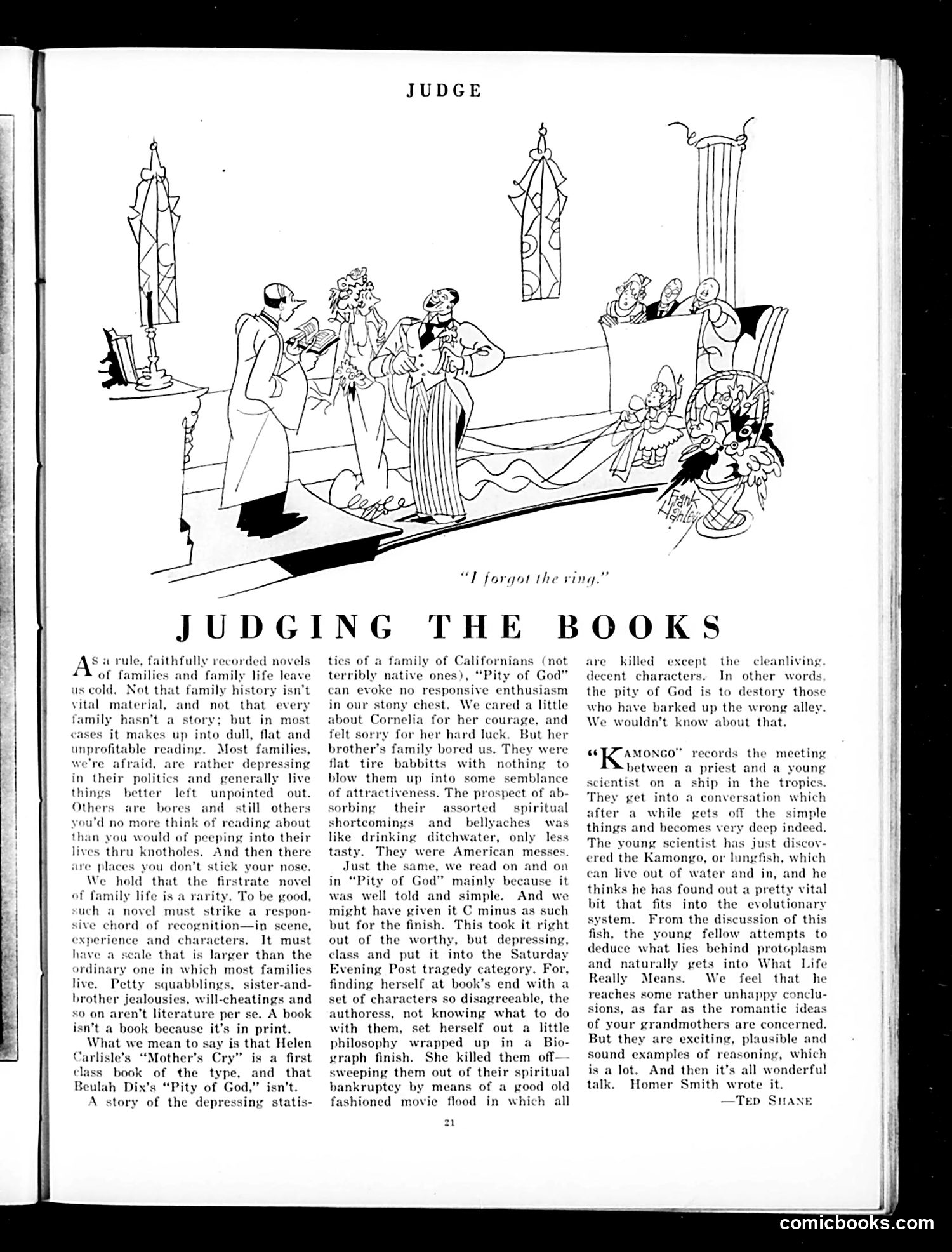
A restored page from Judge, 1932-06-18. Page through the whole issue in the reader above.
📄 Transcribed text from this page (OCR, searchable)
Machine-transcribed from the original scan — historical spelling and the odd misread are preserved.
JUDGING THE BOOKS A’ a rule, faithfully recorded novels 42 of families and family life leave us cold. Not that family history isn’t vital material, and not that every family hasn't a_ sto: but in most cases it makes up into dull, flat and > reading. Most nilies, id, are rather depressing in their politics and generally live things better left. unpointed out. Others are bores and_ still others you'd no more think of reading about than you would of peeping into their lives thru knotholes. And then there re places you don’t stick your nose. We hold that the firstrate novel of family life is a rarity. To be good, uch a novel must strike a respon- sive chord of recognition—in scene, experience and characters. It must seale that is larger than the y one in which most families live. Petty squabblings, sister-and- brother jealousies, will-cheatings and 4 ure per se. A book isn’t a book because it’s in print. What we mean to is that Helen Carlisle’s ‘‘Mother’s ‘y” is a first class book of the type, and that Beulah Dix’s “Pity of God,” isn’t. A story of the depressing statis- “7 forgot the ving.” mily of Californians (not can evoke no r in our stony chest. We cared a little about € lia for her courage, and felt sorry for her hard luck. But her brother bored us. They were flat tire babbitts with nothing to blow them up into some semblance of attractiveness. The prospect of ab- sorbing their assorted — spiritual ortcomings and bellyaches was like drinking ditchwate only less tasty. They were American messes. Just the sa we don and on in “Pity of God” mainly because it was well told and simple. And we might have given it C minus as s but for the finish. This took it out of the worthy, but depre s and put it into the Evening Post t finding herself set of cha Pe authoress, not knowing what to do with them, set herself out a little philosophy wrapped up in a_ Bio- graph finish. She killed them off— sweeping them out of their spiritual bankruptcy by means of a good old fashioned movie flood in which all are killed except. the cleanliving decent characters. In other words the pity of God is to destory those who have barked up the wrong alley. We wouldn't know about that. “ AMONGO” records the meeting between a priest and a young scientist. on a ship in the tropics. They yet into a conversation which after a while gets off the simple things and becomes very deep indeed. The young scientist has just discov- ered the Kamongo, or lungfish, which can live out of water and in, and he thinks he has found out a pretty vital bit that fits into the evolutionary system. From the discussion of this fish, the young fellow attempts to deduce what lies behind protoplasm and naturally gets into What Life Really Means. We feel that he reaches some rather unhappy conclu- sions, as far as the romantic ideas of your grandmothers are concerned. But they are exciting, plausible and sound examples of reasoning, which is a lot. And then it's all wonderful talk. Homer Smith wrote it. —TeD SHANE comicbooks.com J