
Judge, 1932-06-18 · page 18 of 36
Judge — June 18, 1932 — page 18: what you’re looking at
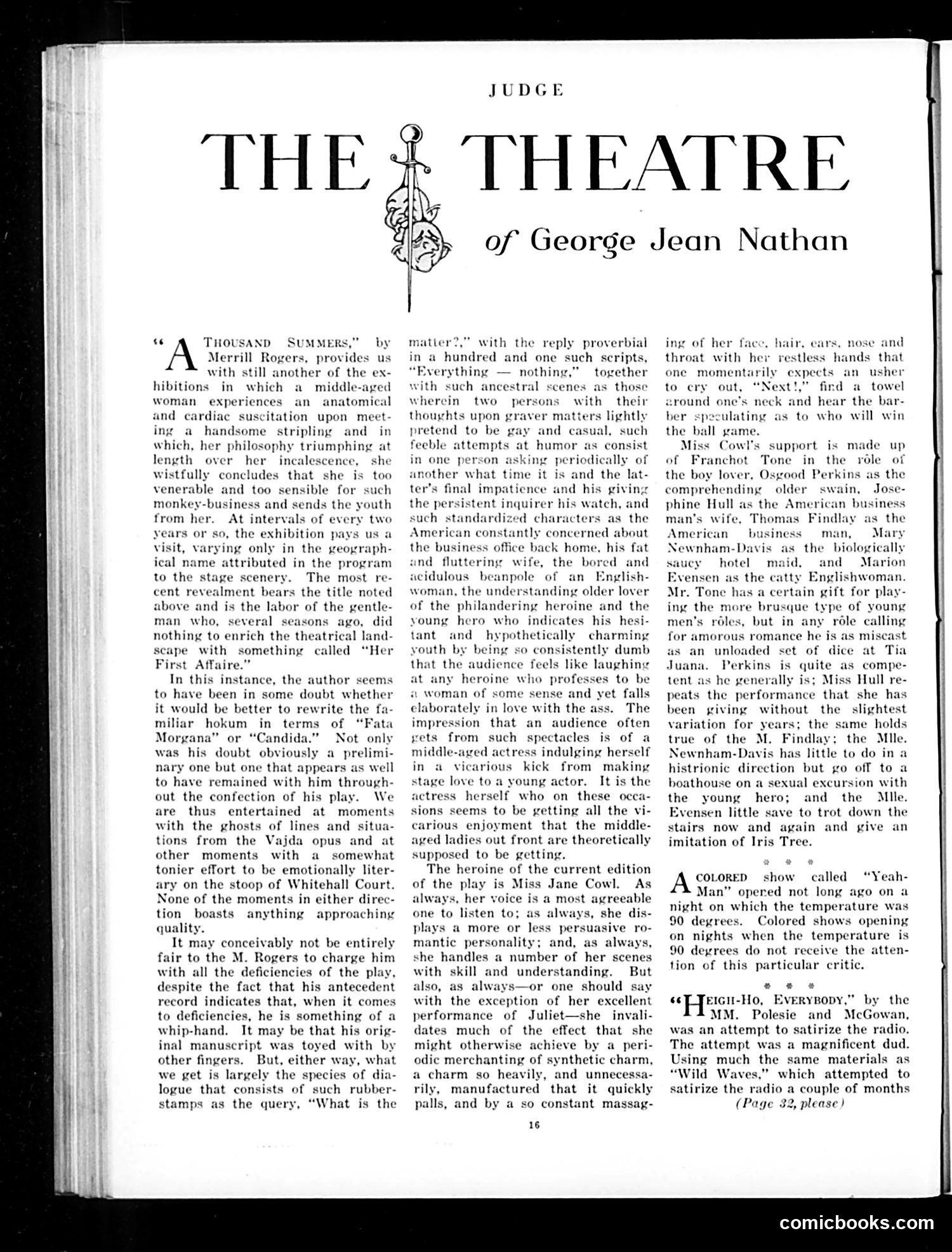
A restored page from Judge, 1932-06-18. Page through the whole issue in the reader above.
📄 Transcribed text from this page (OCR, searchable)
Machine-transcribed from the original scan — historical spelling and the odd misread are preserved.
THE se THOUSAND A Merrill Rog with still anothe hibitions in which a woman experiences an anatomical and card suscitation upon meet- ing a handsome stripling and in which, her philosophy triumphing at length over her incalescence, she wistfully concludes that she too venerable and too sensible for such monkey-business and sends the youth from her. At intervals of every two years or so, the exhibition pays us a visit, varying only in the geograph- ical name attributed in the program to the stage scenery. The most re- cent revealment bears the title noted above and is the labor of the gentle- man who, several seasons ago, did nothing to enrich the theatrical land- scape with something called ‘Her First Affaire.” In this instance, the author seems to have been in some doubt whether it would be better to rewrite the fa- iliar hokum in terms of “Fata ana” or “Candida.” Not only was his doubt obviously a prelimi- nary one but one that appears as well to have remained with him through- out the confection of his play. We are thus entertained at moments with the ghosts of lines and situa- tions from the Vajda opus and at other moments with a somewhat tonier effort to be emotionally liter- ary on the stoop of Whitehall Court. one of the moments in either direc- tion boasts anything approaching quality. It may conceivably not be entirely fair to the M. Rogers to charge him with all the deficiencies of the play, despite the fact that his antecedent record indicates that, when it comes to deficiencies, he is something of whip-hand. It may be that his o: inal manuscript w toyed with by other fingers. But, either way, what we get is largely the species of dia- logue that consists of such rubber- stamps as the query, “What is the provides us of the ex- middle-aged JUDGE . THEATRE of George Jean Nathan matter?,” with the reply provert in a hundred and one such scripts, verything — nothin: together ith such ancestral scenes as those wherein two with their thoughts upon graver matters lightly pretend to be gay and casual, such feeble attempts at humor as consist in one person asking periodically of another what time it is and the lat- ter’s final impatience and his giving the persistent inquirer his watch. such standardized characters a Am an constantly concerned about the business office back home, his fat und fluttering wife, the bored and acidulous beanpole of an English- woman, the understanding older lover of the philandering heroine and the young hero who indicates his hes tant and hypothetically charming youth by being so consistently dumb that the audience feels like laughing at any heroine who professes to be « woman of some sense and yet falls elaborately in love with the ass. The impression that an audience often sets from such spectacles is of a middle-ayed actress indulging herself in a vicarious kick from making stage love to a young actor. It is the actress herself who on sions seems to be getting all the vi- carious enjoyment that the middle- aged ladies out front are theoretically supposed to be getting. The heroine of the current edition of the play is Miss Jane Cowl. As always, her voice is a most agreeable one to listen to; as alw , She dis- plays a more or less persuasive ro- mantic personality; and, as alway she handles a number of her scenes with skill and understanding. But also, as always—or one should say with the exception of her excellent performance of Juliet—she invali- dates much of the effect that she might otherwise achieve by peri- odic merchanting of synthetic charm, a charm so heavily, and unnece: manufactured that it quickly and by a so constant massag- sons 16 ing of her face, hair, ears, nose and throat with her restless hands that one momentarily expects an usher to cry out, “Next!,” find a towel zround one’s neck and hear the bar- ber speculating as to who will win the ball me. Miss Cowl’s support is of Franchot Tone in the the boy lover, Osgood Perkins comprehending older swain, phine Hull as the American business man’s wife, Thomas Findlay as the business oman, Mary Newnham-Davis as the biologically aucy hotel maid, and = Mari vensen as the catty Englishwoman. Mr. Tone has a certain gift for pl. ing the more brusque type of young men’s roles, but in any réle calling for amorous romance he is as miscast as an unloaded set of dice at Tia Juana. Perkins is quite as compe- tent as he generally is; Miss Hull re- peats the performance that she has been giving without the slightest variation for years; the same holds true of the M. Findlay; the Mlle. Newnham- Davis little to do in a strionic direction but go off to a house on a sexual excursion with the young hero; and the Mlle. Evensen little save to trot down the stairs now and again and give an imitation of Iris Tree. made up role of the Jose- COLORED show called Man” opered not long night on which the tempe 90 degrees. Colored shov on nights when the temperature is 90 deyrees do not receive the atten- tion of this particular critic. “Yeah- go on a ure w opening ee @ “ 1G-Ho, RYBODY,” by the MM. Polesie and McGowan, 3 an attempt to satirize the radio. The attempt wa magnificent dud. Using much the same materials as “Wild Waves,” which attempted to satirize the radio a couple of months (Page 32, please) comicbooks.com