
Judge, 1932-05-21 · page 22 of 36
Judge — May 21, 1932 — page 22: what you’re looking at
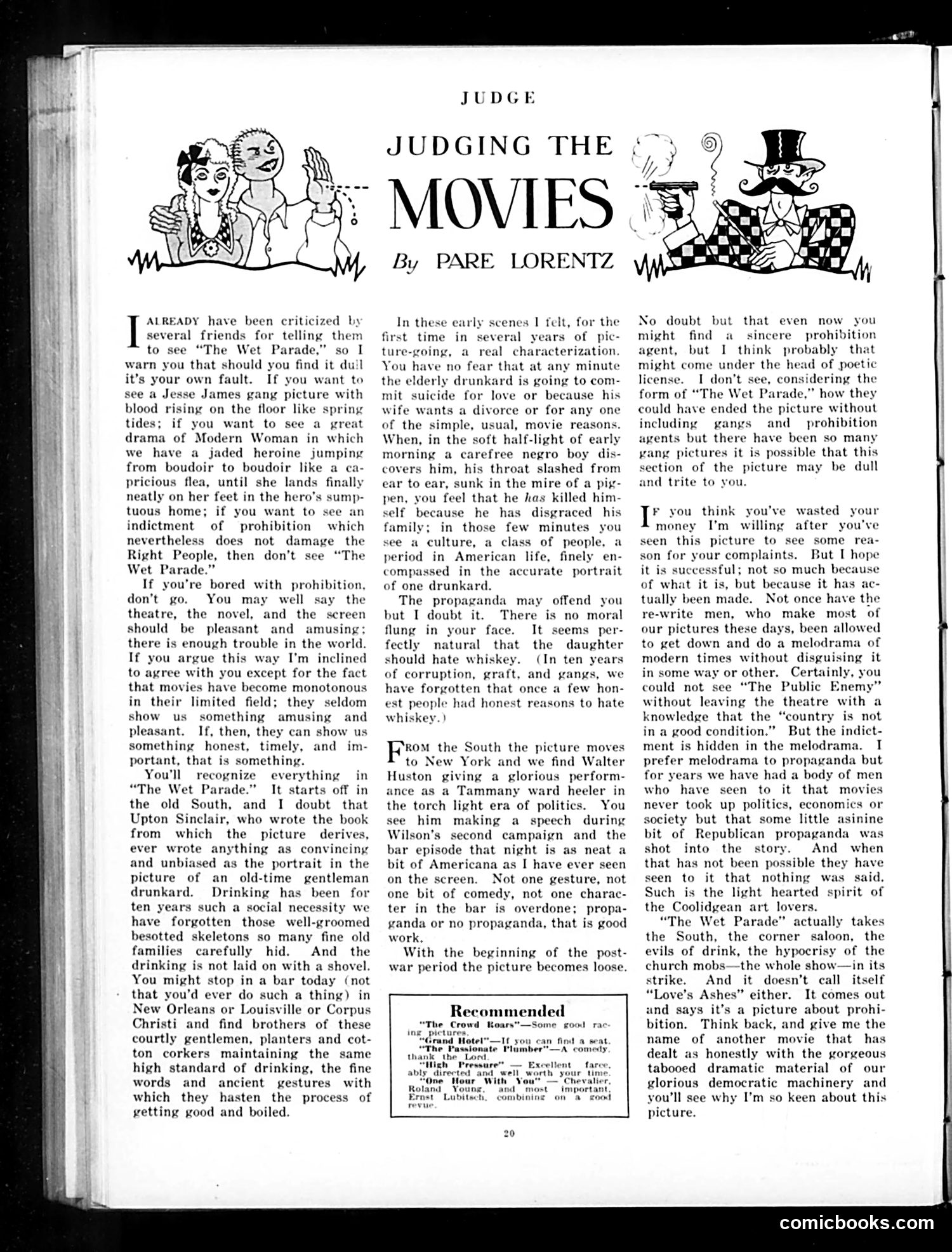
A restored page from Judge, 1932-05-21. Page through the whole issue in the reader above.
📄 Transcribed text from this page (OCR, searchable)
Machine-transcribed from the original scan — historical spelling and the odd misread are preserved.
ALREADY have been criticized by I several friends for telling them to see “The Wet Parade,” so I warn you that should you find it duil it’s your own fault. If you want to see a Jesse James gang picture with blood rising on the floor like spring tides; if you want to see Fi drama of Modern Woman in which we have a jaded heroine jumping from boudoir to boudoir like a ca- pricious flea, until she lands finally neatly on her feet in the hero’s sump- tuous home; if you want to see an indictment of prohibition which nevertheless does not damage the Right People, then don’t see “The Wet Parade.” If you're bored with prohibition, don’t go. You may well say the theat the novel, and the screen should be pleasant and amusing: there is enough trouble in the world. If you argue this way I'm inclined to agree with you except for the fact that movies have become monotonous in their limited field; they seldom show us something amusing and pl nt. If, then, they can show us something honest, timely, and im- portant, that is something. You'll recognize everything in “The Wet Parade.” It starts off in the old South, and I doubt that Upton Sinclair, who wrote the book from which the picture derives, ever wrote anything as convincing and unbiased as the portrait in the picture of an old-time gentleman drunkard. Drinking has been for ten years such a social necessity we have forgotten those well-groomed besotted skeletons so many fine old families carefully hid. And the drinking is not laid on with a shovel. You might stop in a bar today (not that you'd ever do such a thing) in y Orleans or Louisville or Corpus Christi and find brothers of these courtly gentlemen, planters and cot- ton corkers maintaining the same high standard of drinking, the fine words and ancient gestures with which they hasten the process of vetting good and boiled. JUDGE JUDGING THE In these early scenes I felt, for the first time in several years of ture-going, a real ch i You have no fear that at any minute the elderly drunkard is going to com- mit suicide for love or because his wife wants a divorce or for any one of the simple, usual, movie reasons. When, in the soft half-light of early morning a carefree negro boy dis- covers him, his throat slashed from ear to ear, sunk in the mire of a pig- pen, you feel that he has killed him- self because he has disgraced his family; in those few minutes you see a culture, class of people period in American life, finely compassed in the accurate portrait of one drunkard. The propaganda may offend you but I doubt it. There is no moral flung in your face. It seems per- fectly natural that the daughter should hate whis' (In ten years of corruption, graft, and gangs, we have forgotten that once a few hon- est people had honest reasons to hate whiskey.) ROM the South the picture moves to New York and we find Walter Huston giving a glorious perform- ance as a Tammany ward heeler in the torch light era of politics. You see him making a speech during Wilson’s second campaign and the bar episode that night is as neat a bit of Americana as I have ever seen on the screen. Not one gesture, not one bit of comedy, not one charac- ter in the bar overdone; propa- ganda or no propaganda, that is good work. With the beginning of the post- war period the picture becomes loose. Recommended “The Crowd Koars"—Some good rac. ¢ y3 “MOVIES * By PARE LORENTZ No doubt but might find a sine nt, but I think p might come under the hi license. I don’t see, considering the form of “The Wet Parade,” how they could have ended the picture without including gangs and prohibition agents but there have been so many yang pictures it is possible that this section of the picture may be dull and trite to you. that even now you prohibition ybably that 1 of poetic F you think you've wasted your mon I'm willing after you've seen this picture to see some son for your complaints. But I hope it is successful; not so much because of what it is, but because it h: : tually been made. Not once have the re-write men, who make most of our pictures these days, been allowed to get down and do a melodrama of modern times without disguising it in some way or other. Certainly, you could not “The Public Enemy” without leaving the theatre with a knowledge that the “country not in a good condition.” But the indict- ment is hidden in the melodrama. I prefer melodrama to propaganda but for years we have had a body of men who have seen to it that movies never took up politics, economics or society but that some little asinine bit of Republican propaganda was shot into the story And when that has not been possi seen to it that nothing Such is the light hearted sp the Coolidgean art lovers. “The Wet Parade” actually takes the South, the corner saloon, the evils of drink, the hypocrisy of the church mobs—the whole show—in strike. And it doesn’t call its “Love's Ashes” either. It comes out und says it’s a picture about prohi- bition. Think back, and give me the name of another movie that has dealt as honestly with the gorgeous tabooed dramatic material of our glorious democratic machinery and you'll see why I'm so keen about this picture. comicbooks.com