
Judge, 1932-05-14 · page 24 of 36
Judge — May 14, 1932 — page 24: what you’re looking at
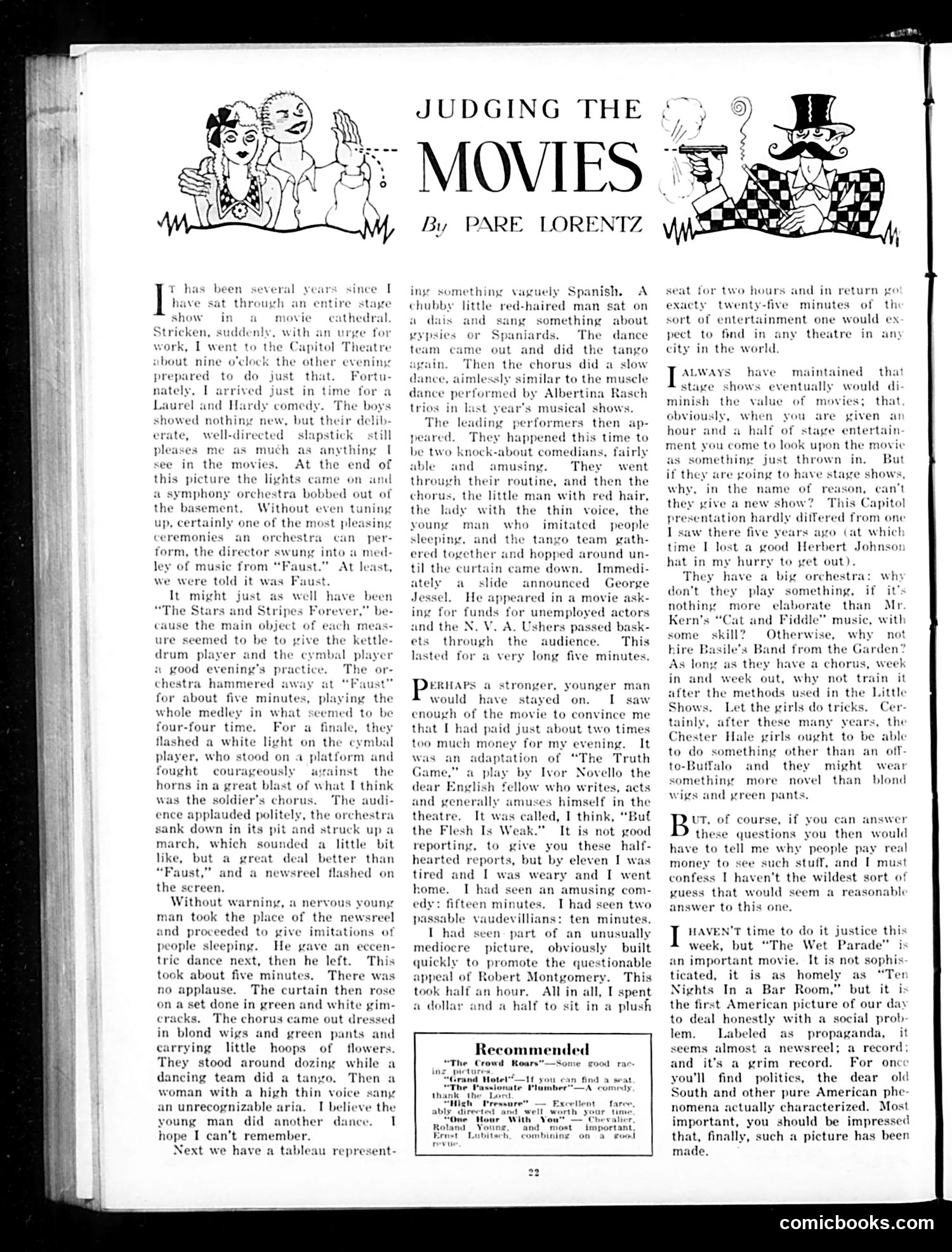
A restored page from Judge, 1932-05-14. Page through the whole issue in the reader above.
📄 Transcribed text from this page (OCR, searchable)
Machine-transcribed from the original scan — historical spelling and the odd misread are preserved.
T has been several year have sat through an show in a vie Stricken, der ntire eat with an ur about nine o'clock the other evening prepared to do just that. ortu- nately, I arrived just in time for Laurel and Hardy comedy. The bi owed nothing new, but th deli erate, well-directed slapstick — still pleases me as much as anything I the movies. At the end of this picture the lights came on and a symphony orchestra bobbed out of the basement. Without even tuning up, certainly one of the most pleasing ceremonies an orchestra can per- form, the director swung into a med- ley of music from “Faust.” At least, we were told it was Faust. It might just as well have been “The Stars and Stripes Forever,” be: cause the main object of each me ure seemed to be to give the kettle- drum player and the cymbal player xood evening’s practice. The o| chestra hammered away at “Fav for about five minutes, playing the whole medley in what seemed to be four-four time. For a finale, they flashed a white light on the cymbal player, who stood on a platform and fought courageously ayainst the horns ina great blast of what I think was the sold orus. The audi- ence applauded politely, the orchestra sank down in its pit and struck up a march, which sounded a little bit like, but a great deal better than “Faust,” and a newsreel flashed on the screen. Without warning, a nervous young man took the place of the newsreel d proceeded to give imitations of people sleeping. He gave an eccen- tric dance next, then he left. This took about five minutes. There was no applause. The curtain then rose on a set done in green and white gim- cracks. The chorus came out dressed in blond wigs and green pants and carrying little hoops of flowers. They stood around dozing while a dancing team did a tanyo. Then a woman with a high thin voice sang an unrecognizable aria. I believe the young man did another dance. 1 hope I can’t remember. Next we have a tableau represent- see in JUDGING THE MOVIES By PARE LORENTZ y something vaguely Spanish. A chubby little red-haired man sat on a dais g sang something about vypsies or Spaniards. The dance team came and did the tango ain. Then the chorus did a slow ince, aimlessly similar to the muscle ice performed by Albertina Rasch trios in last year’: The peared, out musical shows. ading performers then ap- They happened this time to be two knock-about comedians, fairly . d= amusing. They went ) their routine, and then the us, the little man with red hz lady with the thin voice, who imitated people id the tango team gath- ered toyether and hopped around un- til the curtain came down. Immedi- ately a slide announced George Jessel. He appeared in a movie ask- ing for funds for unemployed actors and the N. V. A. Ushers passed bask- ets through the audience. This lasted for a very long five minutes. the ERHAPS a stronger, younger would have stayed on. I enough of the movie to convince me that I had paid just about two times too much money for my evening. It was an adaptation of “T Truth * a play by Ivor Novello the dear English fellow who writes, acts and yenerally amuses himself in the theatr It was called, I think, “But the Flesh Is Weak.” It is not good reporting, to give you these half- hearted reports, but by eleven I was tired and I was weary and I went home. I had n an amusing com- fifteen minutes. I had seen two sable vaudevillians: ten minutes. I had seen part of an unusually mediocre picture, obviously — built quickly to promote the questionable appeal of Robert Montgomery. This took half hour, All in all, T spent a dollar and a half to sit in a plush Recommended “The P thank the “High pat for two f and in return exacty twenty-five minutes of th. sort of entertainment one would ex pect to find in any theatre in any city in the world [ Aeways have maintained that st: shows eventually would di minish the value of movies; that obviously, when y ure ysiven) ar hour and a half of stave entertain ment you come to look upon the movie as something just thrown in. But if they are yoing to have stage shows, y, in the name r n, can't sive a new show This Capit presentation hardly differed from one I saw there five years ayo (at which I lost a good Herbert Johnsor hat in my hurry to set out). They have a big orchestra: why don't they play something, if it’ nothing more elaborate than M1 Kern's “ and Fiddle” music, witl some skill? Otherwise, why not hire Basile’s Band from the Garden? As lony as they have a chorus, week in and week out, why not train it after the methods used in the Littl Shows. Let the girls do tricks. Cer- d fter these many years, the Hale girls ought to be able to do something other than an off- to-Buffalo and they might somethings more novel than wigs and yreen pants. wear blond UT, of cours: you can answer these questions you then would have to tell me why people pay real money to see such stuff, and [I must confess I haven't the wildest sort of guess that would seem a reasonabl answer to this one. J HAVEN'T time to do it justice this week, but “The Wet Parade” is an important movie. It is not sophis ticated, it is as homely as “Ter Nights In a Bar Room,” but it i the first American picture of our day to deal honestly with a social prob lem. Labeled as propaganda, it seems almos record; and it’s a For onc you'll find : South and other pur nomena actually characterized. Most important, you should be impressed that, finally, such a picture has been made. comicbooks.com