
Judge, 1932-05-07 · page 22 of 36
Judge — May 7, 1932 — page 22: what you’re looking at
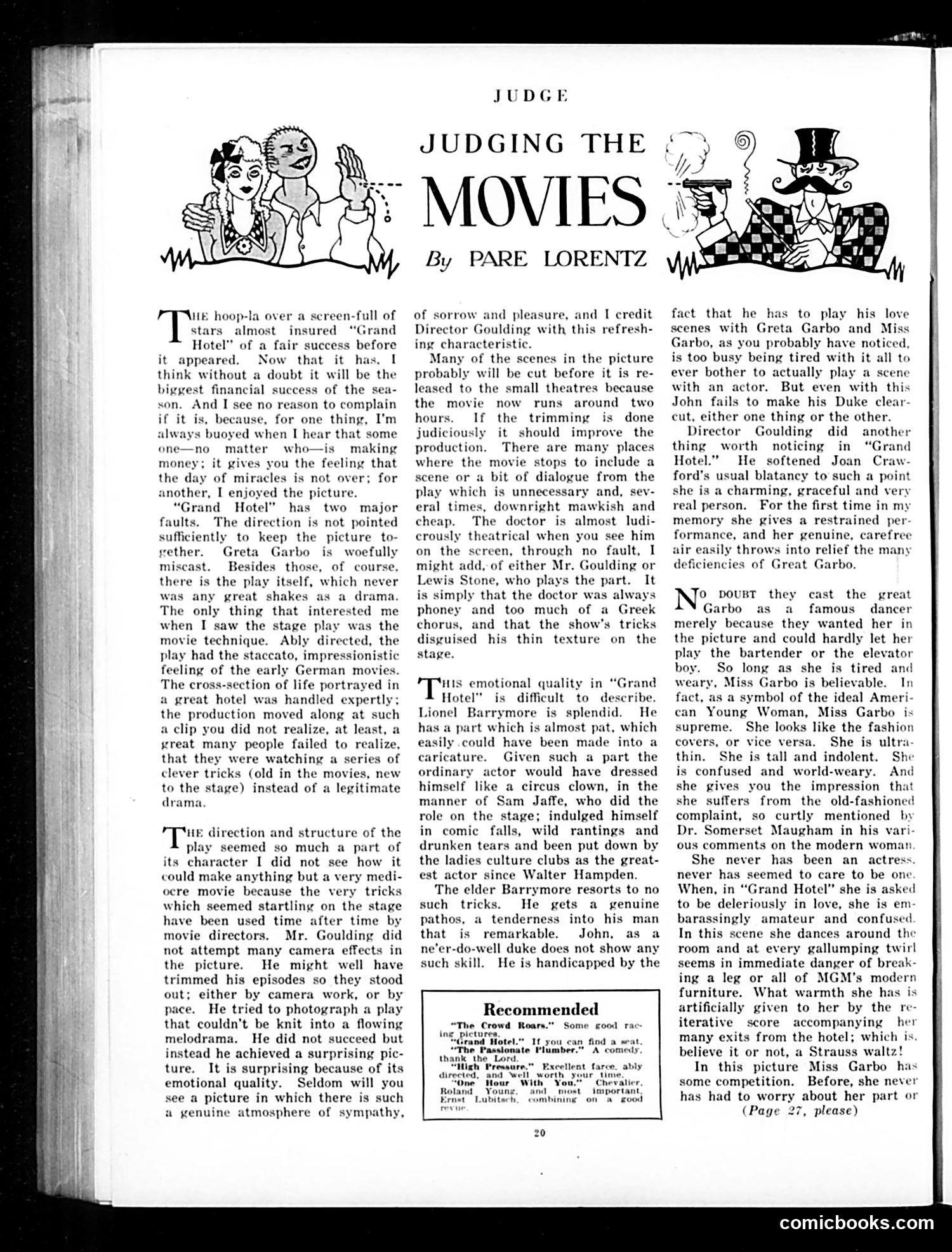
A restored page from Judge, 1932-05-07. Page through the whole issue in the reader above.
📄 Transcribed text from this page (OCR, searchable)
Machine-transcribed from the original scan — historical spelling and the odd misread are preserved.
He hoop-la over a screen-full of | stars almost insured “Grand Hotel” of a fair success before it appeared. Now that it has, I think without a doubt it will be the biggest financial success of the sez son. And I see no reason to complain if it is, because, for one thing, I'm always buoyed when I hear that some one—no matter who—is making mon it gives you the feeling that the day of miracles is not over; for another, I enjoyed the picture. nd_ Hotel ha two major The direction is not pointed sufficiently to keep the picture to- gether. Greta Garbo is woefully miscast. Besides those, of course, there is the play itself, which never v any great shakes as a drama. The only thing that interested me when I saw the stage play was the movie technique. Ably directed, the play had the staccato, impressionistic feeling of the early German movies. The cross-section of life portrayed in a great hotel was handled expertly; the production moved along at such aclip you did not realize, at le: yreat many people failed to realize, that they were watching a series of clever tricks (old in the movies, new to the stage) instead of a legitimate drama HE direction and structure of the seemed so much a part of racter I did not see how it could make anything but a very medi- ocre movie because the very tricks which seemed startling on the stage have been used time after time by movie directors. Mr. Goulding did not attempt many camera effects in the picture. He might well have trimmed his episodes so they stood out; either by camera work, or by pace. He tried to photograph a play that couldn’t be knit into a flowing melodrama. He did not succeed but instead he achieved a surprising pic- ture. It is surprising because of its emotional quality. Seldom will you see a picture in which there is such a genuine atmosphere of sympathy, JUDGE JUDGING THE OVIES By PARE LORENTZ of sorrow and pleasure, and I credit Director Goulding with this refresh- ing characteristic. Many of the scenes in the picture probably will be cut before it is re- leased to the small theatres because the movie now runs around two hours. If the trimming is done judiciously it should improve the production. There are many places where the movie stops to include a scene or a bit of dialogue from the play which is unnecessary and, sev- eral times, downright mawkish and cheap. The doctor is almost ludi- crously theatrical when you see him on the screen, through no fault, I might add, of either Mr. Goulding or Lewis Stone, who plays the part. It is simply that the doctor w always phoney and too much of Greek chorus, and that the show's tricks disguised his thin textu on the stage. His emotional quality in “Grand Hotel” is difficult to describe. Lionel Barrymore is splendid. He 1 part which is almost pat, which ly .could have been made into a icature. Given such a part the nary actor would have dressed himself like a circus clown, in the manner of Sam Jaffe, who did the role on the stage; indulged himself in comic falls, wild rantings and drunken tears and been put down by the ladies culture clubs as the great- est actor since Walter Hampden. The elder Barrymore resorts to no such tricks. He gets a genuine a tenderness into his man s remarkable. John, as a do-well duke does not show any such skill. He is handicapped by the Recommended “The Crowd Roars.” ing pictur Some good rac: jotel.”” If you can find a seat “The Passionate Plumber.” A. comely ellent farce, ably fact that he has to play his love scenes with Greta Garbo and Mi Garbo, as you probably have noticed, is too busy being tired with it all to ever bother to actually pl: with an actor. y a scene But even with this John fails to make his Duke clear- cut, either one thing or the other. Director thing Goulding did another worth noticing in “Grand -” He softened Joan Craw- usual blatancy to such a point she is a charming, graceful and very real person. For the first time in my memory she gives a restrained per- formance, and her genuine, carefree sily throws into relief the many deficiencies of Great Garbo. N° DOUBT they cast the great Garbo a famous dancer merely because they wanted her in the picture and could hardly let her play the bartender or the elevator bo: _So long as she is tired and . Miss Garbo is believable. In a symbol of the ideal Ameri- can Young Woman, Miss Garbo i supreme. She looks like the fashion covers, or vice versa. She is ultra thin. She is tall and indolent. She is confused and world-weary. And she gives you the impression that she suffers from the old-fashioned complaint, so curtly mentioned by Dr. Somerset Maugham in his vari- ous comments on the modern woman. She never has been an actress. never has seemed to care to be one When, in “Grand Hotel” she is asked to be deleriously in love, she is em eur and confused e dances around the room and at every gallumping twirl seems in immediate danger of break- ing a leg or all of MGM's modern furniture. What warmth she has is artificially given to her by the re- iterative score accompanying her many exits from the hotel; which is believe it or not, a Strauss waltz! In this picture Miss Garbo has me competition. Before, she never had to worry about her part or (Page 27, please) comicbooks.com