
Judge, 1932-05-07 · page 20 of 36
Judge — May 7, 1932 — page 20: what you’re looking at
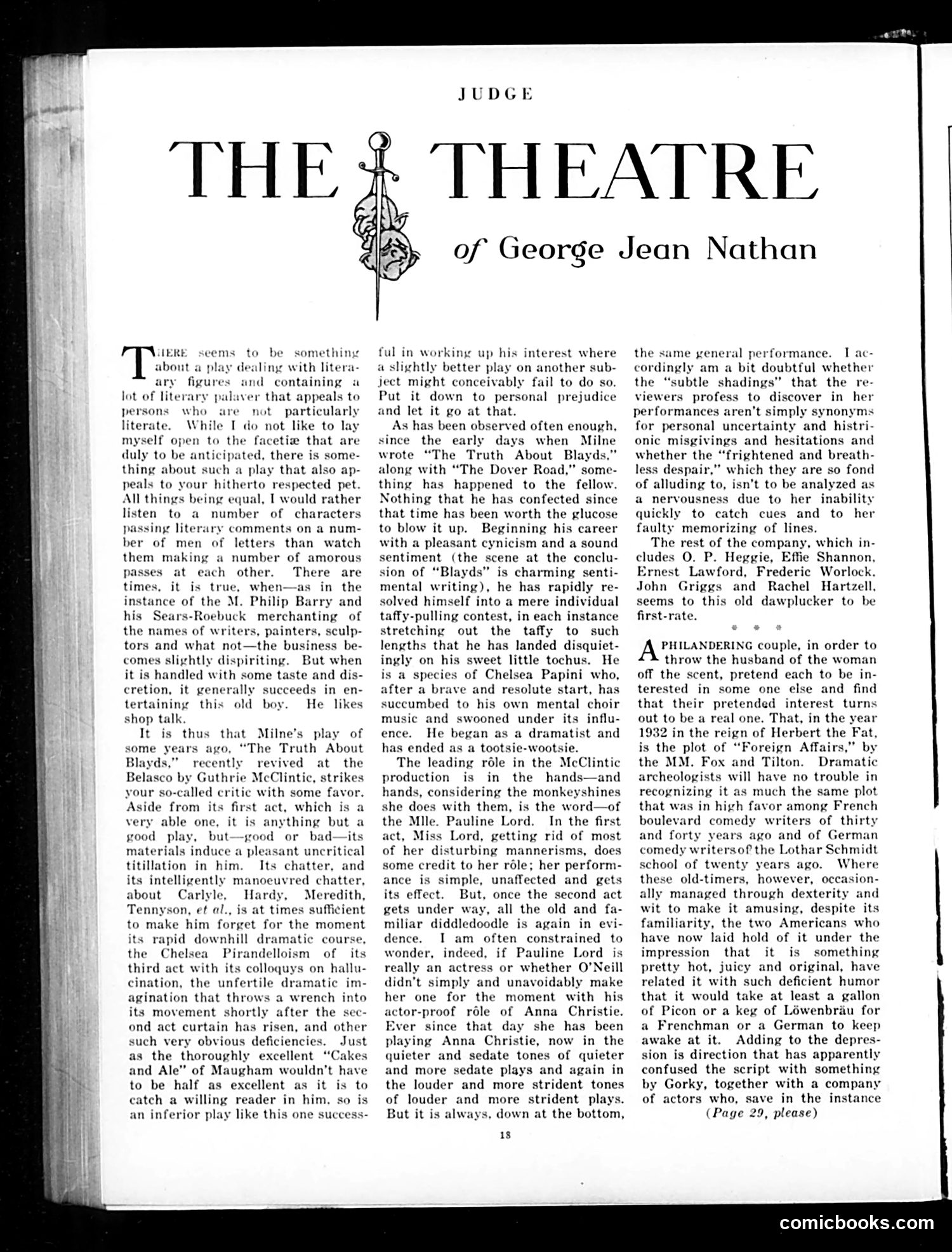
A restored page from Judge, 1932-05-07. Page through the whole issue in the reader above.
📄 Transcribed text from this page (OCR, searchable)
Machine-transcribed from the original scan — historical spelling and the odd misread are preserved.
THE 1ERE seems to be something bout a play dealing with litera- ry figures and containing a lot of literary palaver that appeals to persons who not y literate. Wh myself open to the duly to be anticipated, there is some- thing about such a play that also ap- peals to your hitherto respected pet. All things being equal, I would rather listen to a number of characters passing literary comments on a num- ber of men of letters than watch them making a number of amorous sses at each other. There are times, it is true, when—as in the instance of the M. Philip Barry and his Sears-Roebuck merchanting of the names of writers, painters, sculp- tors and what not—the business be- comes slightly dispiriting. But when it is handled with some ta nd dis- cretion, it generally succeeds in en- tertaining this old boy. He likes shop talk. It is thus that Milne’s play of some ars ago, “The Truth About Blayds, recently revived at the sco by Guthrie McClinti so-called critic with some Aside from its first act, which is ' nle one, it is anything but a good play, but—sood or bad—its materials induce a pleasant unc titillation in him. Its chatter, and its intelligently manoeuvred chatter, about Carlyle, Hardy, Meredith, Tennyson, et al., is at times sufficient to make him forget for the moment its rapid downhill dramatic course, the Chelsea Pirandelloism of its third act with its colloquys on hallu- cination, the unfertile dramatic im- agination that throws a wrench into its movement shortly after the s ond act curtain has risen, and other such very obvious deficienci Just the thoroughly excellent “Cakes and Ale” of Maugham wouldn't have to be half as excellent as it is to catch a willing reader in him. so i an inferior play like this one suce are JUDGE ful in working up his interest where a slightly better play on another sub- ject might conceivably fail to do so. Put it down to personal prejudice and let it go at that. As has been observed often enough, since the early days when Milne wrote “The Truth About Blayds,” along with “The Dover Road,” some- thing has happened to the fellow. Nothing that he has confected since that time has been worth the glucose to blow it up. Beginning his career with a pleasant cynicism and a sound sentiment (the scene at the conclu- sion of “Blayds” is charming senti- mental writing), he has rapidly re- solved himself into a mere individual taffy-pulling contest, in each instance stretching out the taffy to such lengths that he has landed disquiet- ingly on his sweet little tochus. He is a species of Chelsea Papini who, after a brave and resolute start, succumbed to his own mental choir music and swooned under its influ- ence. He began as a dramatist and has ended as a tootsie-wootsie. The leading réle in the McClintic production is in the hands hands, considering the monk she does with them, is the word—of the Mlle. Pauline Lord. In the first act, Miss Lord, getting rid of most of her disturbing mannerisms, does some credit to her réle; her perform- ance is simple, unaffected and gets its effect. But, once the second act ets under way, all the old and fa- miliar diddledoodle is again in evi- dence. I am often constrained to wonder, indeed, if Pauline Lord is really an actress or whether O'Neill didn’t simply and unavoidably make her one for the moment with his actor-proof réle of Anna Christie. since that day she has been ng Anna Christie, now in the quieter and sedate tones of quieter and more sedate plays and again in the louder and more strident tones of louder and more strident plays. But it is always, down at the bottom, and shines 18 THEATRE of George Jean Nathan the same general performance. I ac- cordingly am a bit doubtful whether the “subtle shadings” that the re- viewers profess to discover in her performances aren't simply synonyms for personal uncertainty and histri- onic misgivings and hesitations and whether the “frightened and breath- less despair,” which they are so fond of alluding to, isn’t to be analyzed as a nervousness due to her inability quickly to catch cues and to her faulty memorizing of lines. The rest of the company, which in- cludes O. P. Heggie, Effie Shannon, Ernest Lawford, Frederic Worlock. John Griggs and Rachel Hartzell, seems to this old dawplucker to be first-rate. PHILANDERING couple, in order to throw the husband of the woman off the scent, pretend each to be in- terested in some one else and find that their pretended interest turns out to be a real one. That, in the year 1932 in the reign of Herbert the Fat, is the plot of “Foreign Affairs,” by the MM. Fox and Tilton. Dramatic archeologists will have no trouble in recognizing it as much the same plot that was in high favor among French boulevard comedy writers of thirty and forty years ago and of German comedy writersof the Lothar Schmidt school of twenty years ago. Where these old-timers, however, occasi ally managed through dexterity wit to make it amusing, despite its familiarity, the two Americans who have now laid hold of it under the impression that it is something pretty hot, juicy and original, have related it with such deficient humor that it would take at least a gallon of Picon or a keg of Léwenbrau for a Frenchman or a German to keep awake at it. Adding to the depres sion is direction that has apparently confused the script with something by Gorky, together with a company of actors who, save in the instance (Page 29, please) comicbooks.com