
Judge, 1932-05-07 · page 16 of 36
Judge — May 7, 1932 — page 16: what you’re looking at
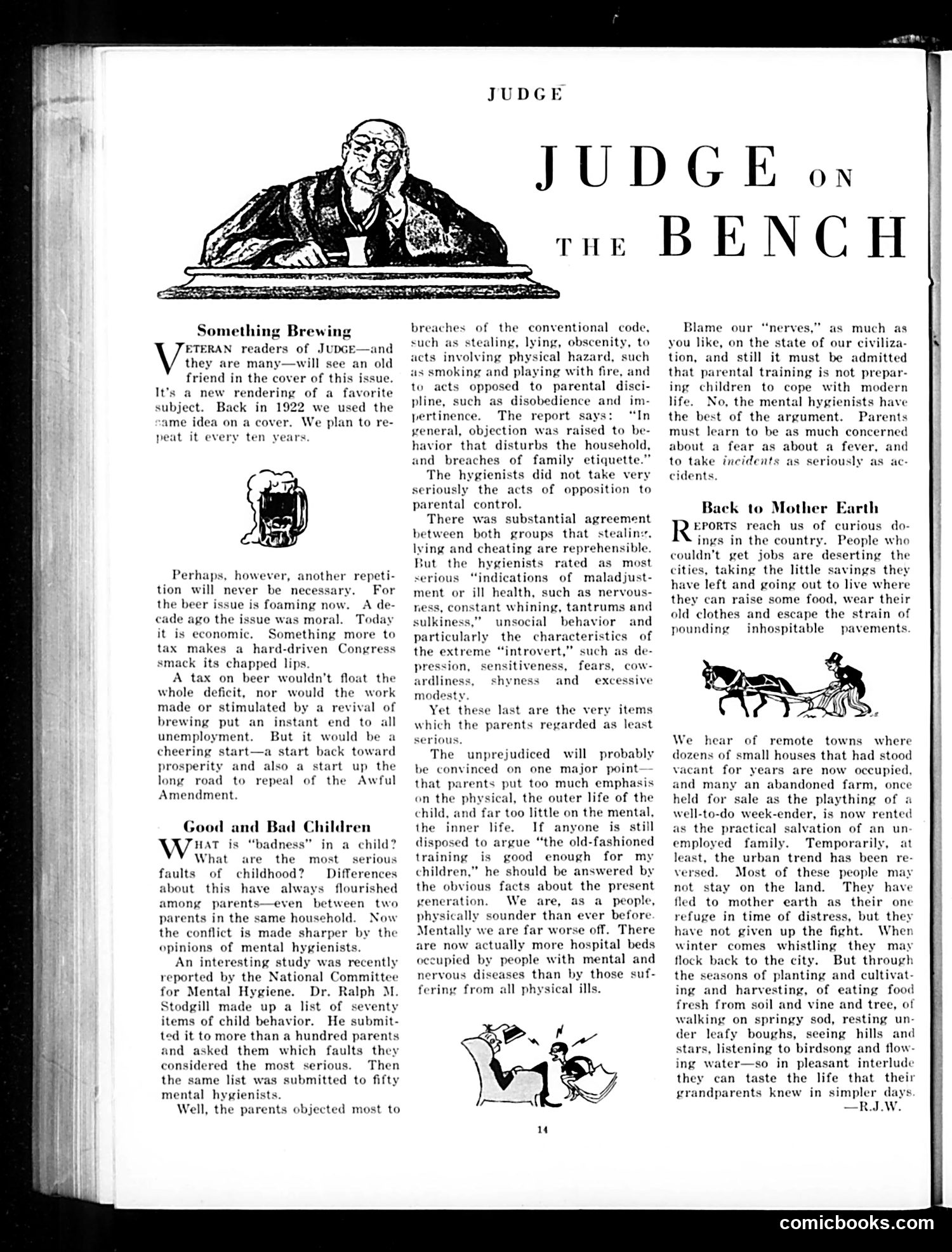
A restored page from Judge, 1932-05-07. Page through the whole issue in the reader above.
📄 Transcribed text from this page (OCR, searchable)
Machine-transcribed from the original scan — historical spelling and the odd misread are preserved.
Something Brewing ETERAN readers of JUDG they are many—will see friend in the cover of this issue. It’s a new rendering of a favorite subject. Back in 1922 we used the ame idea on a cover. We plan to re- Perhaps, however, another repeti- tion will never be necessary. For the beer issue is foaming now. A de- cade ago the issue was moral. Today it is economic. Something more to tax makes a hard-driven Congress smack its chapped lips. A tax on beer wouldn't float the whole deficit, nor would the work made or stimulated by a revival of brewing put an instant end to all unemployment. But it would be a cheering start—a start back toward prosperity and also rt up the long road to repeal of the Awful Amendment. Good and Bad Children V HAT is “badness” in a child? What are the most serious faults of childhood? Differences about this have al flourished among parents—even between two parents in the same household. Now the conflict is made sharper by the opinions of mental hygienists. An interesting study was recently reported by the National Committee for Mental Hygiene. Dr. Ralph M. Stodgill made up a list of seventy items of child behavior. He submit- ted it to more than a hundred parents and asked them which faults they considered the most serious. Then the same list was submitted to fifty mental hygienists. Well, the parents objected most to JUDGE UDGE on breaches of the conventional such as stealing, lying, obscenit acts involving phys hazard, s us smoking and playing with fir to acts opposed to parental d pline, such as disobedience and im- pertinence. The report 7 yeneral, objection v ra havior that disturbs the household, and br es of family etiquette. The hygienists did not take very seriously the acts of opposition to parental control. There was substantial agreement between both groups that stealin:, lying and cheating are reprehensible. But the hygienists rated serious “indications of ment or ill health, such as nervous- ness, constant whining, tantrums and sulkiness,” unsocial behavior and particularly the characteristics of the extreme “introvert,” such as de- pression, sensitiveness, fears. ardliness, shyness and excessive modesty Yet these last are the very items which the parents regarded as least serious. The unprejudiced will probably be convinced on one major point that parents put too much emphasis on the physical, the outer life of the child, and far too little on the mental, the inner life. If anyone is still disposed to argue “the old-fashioned ining is good enough for my children,” he should be answered by the obvious facts about the present yeneration. We are, as a people, physically sounder than ever before Mentally we are far worse off. There are now actually more hospital beds occupied by people with mental and nervous dise; than by those suf- fering from all p! code, cow- Blame our “nerves,” as much as you like, on the state of our civiliza- tion, and still it must be admitted that parental training is not prepar- ing children to cope with modern life. No, the mental hygienists have the best of the argument. Parents must learn to be as much concerned about a fear as about a fever, and to take incidents as seriously as ac- cidents, Back to Mother Earth I EPORTS reach us of curious do- ings in the country. People who couldn't yet jobs are deserting the cities, taking the little savings they have left and going out to live where they can raise some food, wear their old clothes and escape the n of pounding inhospitable pavements. We hear of remote towns where dozens of small houses that had stood vacant for rs are now occupied, and many an abandoned farm, once held for sale as the plaything of a well-to-do week-ender, is now rented as the practical vation of an un employed mily. Temporarily, at least, the urban trend has been re- versed. Most of these people may not stay on the land. They have fled to mother earth as their onc refuge in time of distress, but they have not given up the fight. When winter comes whistling they may flock back to the city. But throug the seasons of planting and cultivat- ing and harvesting, of eating food fresh from soil and vine and tree, of walking on springy sod, resting un- der leafy boughs, seeing hills and stars, listening to birdsong and flow- ing water—so in pleasant interlude they can taste the life that their grandparents knew in simpler days —RAILW. comicbooks.com