
Judge, 1932-04-30 · page 16 of 36
Judge — April 30, 1932 — page 16: what you’re looking at
A restored page from Judge, 1932-04-30. Page through the whole issue in the reader above.
📄 Transcribed text from this page (OCR, searchable)
Machine-transcribed from the original scan — historical spelling and the odd misread are preserved.
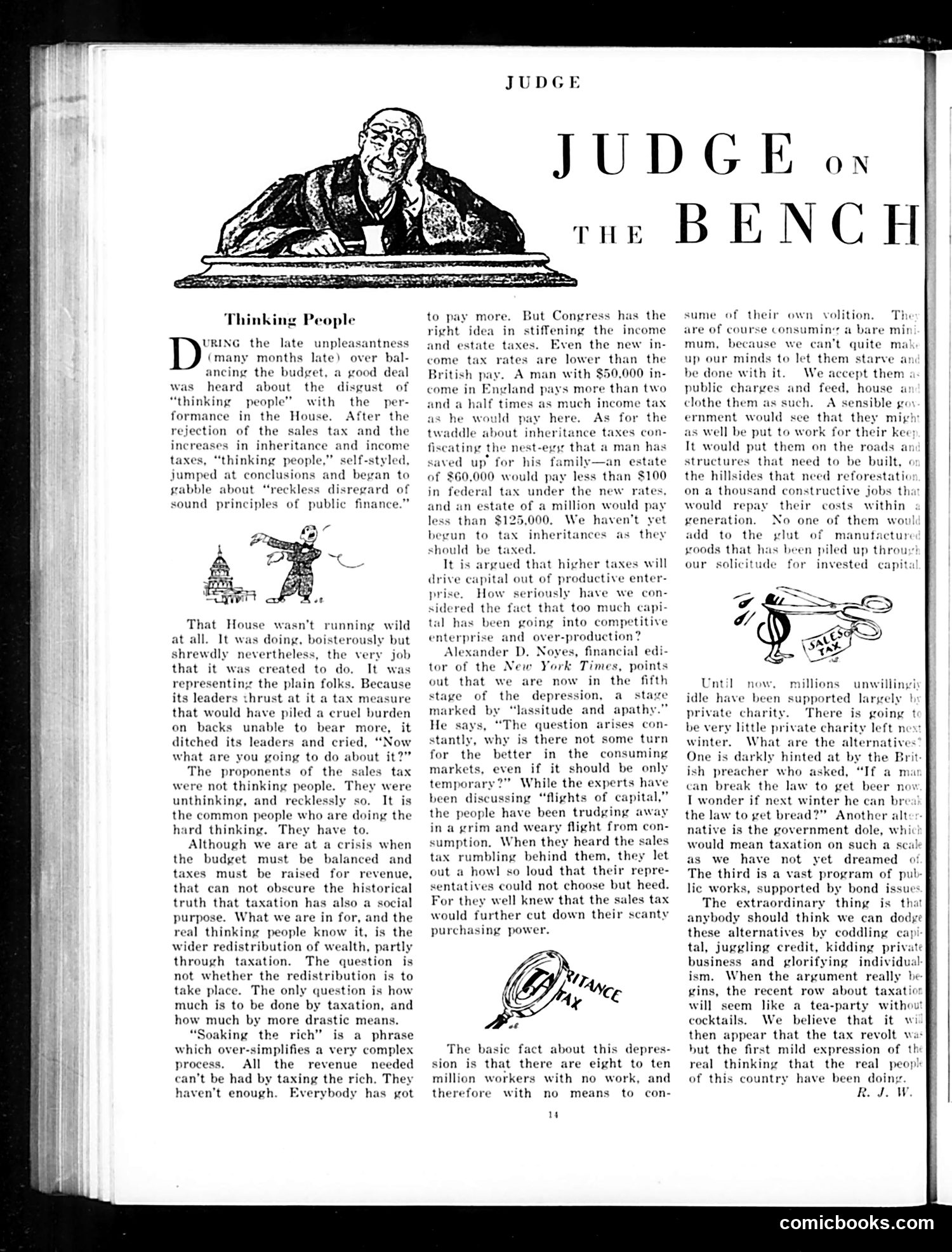
JUDGE JUDGE on rox BENCH Se ET People URING the late unpleasantness (many months late) over bal- ancing the budget, a good deal heard about the disgust of hinking people’ with the per- formance in the House. After the tion of the and the ses in inhe’ nd income “thinking people,” self-styled, jumped at conclusions and began to gabble about “reckless disregard of sound principles of public finance.” That House wasn't running wild at all. It was doing, boisterously but shrewdly nevertheless, the very job that it was created to do. It was representing the plain folks. Because its leaders thrust at it a tax measure that would have piled a cruel burden on backs unable to bear more, it ditched its leaders and cried, what are you going to do about it?” The proponents of the sales t: were not thinking people. They were unthinking, and recklessly so. It is the common people who are doing the hard thinking. They h to. Although we are at a crisis when the budget must be balanced and taxes must be raised for revenue, that can not obscure the histori truth that taxation purpose. What we are in for, and the real thinking people know it, is the wider redistribution of wealth, partly through taxation. The question is not whether the redistribution is to take place. The only question is how much is to be done by tion, and how much by more drastic means. “Soaking the rich” phrase which over-simplifies a very complex proc All the revenue needed can't be had by taxing the rich. They haven't enough. Everybody has got more. But Congress has the idea in stiffening the income Even the new in- re lower than the A man with $50,000 in- come in England pays more than two and a half times as much income tax as he would pay here. $ for the twaddle about inheritance fiscatiny the nest-eyyr that a man has saved up’ for his fami of $60,000 would pay less than $100 in federal tax under the new rat and an estate of a million would pay less than $125,000. We haven't yet bevun to tax inheritances as they should be taxed. It is argued that higher taxes will drive capital out of productive enter- prise. How seriously have we con- sidered the fact that too much capi- tal has been going into competitive enterprise and over-production Alexander D. N . financial edi- tor of the New York Times, points out that we are now in the fifth stage of the depression, a s marked by situde and apath. He vs, “The question arises con- stantly, why is there not some turn for the better in the consuming markets, even if it should be only temporary?” While the experts have been discussing “flights of capital,” the people have been trudging away ina grim and weary flight from con- sumption. When they heard the sales tax rumbling behind them, they let out a howl so loud that their repre- sentatives could not choose but heed. For they well knew that the would further cut down the purchasing power. to pay right and ests come British pay The basic fact about this depres- sion that there are eight to ten million workers with no work, and therefore with no means to con- WW sume of their volition are of course consumins: a bare mir mum, because we can't quite ma up our minds to let them starve be done with it. We accept them ; public charves and feed, house a clothe them as such. A sensible gx ernment would see that they mist as well be put to work for their kee; It would put them on the roads an: structures that need to be built, « the hillsides that need reforestatio on a thousand constructive jobs the would repay their within veneration. No one of them woul add to the ylut of manufactur: soods that has been piled up throuy! our solicitude invested capit: own costs millions unwilling idle have been supported largely | private charity. There is going t be very little private charity left winte: What are the alte One is d y hinted at by the Brit- ish preacher who asked, “If a mar can break the law to get beer I wonder if next winter he can bre the law to vet bread?” Another alt native is the government dole, whic would mean taxation on such a sca! as we have not yet dreamed of The third is a vast program of pul- lic wor supported by bond issues The extraordinary thing is th anybody should think we can dody these alternati by coddling c tal, juggling credit kidding priva business and glorifying individ ism. When the argument really be gins, the recent row about ta I will witho cocktails. We believe it wi then appear that the tax revolt wa: but the first mild expression of tt al thinking that the real peop! f this country have been doiny. RJ. W. comicbooks.com