
Judge, 1932-04-30 · page 12 of 36
Judge — April 30, 1932 — page 12: what you’re looking at
What you’re looking at
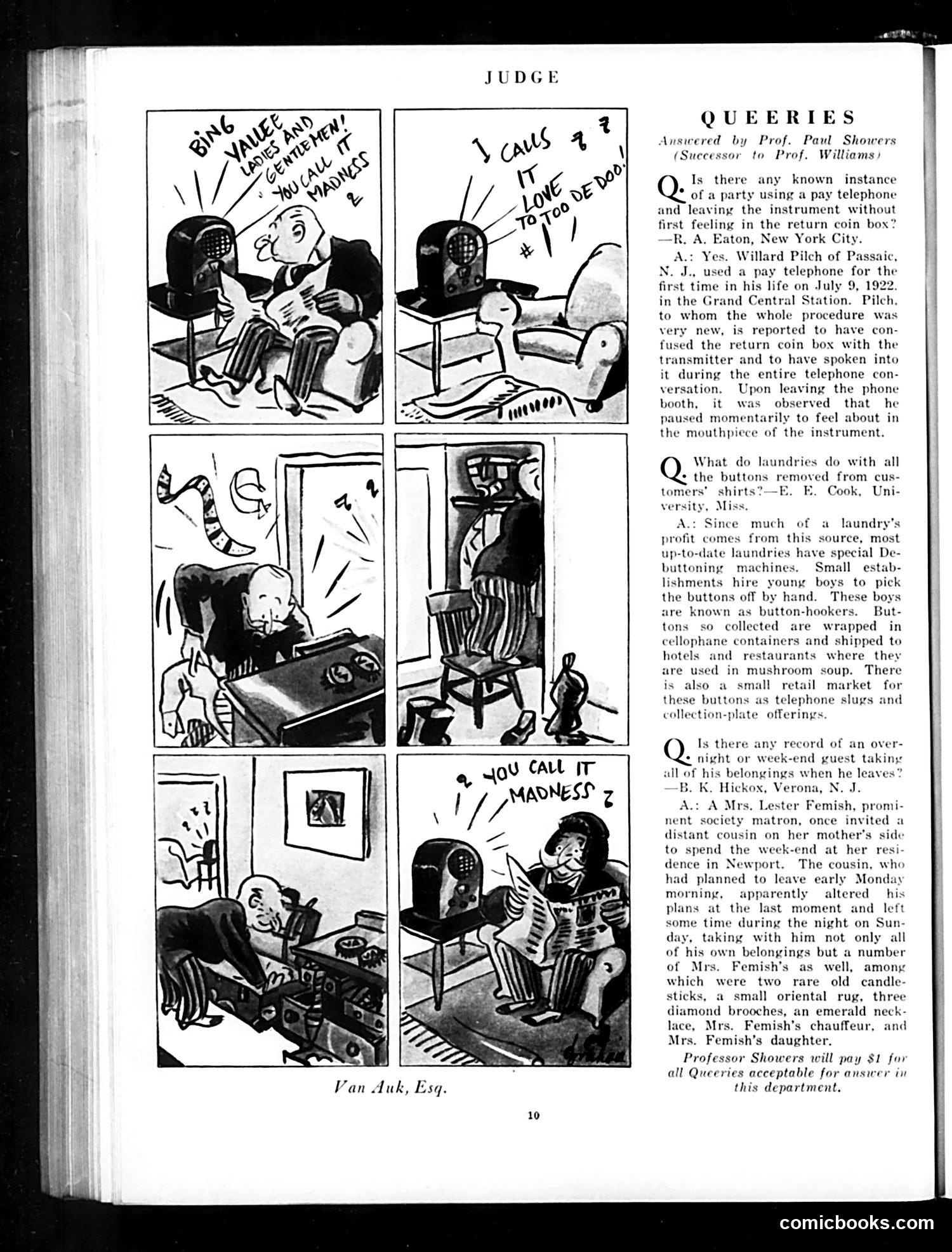
# Judge Magazine: "Queeries" Column Analysis This page features a humorous advice column called "Queeries," answered by "Prof. Paul Showers." The content satirizes modern conveniences and social etiquette of the 1920s through absurdist fake answers. The comic strip illustrates the first query about pay telephones—a relatively new technology. It shows someone confused by the phone booth mechanism, speaking into the coin return box instead of the receiver, capturing anxiety about unfamiliar modern gadgetry. The subsequent written answers employ deadpan humor: buttons from laundry are claimed to be recycled into mushroom soup and used as "telephone slugs" (fake coins); a houseguest is described stealing the host's valuables—presented as an actual documented case. The satire targets both technological bewilderment among Americans adapting to 1920s innovations and upper-class social pretensions. The column mocks both the gullibility of readers seeking advice and contemporary society itself through deliberately absurd "facts."
📄 Transcribed text from this page (OCR, searchable)
Machine-transcribed from the original scan — historical spelling and the odd misread are preserved.
JUDGE QUEERIES Answered by Prof. Paul Showers (Successor to Prof. Williams) Is there a known instance ng a pay telephone ng the instrument without : ng in the return coin box? R. A. Eaton, New York Ci A.: Yes. Willard Pilch of Passaic, ay telephone for the : life on July 9, 1922. in the Grand Central Station. Pilch, to whom the whole procedure was very new, is reported to have con- fused the return coin box with the transmitter and to have spoken into it during the entire telephone con- versation. Upon leaving the phone booth, it was observed that he paused momentarily to feel about in the mouthpiece of the instrument. What do laundries do with all : the buttons ved from c tom shirts?—E. Cook, Uni- versity, Miss. A.: Since much of a laundry’s profit comes from this source, most up-to-date laundries have special De- buttoning machines. Small estab- lishments hire young b to pick the buttons off by hand. These boys are known as button-hookers. But- tons so collected are wrapped in cellophane containers and shipped to hotels and restaurants where they re used in mushroom soup. There is also a small retail market for these buttons as telephone slugs and collection-plate offerings. Is there any record of an over- Vv CALL Iv : night or w nd guest taking a, 40 : his belongings when he leaves? MADNESS B. K. Hickox, Verona, N ae — A: ster Femish, promi- nent socie atron, once invited a = = distant cousin on her mother’s side to spend the week-end at her resi- dence in Newport. The cousin, who had planned to leave ea Monday morning, apparently Itered his plans at the last moment and left some time during the night on Sun- day, taking with him not only all of his own belongings but a number of Mrs. Femish’s as well, among which were two rare old candle- sticks, a small oriental rug, three diamond brooches, an emerald neck- Femish’s chauffeur, and ’s daughter, Professor Showers will pay $1 for all Queeries acceptable for answer in this department. comicbooks.com