
Judge, 1932-04-16 · page 18 of 36
Judge — April 16, 1932 — page 18: what you’re looking at
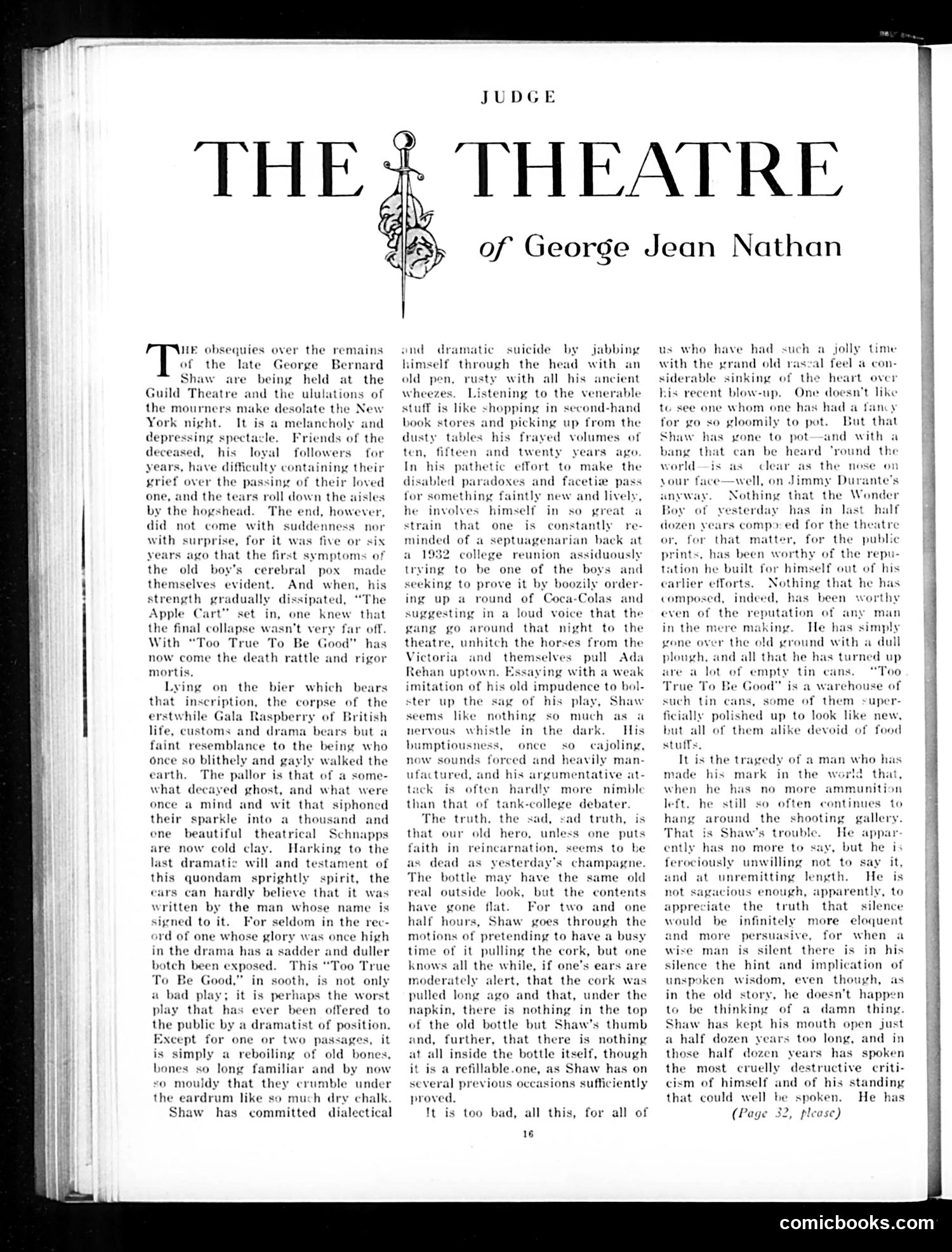
A restored page from Judge, 1932-04-16. Page through the whole issue in the reader above.
📄 Transcribed text from this page (OCR, searchable)
Machine-transcribed from the original scan — historical spelling and the odd misread are preserved.
THE HE obsequies over the remains of the late George Bernard Shaw are being held at the Guild Theatre and the ululations of the mourners make desolate the New York night. It is a melancholy and ssing spectacle. Friends of the deceased, his loyal followers for . have difficulty containing their rief over the passing of their loved one, and the tears roll down the aisles by the hogshead. The end, however, did not come with suddenness nor with surprise, for it was five or six years ayo that the first symptoms of the old boy's cerebral pox themselves evident. And when strength gradually dissipated, Apple Cart” set in, e knew the final collapse wasn't very far off With “Too True To Be Good” has now come the death rattle and rigor mortis. Lying on the bier which bears that inscription, the corpse of the erstwhile Gala Raspberry British life, customs and drama bears but a faint resemblance to the being who once so blithely and gayly walked the earth. The pallor is that of a some what decayed ghost, and what we once a mind and wit that siphoned their sparkle into a thousand and one beautiful theatrical Schnapps e now cold c¢ Harking to the last dramatic will and te ont of this quondam sprightly spirit, the ears can hardly believe that it was written by the man whose name is signed to it. For seldom in the rec- ord of one whose glory was once high in the drama has a sadder and duller botch been exposed. This “Too True To Be OU in sooth, is not only a bad play; it is perhaps the worst play that has ever been offered to the public by a dramatist of position. cept for one or two ages, it is simply a reboiling of old bones, bones so long familiar and by now so mouldy that they crumble under the eardrum like so much dry chalk. Shaw has committed dialectical made JUDGE THEATRE of George Jean Nathan ond dramatic suicide by jabbing himself through the head with an old pen, rusty with all his ancient wheezes. Listening to the venerable stuff is like shopping in second-hand book stores and picking up from the dusty tables his frayed volumes of ten, fifteen and twenty Ars ago. In his pathetic effort to make the disabled paradoxes and facet pass for something faintly new and lively, he involves himself in so great a strain that one is constantly re- minded of a septuagenarian back at a 1932 college reunion assiduously trying to be one of the boys and seeking to prove it by boozily order- ing up a round of Coca-Colas and suggesting in a loud voice that the gang go around that night to the patre, unhitch the horses from the ria and themselves pull) Ada Rehan uptown. Essaying with a weak tion of his old impudence to bol- ster up the sag of his play, S seems like nothing so much as nervous whistle in the d. humptiousness, once so now sounds forced and heavily man- ufactured, and his argumentative at- tack is often hardly more nimble than that of tank-college debater. The truth, the sad, sad truth, is that our old hero, unless one puts faith in reincar ym, seems to be as dead as yesterday’s champagne. The bottle may have the pal outside look, but the contents ave gone flat. For two and one half hours, Shaw goes through the motions of pretending to have a busy time of it pulling the cork, but one knows all the while, if one’s ears are moderately alert, that the cork was pulled long ago and that, under the napkin, there is nothing in the top of the old bottle but Shaw’s thumb and, further, that there is at all inside the bottle itself, though it is a refillable.one, as Shaw has on several previous occasions sufficiently proved. It is too bad, all this, for all of same old nothing: 16 us who with the had such a jolly time and old rasval feel a con- siderable sinking of the heart his recent blow-up. One doesn’t like te see one whom one has had a fancy for go so gloomily to pot. But that Shaw has yone to pot—and with a bang that can be heard ‘round the world clear as the your face ell, on Jimmy Dura thing that the V yesterday has in last half dozen years compo: ed for the theatre for that matter, for the public rints, has been worthy of the repu- tation he built for himself out of his earlier efforts. hing that he has composed, indeed, has been worthy even of the reputation o: in the mere makiny. He has simply gone over the old ground with a dull plough, and all that he has turned up are a lot of empty tin cans. “Too True To Be Good” is a warehouse of such tin cans, some of them super- ficially polished up to look like new, but all of them alike devoid of food stuffs. It is the tragedy of a man who has made his mark in the w that, when he has no more ammunition left. he still so often continues to hang around the shooting gallery. That is Shaw's trouble. He appar ly has no more to say, but he is xciously unwilling not to say it, and at unremitting lengt He is not sagacious enough, apparently, to appreciate the truth that silence would be infinitely more eloquent nd more persuasive, for when a wise man is silent there is in his silence the hint and implication of unspoken wisdom, even though, as in the old story, he doesn't happen to be thinking of a damn thing Shaw has kept his mouth open just a half dozen years too long, and in those half dozen years has spoken the most cruelly destructive criti- cism of himself and of his standing that could well be spoken. He has (Page 32, please) over is us nos anyway Boy of any man comicbooks.com