
Judge, 1932-04-16 · page 14 of 36
Judge — April 16, 1932 — page 14: what you’re looking at
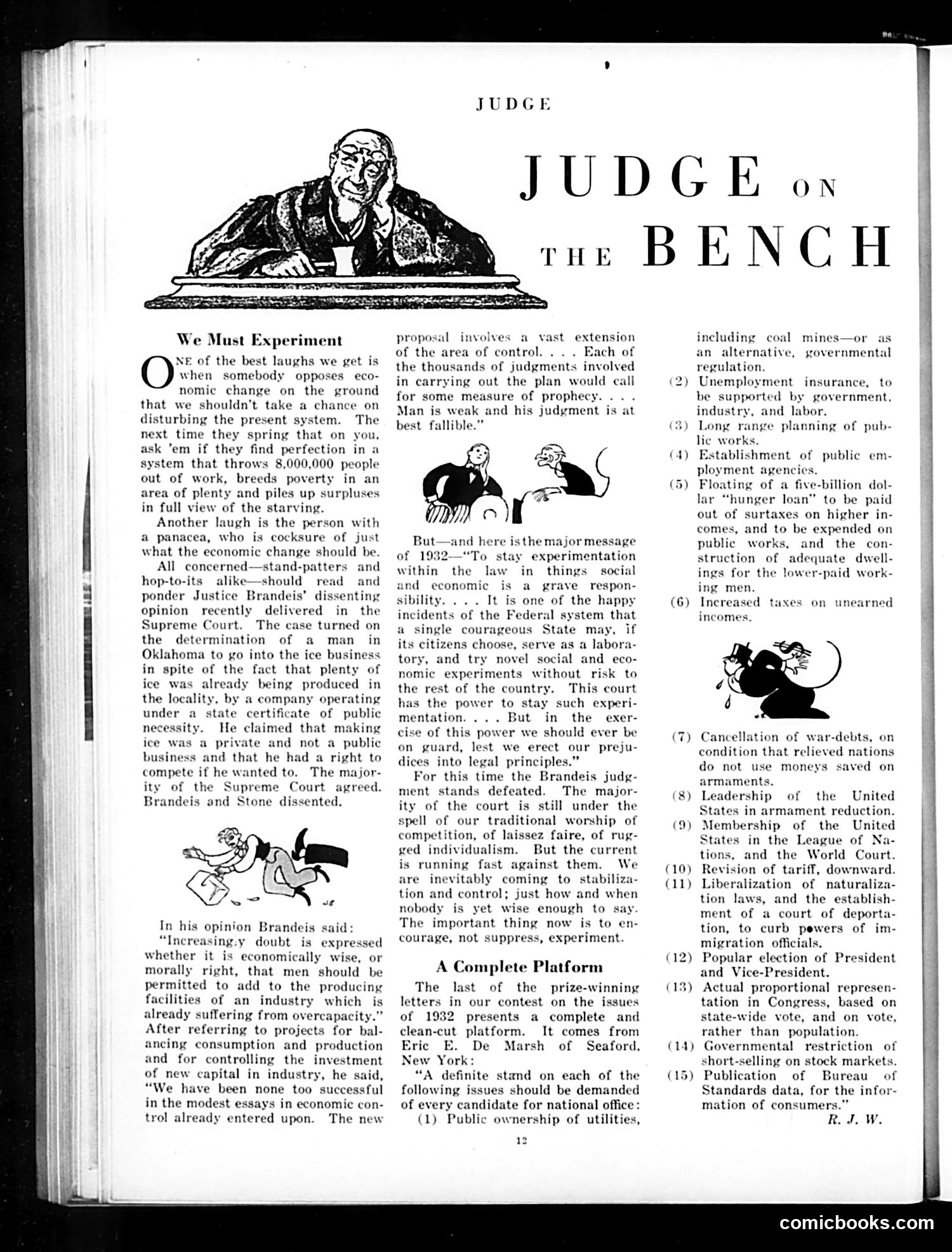
A restored page from Judge, 1932-04-16. Page through the whole issue in the reader above.
📄 Transcribed text from this page (OCR, searchable)
Machine-transcribed from the original scan — historical spelling and the odd misread are preserved.
We Must Experiment E of the best laughs we get is Orne somebody opposes eco- nomic change on the ground that we shouldn't take a chance on disturbing the present system. The next time they spring that on you, ask 'em if they find perfection in a system that throws 8,000,000 people out of work, breeds poverty in an area of plenty and piles up surpluses in full view of the starving. Another laugh is the person with a panacea, who is cocksure of just what the economic change should be. All concerned—stand-patters and hop-to-its alike—should ds and ponder Justice Brandeis’ dissenting opinion recently delivered in the Supreme Court. The case turned on the determination of a man in Oklahoma to go into the ice business in spite of the fact that plenty of ice was already being produced in the locality, by a company operating under a state certificate of public necessit He claimed that making ice was a private and not a public business and that he had a right to compete if he wanted to. The major- ity of the Supreme Court agreed. Brandeis and Stone dissented. In his opinion Brandeis said: “Increasing.y doubt is expressed whether it is economically wise, or morally right, that men should be permitted to add to the producing facilities of an industry which is already suffering from overcapacity.” After referring to projects for bal- ancing consumption and production and for controlling the investment of new capital in indust he said, “We have been none too successful in the modest ess: n economic con- trol already entered upon. The new JUDGE JUDGE ox proposal involves a vast extension of the area of control. . . . Each of the thousands of judgments involved in carrying out the plan would call for some measure of prophecy. . . . Man is wea nd his judgment is at best fallible. ai «— aA But—and here isthe major message of 1 ‘To stay experimentation within the law in things social and economic is a grave respon- sibility. .. . It is one of the happy incidents of the Federal system that a single courageous e may, if its citizens choose, serve as a labora- tory, and try novel social and eco- nomic experiments without risk to the rest of the country. This court has the power to stay such experi- mentation. ... But in the exer- cise of this power we should ever be on guard, lest we erect our preju- dices into legal principles.” For this time the Brandeis judg- ment stands defeated. The major- ity of the court still under the spell of our traditional worship of competition, of laissez faire, of rug- ged individualism. But the current is running fast against them. We are inevitably coming to stabiliza- tion and control; just how and when nobody is yet wise enough to s: The important thing now is to en- courage, not suppress, experiment. A Complete Platform The last of the prize-winning letters in our contest on the issues of 1932 presents a complete and clean-cut platform. It comes from Eric E. De Marsh of Seaford, New York: “A definite stand on each of the following issues should be demanded of every candidate for national office: (1) Public ownership of utilities, 13 including coal mines—or as an alternative, sovernmental regulation. Unemployment insurance, to be supported by government, industry, and labor. Long range planning of pub- lic works. stablishment of public em- ployment agencies. Floating of a five-billion dol- lar “hunger loan” to be paid out of surtaxes on higher in- comes, and to be expended on public works, and the con- struction of equate dwell- ings for the lower-paid work- ing men. Increased taxes on unearned incomes. Cancellation of war-debts, on condition that relieved nations do not use moneys saved on of the United ates in armament reduction. Membership of the United States in the League of Na- tions, and the World Court. Revision of tariff, downward. Liberalization of naturaliza- tion laws, and the establish- ment of a court of deporta- tion, to curb pewers of im- migration officials. Popular election of President and Vice-President. Actual proportional represen- tation in Congress, based on state-wide vote, and on vote, rather than population. vernmental restriction of short-selling on stock markets. Publication of Bureau of Standards data, for the infor- mation of consumers.” RJ. W. comicbooks.com