
Judge, 1932-03-05 · page 26 of 36
Judge — March 5, 1932 — page 26: what you’re looking at
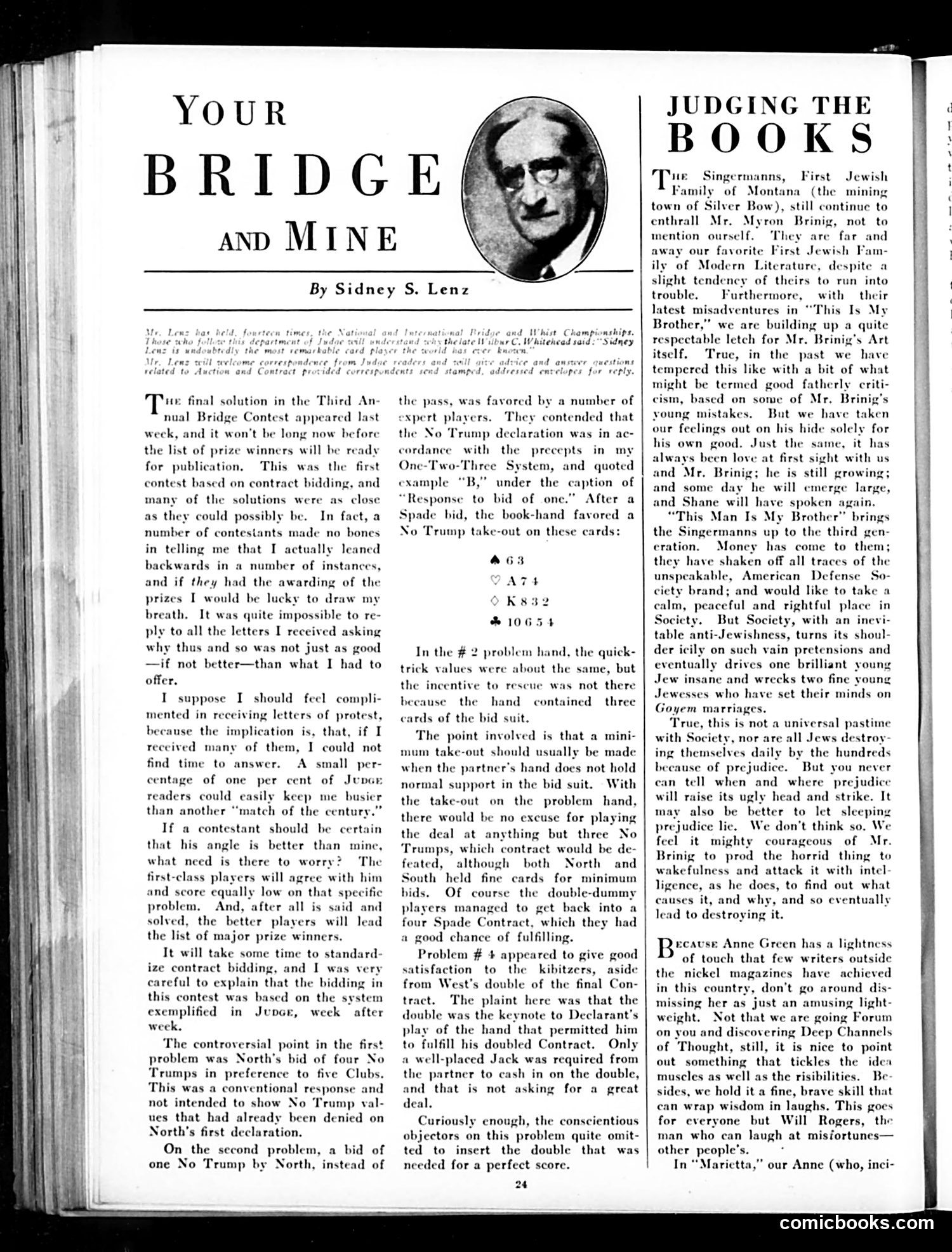
A restored page from Judge, 1932-03-05. Page through the whole issue in the reader above.
📄 Transcribed text from this page (OCR, searchable)
Machine-transcribed from the original scan — historical spelling and the odd misread are preserved.
YOUR BRIDGE AnD MINE © final solution in the Third An- nual Bridge Contest appeared last and it won't be long now before the list of prize winners will be ready for publication. This first contest based on contract bidding, and was the many of the solutions were as close as they could possibly be. In fact, a > no bones lly leaned stances, and if they had the awarding of the prizes I would be lucky to draw my breath. It was quite impossible to re- ply to all the letters I received asking why thus and so was not just as good —if not better—than what I had to offer. number of contestants in telling me that I act backwards in a number of I suppose I should feel compli- nted in re riving letters of protest, use the implication is, that, if I received many of them, I could not find time A small centage of one per cent of readers could easily keep me busier than another “match of the century.” If a contestant should be certain that his angle is better than mine, what need is there to worry? The first-class players will agree with him and score equally low on that specific problem, And, after all is said and solved, the better players will lead the list of major prize winners. oO answer. per- Juper It will take some time to standard- ize contract bidding, and I was very careful to explain that the bidding in this contest was based on the system exemplified in Jupor, week week. after The controversial point in the first problem was North's bid of four No Trumps in preference to five Clubs. This was a conventional response and not intended to show No Trump val- ues that had already been denied on North’s first declaration. bid of stead of On the second problem one No Trump by North, and IWhist Championships. ehead said: "Sidney the pass, was favored by a number of expert players. They contended that the No Trump deela cordance with the One-Two-Three System, and quoted example “B,” tion was in ac- precepts in’ my under the caption of “Response to bid of one.” After a Spade bid, the book-hand favored a No Trump take-out on these cards: a63 AT4 K832 H10G54 In the # 2 problem hand, the quick- trick values were about the same, but the incentive to rescue was not there hand contained three cards of the bid suit. because the The point involved is that a mini- mum take-out should usually be made when the partner's hand does not hold normal support in the bid suit. With the take-out on the problem hand, there would be no excuse for playing the deal at anything but three No ‘Trumps, which contract would be de- feated, although both North and South held fine cards for minimum bids. Of course the double-dummy players managed to get back into a four Spade Contract, which they had a good chance of fulfilling. Problem # + appeared to give good satisfaction to the kibitzers, aside from West's double of the final Con- tract. The plaint here was that the double was the keynote to Declarant’s play of the hand that permitted him to fulfill his doubled Contract. Only a well-placed Jack was required from the partner to cash in on the double, and that is not asking for a great deal. Curiously enough, the conscientious objectors on this problem quite omit- ted to insert the double that was needed for a perfect score. 24 JUDGING THE & Singermanns, First Jewish T nily of Montana (the mining town of Silver Bow), still continue to enthrall Mr. Myron Brinig, not to mention ourself. They are far and y our favorite First Jewish Fam- ily of Modern Literature, despite a slight tendency of theirs to run into trouble. Furthermore, with — their latest misadventures in “This Is My Brother,” we are building up a quite a respectable letch for Mr. Brinig's Art itself. True, in the past we have tempered this like with a bit of what might be termed good fatherly cism, based on some of Mr. Bri young mistakes. But we have taken our feclings out on his hide solely for his own good. Just the same, it has always been love at first sight with us and Mr. Brinig; he is still growing; and some y he will emerge large, and Shane will have spoken again. “This Man Is My Brother” brings the Singermanns up to the third gen- eration. Money has come to them; they have shaken off all traces of the unspeakable, American Defense So- ciety brand; and would like to take m, peaceful and rightful pla Society. But Society, with an inevi- table anti-Jewishness, turns its shoul- der icily on such vain pretensions and eventually drives one brilliant young Jew insane and wrecks two fine young Jewesses who have set their minds on Goyem marriages. True, this is not a universal pastime with Society, nor are all Jews destroy- ing themselves daily by the hundreds because of prejudice. But you never can tell when and where prejudice will raise its ugly head and strike. It may also be better to let sleeping prejudice lie. We don't think so. We feel it mighty courageous of Mr. Brinig to prod the horrid thing to wakefulness and attack it with intel ligence, as he does, to find out what causes it, and why, and so eventually lead to destroying it. ecause Anne Green has a lightness of touch that few writers outside the nickel magazines have achieved in this country, don’t around dis- missing her as just an amusing light- Not that we are going Forum you and discovering Deep Channels of Thought, still, it is nice to point out something that tickles the ides muscles as well as the risibilities. Be- sides, we hold it a fine, brave skill that can wrap wisdom in laughs. This goes for everyone but Will Rogers, the man who can laugh at misfortunes— other people’s. In “Marictt a,” our Anne (who, inci- comicbooks.com