
Judge, 1932-03-05 · page 20 of 36
Judge — March 5, 1932 — page 20: what you’re looking at
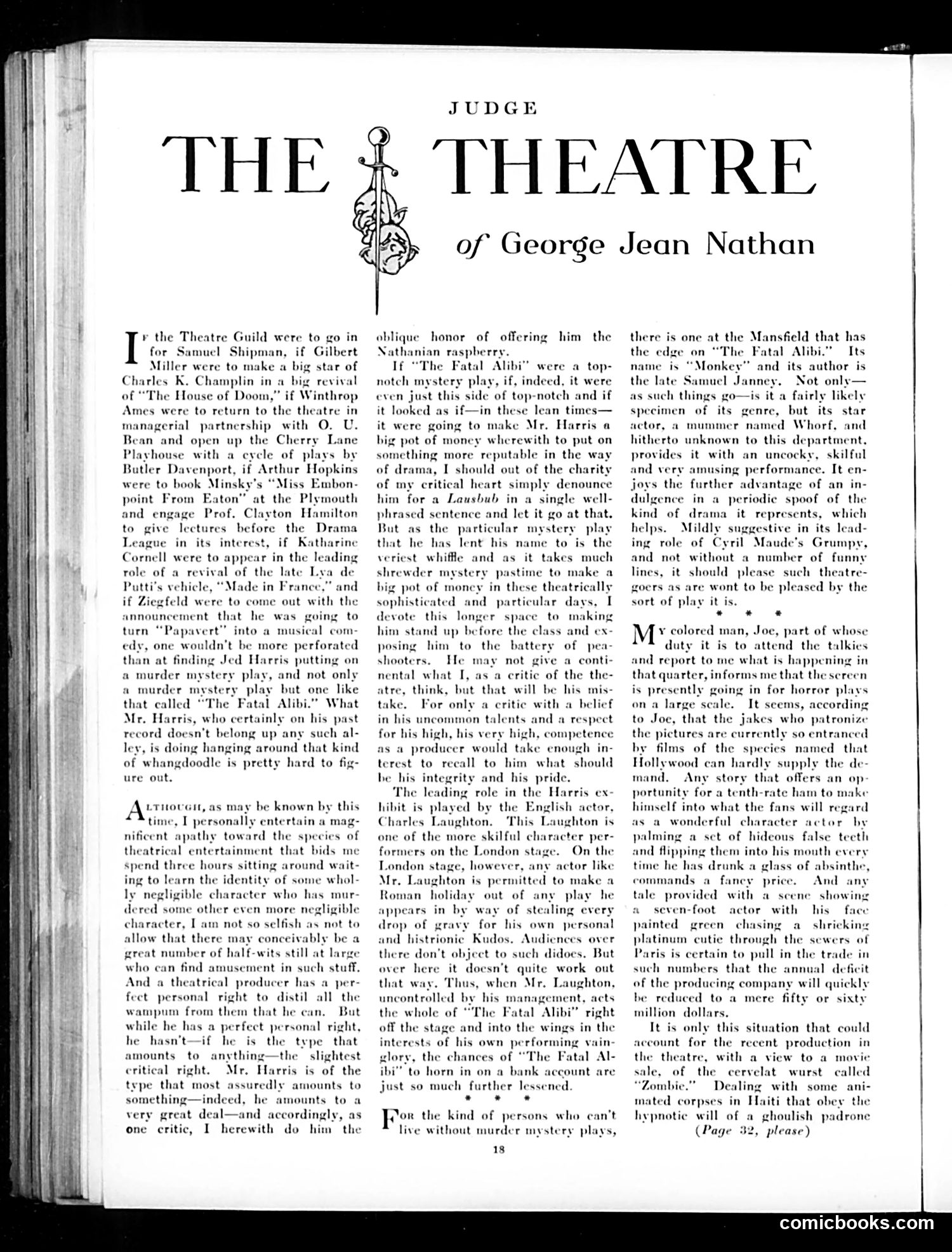
A restored page from Judge, 1932-03-05. Page through the whole issue in the reader above.
📄 Transcribed text from this page (OCR, searchable)
Machine-transcribed from the original scan — historical spelling and the odd misread are preserved.
THE ¥ the Theatre Guild were to go in I for Samuel Shipman, if Gilbert Miller w to make a big star of Charles K. Champlin in a big of “The House of Doom,” if V Ames revival throp © to return to the theatre in 1 partnership with O. U. d open up the Cherry Lane Playhouse with a cycle of plays by Butler Davenport Arthur Hopkins were to book Minsky’s “Miss Embon- point From Eaton the Plymouth and engage Prof. Clayton Hamilton to give lectures before the Drama League in its interest, if Katharine Cornell were to appear in the leading role of a revival of the late Lya de Putti’s vehicle, “Made in France,” and if Ziegfeld were to come out with the announcement that he was going to turn “Papavert” into a musical com- edy, one wouldn't be more perforated than at finding Jed Harris putting a murder mystery play, and not only a murder mystery play but one like led “The Fatal Alibi.” What Mr. Harris, who certainly on his past rd doesn’t belong up any such al- y, is doing hanging around that kind of whangdoodle is pretty hard to fig- ure out. At THOUGH, as may be known by this time, I personally entertain a mag- nificent apathy ard the s theatrical entertainment that | spend three hours sitting around wait- ing to learn the identity of some whol- ly negligible ch: eter who has mur- igible dered some other even more ne: « ter, I am not so selfish as not to allow that there may conceivably be great number of half-wits still at large who can find amusement in such stuff, And a theatrical producer has a per- fect personal right to distil all the wampum from them that he can, But while he has a perfect personal right, he hasn't—if he is the type that amounts to anything—the slightest ight. Mr. Harris is of the type that most assuredly amounts to something—indeed, he amounts to a very great deal—and accordingly, as one critic, I herewith do him the JUDGE oblique honor of offering him the Nathanian raspberry. If “The Fatal Alibi” were a top- notch mystery play, if, indeed, it were even just this side of top-notch and if it looked as if—in these lean times— it were going to make Mr. Harris a hig pot of money wherewith to put on something more reputable in the way of drama, I should out of the charity of my critical heart simply denounce him for a Lausbub in a single well- phrased sentence and let it go at that. But as the particular mystery play that he has lent his name to is the veriest whiffe and as it takes much shrewder mystery pastime to m: a big pot of money in these theatrically sophisticated and particular days, I devote this longer space to making him stand up before the class and ex- posing him to the battery of shooters. He may not give a conti- nental what I, as a critic of the the- atre, think, but that will be take. For only a critic with a belief in his uncommon talents and a respect for his high, his very high, compete as a producer would take enough in- terest to recall to him what should be his integrity and his pride. The leading role in the Harris ex- hibit is played by the English Charles Laughton. This L: pea- his m ee one of the more skilful character per- formers on the London stage. On the London stage, however, actor like Mr. Laughton is permitted to make a Roman holiday out of any play he rs in by way of stealing drop of gravy for his own personal and histrionie Kudos, Audiences over there don't object to such didoes. But over here doesn't quite work out that way. Thus, when Mr. Laughton, uncontrolled by his management, acts the whole of “The Fatal Alibi” right off the stage and into the wings in the interests of his own performing vain- glory, the chances of “The Fatal Al- ibi” to horn in on a bank account are just so much further lessened. 8 appe: every FRee the kind of persons who can't live without murder mystery plays, 18 THEATRE of George Jean Nathan there is one at the Mansfield that has the edge on “The al Alibi. Its ame is “Monkey” and its author is the late Samuel Janney. Not only— as such things go—is it a fairly likely specimen of its genre, but its star actor, a mummer named Whorf, and hitherto unknown to this department, provides it with an uncocky, skilful and very amusing performance. It en- joys the further advantage of an in- dulgence in a periodic spoof of the kind of drama it represents, which helps. Mildly suggestive in its lead- ing role of Cyril Maude’s Grumpy, and not without a number of funny lines, it should please such theatre- goers as are wont to be pleased by the sort of play it is. * * « ¥ colored man, Joe, part of whose duty it is to attend the talkies and report to me what is happening in that quarter, informs me that the sercen is presently ona Ia ving in for horror p! It seems, a : named that Hywood can hardly supply the de- mand. Any story that offers an op portunity for a tenth-rate ham to make himself into what the fans will regard wonderful character actor by palming a set of hideous false teeth and flipping them into his mouth every time he has drunk a glass of absinthe. commands a faney. pri And tale provided with as showing a seven-foot actor with his face painted green chasing a shrieking platinum cutie through the sewers of Paris is certain to pull in the trade in such numbers that the annual deficit of the producing company will quickly be reduced to a mere fifty or sixty million dollars. It is only this situation that could account for the recent production in the theatre, with a view to a movie the lat wurst . ing with some rpses in Haiti that obe hypnotic will of a ghoulish padrone (Page 32, please) asa y the comicbooks.com