
Judge, 1932-02-20 · page 12 of 36
Judge — February 20, 1932 — page 12: what you’re looking at
What you’re looking at
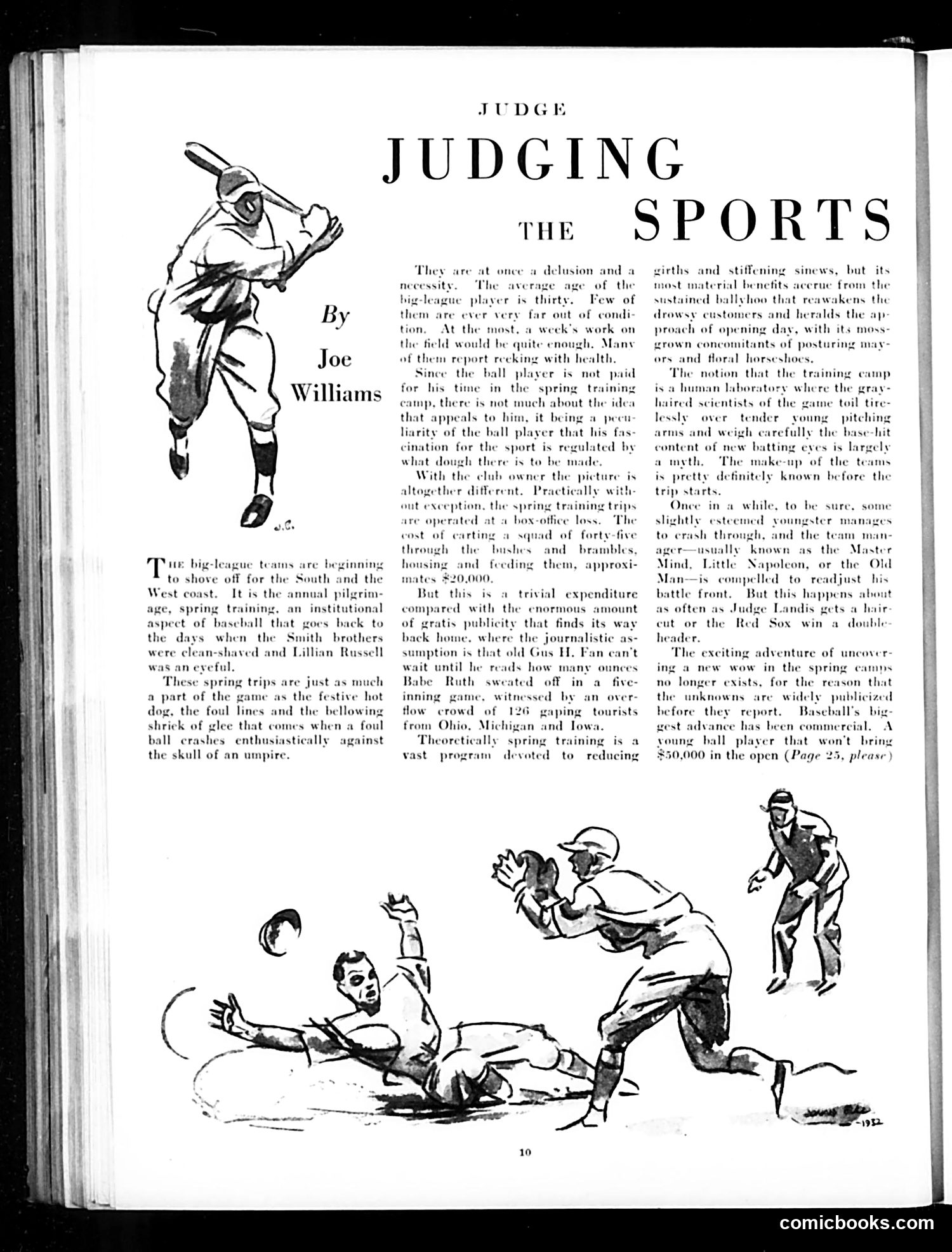
# "Judging the Sports" by Joe Williams This article satirizes **spring training in Major League Baseball** as pure commercial theater rather than athletic necessity. Williams argues that players—paid only during the season—have little incentive to train seriously in spring, yet club owners run these trips at a loss for the **publicity value**. The satire targets the media's role in creating mystique around spring training. References to "old Gus H. Fan" and breathless reporting about Babe Ruth sweating in front of small tourist crowds mock how baseball generates customer excitement through manufactured drama and journalistic hype. Williams debunks the romantic notion that training camps develop young talent ("gray-haired scientists" carefully grooming prospects). Instead, team rosters are predetermined; the camps primarily serve as **commercial promotion** for the upcoming season—complete with "floral horseshoes" and ceremonial mayors. The punchline: baseball's greatest achievement isn't athletic development but **commercial advancement**. The "exciting adventure" of discovering unknown talent is dead because modern publicity exposes prospects before spring training even begins.
📄 Transcribed text from this page (OCR, searchable)
Machine-transcribed from the original scan — historical spelling and the odd misread are preserved.
By Joe Williams uc teams are beginning to shove off for the South and the West coast. It is the annual pilgrim- age, spring training, an institutional aspect of baseball that goes back to the days when the Smith brothers were clean-shaved and Lillian Russell was an eyeful. These spring trips are just as much a part of the game as the festive hot dog, the foul lines and the bellowing shrick of glee that comes when a foul ball crashes enthusiastically against the skull of an umpire. JUDGE THE They are at once a delusion and a necessity. The average age of the hig-le aver is thirty. Few of them are ever very far out of condi tion, At the most. a week's work on the field would be quite enough, Many of them report reeking with health, Since the ball player is not paid for his time in the spring training. camp, there is not much about the idea that appeals to him, it being a pecu liarity of the ball player that his fas cination for the sport is regulated by what dough there is to be made. With the club owner the picture is altogether different. Practically with- out xception, the spring training trips ire operated at a box-othice loss. The cost of carting a squad of forty-five through — the nbles, housi and feeding them, approxi- 20.000, But this is a trivial expenditure compared with the enormous amount of gratis publicity that finds its back home. where the bushes and by mates ay journalistic sumption is that old Gus Hl. Fan can’t wait until he reads how many ounces Babe Ruth sweated off in a five- inning game, witnessed by an over- flow crowd of 126 gaping tourists from Ohio, Michigan and Iowa. Theoretically spring training is a vast) program devoted to reducing JUDGING SPORTS ths and stiffening sinews, but its most material benefits acerue from the sustained ballyhoo that reawakens the drowsy customers and heralds the ap proach of opening day, with its moss- grown concomitants of posturing may- ors and floral horseshoes, The notion that the training eamp isa human 1 atory where the gray- haired scientists of the game toil tire lessly over tender young pitching arms and weigh carefully the base-hit content of new batting eves is | acmyth, The make-up of the teams is pretty definitely known before the trip starts. ely Once in a while, to be sure. s slightly esteemed youngster to crash through, and the team man- ager—usually known as the Master Mind, Little Napoleon, or the Old Man—is compelled to readjust) his battle front. But this happens about as often as Judge Landis gets a hair cut or the Red Sox win a double Phe exciting adventure of uncover- ing a new wow in the spring camps no longer exists, for the reason that the unknowns are widely publi before they report. Baseball's t gest advance has been commercial. young ball player that won't bring 30,000 in the open (Pag + please) aed comicbooks.com