
Judge, 1932-01-23 · page 10 of 36
Judge — January 23, 1932 — page 10: what you’re looking at
What you’re looking at
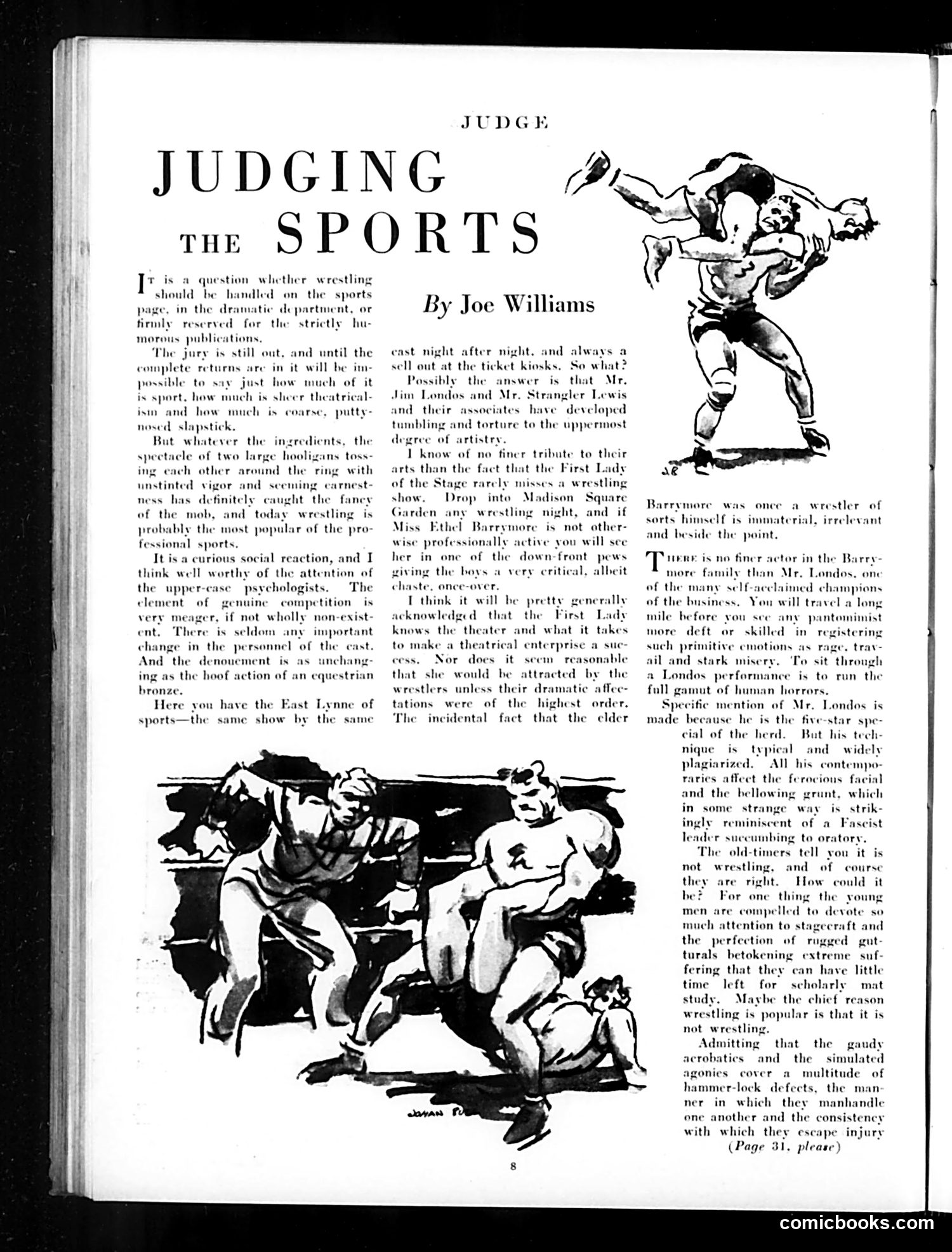
# "Judging the Sports" by Joe Williams This article defends professional wrestling as entertainment while acknowledging it's theatrical spectacle rather than genuine sport. Williams argues the "jury is still out" on whether wrestling belongs in sports or dramatic coverage, given its staged nature—comparing it to the melodrama "East Lynne." The satire targets both wrestling promoters and high society. Williams notes that despite wrestling's obvious artificiality (predetermined outcomes, consistent cast, rehearsed drama), it sells out nightly. He adds pointed commentary by mentioning that even *Ethel Barrymore* (the acclaimed actress and member of the famous theatrical family) attends wrestling matches, suggesting that respectable society recognizes wrestling's theatrical merit—or that they're fooled by it. The piece mocks Jim Londos and "Strangler" Lewis as masters of stagecraft who perform primitive emotions expertly. Williams's final jab: young men waste scholarly time perfecting wrestling's "rug naturals" and acrobatics rather than studying—yet wrestling remains popular *because* it's not wrestling.
📄 Transcribed text from this page (OCR, searchable)
Machine-transcribed from the original scan — historical spelling and the odd misread are preserved.
JUDGING JUDGE rm SPORT I is a question whether wrestling mild be handled on the sports page. in the dramatic department, or firmly strictly hu- morous public he jury is still eut, and until the complete returns are in it: will be im- possible to say just how much of it reserved for the is sport. how much is sheer theatrical- ism and how much is coarse, putty- nosed. slapstick. But whatever the ingredients, the speeta ‘ye hoolig ing around the ri unstir and seeming carnest- ness has definitely caught the f of the mob, and tod wrestli probably the most popular of the pro- fessional sports. tion, and I attention of psychologists. The nuine competition is very meager, if not wholly non-exist- ent, There is seldom any important change in the personnel of the cast. And the denouement is as unch as the hoof action ef an equestrian bronze. Here you have the East Lynne of sports—the same show by the same It is a curious social r think well worthy of tl the upper-e: element of By Joe Williams cast night after night. and always a sell out at the ticket kiosks. So what? Possibly the that Mr. Jim Londos and Mr, Strangler Lewis and their associates tumbling degree of artistry. I know of no finer tribute to their arts than the fact that the First Lady of the St rarely misses a wrestling show. Drop. into Madison Square Garden any wrestling night, and if Miss Ethel Barrymore is not other- wise professionally active her in one of the givin answer is have developed nd torture to the uppermost uu Will see down-front pews the boys a very critical, albeit chaste, once-over, I think it will be pretty generally acknowledged that) the First) Lady knows the theater and what it t tow a theatrical enterprise a suc- cess. Nor does it that she would be attracted by the wrestlers unless their dr: tations were of the highest The incidental fact that the seem reasonable matic affec- order. elder Be wrestler of sorts himself is immaterial, irrelevant and beside the Barrymore was once a point, HERE is no finer more family t of the many self-acelaimed champions of the business. You will travel a le mile before you see any pantomimist more deft or skilled in registering such primitive emotions as r. ail and stark misery. ‘To sit through a Londos performance is to run the full gamut of human horrors. mention of Mr. Londos is made beeause he is the five-star spe- cial of the herd. But his teeh- nique is typical and widely plagiarized.” AML his contem rarics affect the ferocious f and the bellowing grant, which in some strange way is strik- ingly reminiscent of a Fascist leader succumbing to oratory, The old-timers tell you it is not wrestling, and of they How thing the tor in the Barry an Mr. Londos. one course could it young men are compelled to devote so much attention to stagecraft and the perfection of rug turals betokening ext fering that they can have little time left for olarly study. Maybe the chief’ re wrestling is popular is th not wrestling. tting that the gaudy and the simulated rs cover a multitude of hammer-lock defeets, the man ner in which they manhandk one another and the consistency with which they escape injury (Page 31, please) are right. For one comicbooks.com