
Judge, 1932-01-16 · page 26 of 36
Judge — January 16, 1932 — page 26: what you’re looking at
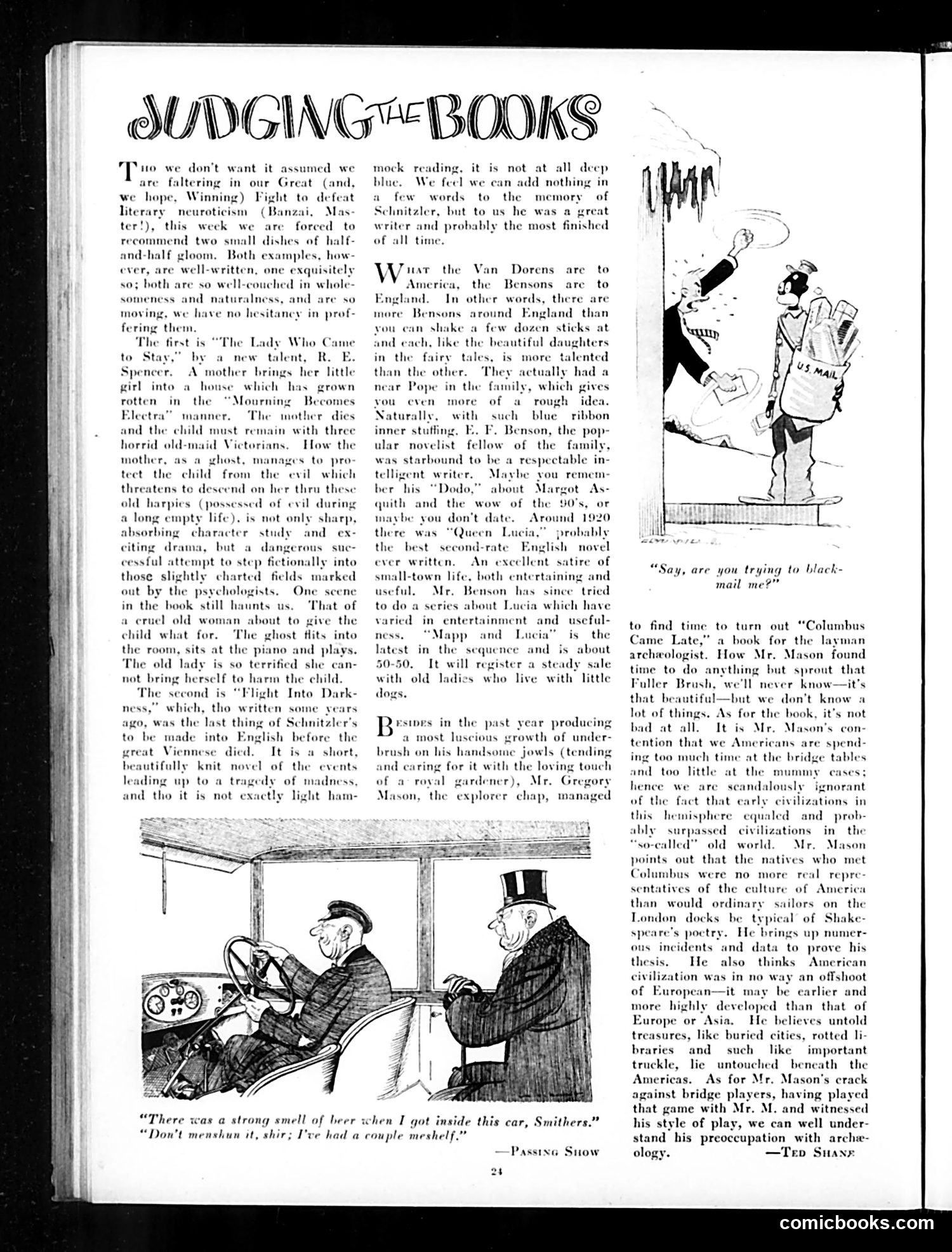
A restored page from Judge, 1932-01-16. Page through the whole issue in the reader above.
📄 Transcribed text from this page (OCR, searchable)
Machine-transcribed from the original scan — historical spelling and the odd misread are preserved.
JUDGING“ BOOKS » don’t want it assumed we tering in our Great (and, Winning) Fight to defeat literary neuroticism (Banzai, Mas ter!), this week we are forced to recommend two small dishes of f- and-half gloom. Both examples, how- ever, are well-written, one exquisitely so; both « som hope re so well-couched in whole- ness and naturalness, and are so we have no hesitaney in prof- them, The first is “The Lady Who Came to Stay,” by a new talent, R. E. A mother brings her little girl into a which has rotten in’ the “Mourning Electra” The mother dies and the child must remain with three horrid old-maid Vietorians. How the mother, as a ghost, manages to pro tect the child from the evil) which threatens te descend on her thru these old harpies (possessed of evil during a long empty life). is not only sharp, absorbing character study and ex- citing drama, but a dangerous suc- Spencer. house grown Becomes manner, cessful attempt to step fictionally into those slightly charted fields marked out by the psychol One scene unts us. That of 1 cruel old woman about to give the child what for. The ghost flits into the room, sits at the piano and plays. The old lady is so terrified she can- not bring herself to harm the child. The second is “Flight Into Dark- ness,” which, tho written some years ago, was the last thing of Schnitzler’s to be made into English before the great Viennese died. It is a short, beautifully knit novel of the events leading up to a tragedy of madness, and tho it is not exactly light ham- ists. in the book still 1 mock reading, it is not blue. We feel we a few at all deep an add nothing in words to the memory of Schnitzler, but to us he was a great writer and probably the most finished of all time. Wir the Van Dorens are to America, the Bensons are to England. In other words, there are Bensons around England than you can shake a few dozen sticks at and each, like the beautiful daughters in the fairy tales, is more talented than the other. They actually had a near Pope in the family, which you even more of a rough idea. Naturally, with blue ribbon inner stuffing, E. F. Benson, the pop- ular novelist llow of the famil was starbound to be a respectable i telligent writer. Maybe 4 ber his “Dodo,” abe quith and the wow of maybe you don't date. there was “Queen Lucia,” probably the best second-rate glish novel ever written, An excellent satire of small-town life, both entertaining and useful, Mr. Benson ha tried to do a series about Lucia which have varied in entertainment and useful- ness. “Mapp and Lue is the latest in’ the and is about 50-50. It will register a ste with old ladies dogs. more such pu remem Around 1 s since sequence ly sale who live with little Bees in the past year producing a most luscious growth of under- brush on his handsome jowls (tending and caring for it with the loving touch of a royal gardener), Mr. Gregory Mason, the explorer chap, managed cas a strong smell of beer when I got inside this car, Smithers.” “Don't menshun it, shir; I've had a couple meshelf” Passixe Siow “Say, are you trying to black- mail me? to find time Came L: to turn out “Columbus sa book for the layn archeologist. How Mr. Mason found time to do anything but sprout that Faller Brash, we'll never know—it's that beautiful—but we don't know a lot of things, As for the book, it’s not bad at all. It is Mr. Mason's con- tention that we Americans are spend- ing too much time at the bridge tables ind too little at the hence we idalously ignorant of the fact that early civilizations in this hemisphere equaled and prob- ably surpassed civilizations in the “so-called” old) world. Mr. Mason points out that the natives who met Columbus were no more real repre- sentatives of the culture of America than would ordinary sailors on the London docks be typical of Sha speare’s poetry. He brings up numer- ous incidents and data to prove his thesis. He also thinks American civilization was in no way an offshoot of European—it may be earlier and more highly developed than that of Europe or Asia. He believes untold t ures, like buried cities, rotted li- braries and such like important truckle, lie untouched beneath the Americas. As for Mr. Mason's crack against bridge players, having played that game with Mr. M. and witnessed his style of play, we can well under- stand his preoccupation with archw- ology. —Tep Suanr mummy cases; ares comicbooks.com