
Judge, 1932-01-16 · page 20 of 36
Judge — January 16, 1932 — page 20: what you’re looking at
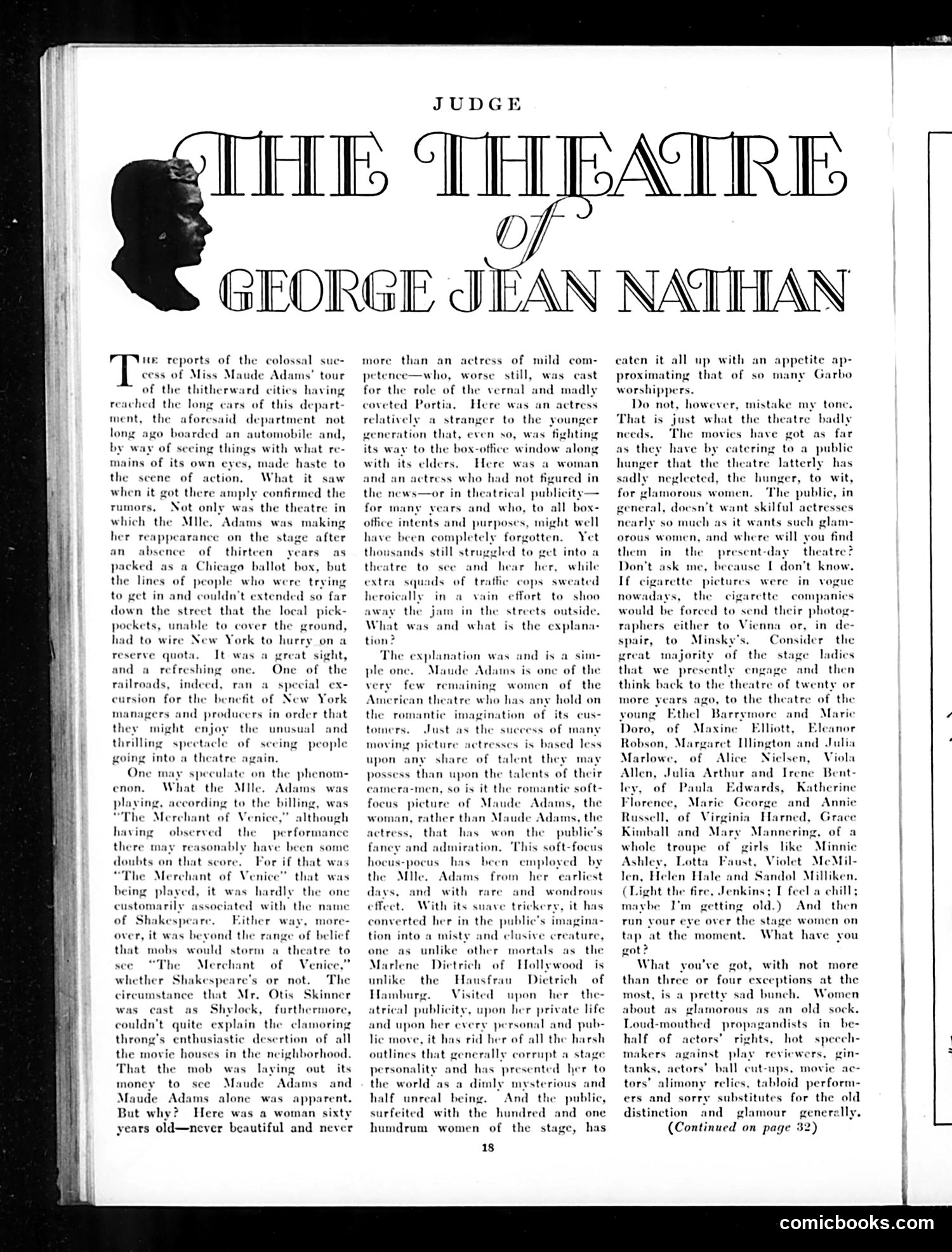
A restored page from Judge, 1932-01-16. Page through the whole issue in the reader above.
📄 Transcribed text from this page (OCR, searchable)
Machine-transcribed from the original scan — historical spelling and the odd misread are preserved.
ite reports of the colossal suc- cess of Miss Maude Adams’ tour of the thitherward cities having reached the long cars of this depart- ment, the aforesaid department not long ago boarded an automobile and, by way of seeing things with what re mains of its own eyes, made haste the scene of acti What it saw when it got there amply confirmed the rumors, Not only was the theatre in which the Mlle. Adams was making her reappearance on the stage after an absence of thirteen” years as packed as a Chicago ballot’ box, but the lines of people who were trying to get in and couldn't extended so far down the street that the local pick- pockets, unable to cover the ground, had to wire > w York to hurry on a reserve quota. It was a great sight, and a refreshing one. One of the railroads, indeed, ran a special ex cursion for the benefit of New York q vroducers in order that the unusual and spectacle of sceing people » a theatre in, One may speculate on the phenom- enon. What the Mlle. Adams was playing, according to the billing, was “The Me int of Venice,” having observed the — perform: there may reasonably have been some doubts on that score. For if that was “The Merchant of Venice” that was being played, it was hardly th customarily associated with the name of Shakespeare. Either way, more- over, it was beyond the range of belief that mobs would storm theatr see “The Merchant of Ve whether Shakespeare's or not. The circumstance that Mr. Otis Skinner was cast as Shylock, furthermore, couldn't quite explain the clamoring throng’s enthusiastic desertion of all the movie houses in the n iborhood. That the mob was I: out its money to sce Maude Adams and Maude Adams alone Was apparent. But why? Here was a woman sixty years old—never beautiful and never to JUDGE 0, more than an actress of mild com- petence—who, worse still, was cast for the role of the vernal and madly coveted Portia, Here was actress relatively a stranger to the younger gene mm that, even so, was fighting its way to the box-office window along with its elders. Here was a woman n actress who had not figured in “s—or in theatrical publicity— any years and who, to all box- office intents and purposes, might well have been completely forgotten. Yet led to get into a theatre to see and hear her, while extra squads of trathe cops sweated lly in a vain effort to. shoo away the jam in the streets outside. What was and what is the explana: tion? here The explanation was and is a. sim- ple one. Maude Adains is one of the very few remaining women of the American theatre who has any hold on the romantic imagination of its cus- tomers. Just as the success of im ed upon any share of talent they may possess than upon the talents of their camera-men, so is it the romantic soft- focus picture of Maude Adams, the woman, rather than Maude Adams, the actress, that has won the public's fancy and admiration. ‘This soft-focus hocus-pocus has been employe the Mlle. Adams from her earliest days, and with rare and wondrous effect. With its suave trick converted her in the pul n into a misty and elusive cr ny moving picture actresses is bs less by > it has ina- ature, one as unlike other mortals as. the Marlene Dietrich of Hollywood is unlike the Hanusfrau Dietrich of Hamburg. Visited upon her the- atrical publicity, upon her private life and upon her every personal and pub- lic move, it has rid her of all tl outlines that personality harsh enerally corrupt nd has presented her to the world as a dimly mysterious and half unreal being. | And the public, surfeited with the hundred and one humdrum women of the stage, has 18 Ib (HADEACHIIRE: GEORGE JEAN NATHAN eaten it all up with an appetite proximating that of so many worshippers. Do not, however, mistake my tone. That is just what the theatre badly needs, The movies have as far as they have by catering to a public hunger that the theatre latterly has sadly neglected, the hunger, to. wit, for glamorous women. The public, in general, doesn’t want skilful nearly so mu orous women, rbo tresses. ch as it wants such glam- nd where will you find them in the present-day — theatre? Don't ask me, because [I don’t know, If cigarette pictures were in’ vogue nowadays, the cigarette comp: would be forced to send their photog raphers either to Vienna or, in de- spair, to Minsky’s. Consider the majority of the ste ladies that we presently engage and then think back to the theatre of twenty or more years ago, to the theatre of the young Ethel Barrymore and M Doro, of Maxine Hiott, Eleanor Robson, Margaret Hlington and Julia Marlowe, of Alice Nielsen, Viola Allen, Julia Arthur and Irene Bent- ley, of Paula Edwards, Katherine r cc, M George and Russell, of Virginia Harned, G Kimball and Mary Mannering, of a whole troupe of girls like Minnie Ashley, Lotta Faust, Violet MeMil- len, Helen Hale and Sandol Milliken. (Light the fire, Jenkins; T feel a chill; maybe I'm getting old.) And then run your eve over the st tap at the moment. Wh: got? What you've got, with not more than three or four exceptions at the most, is a pretty sad bunch, Women about as g s an old sock. ndists in’ be- hts, hot speech- nst play reviewers, gin- women on have you imorous Loud-mouthed prop: half of makers tank rtors’ actors’ ball cut-ups. movie ac- tors’ alin relics, tabloid perform- ers and sorry substitutes for the old distinction and glamour generelly. (Continued on page 32) comicbooks.com