
Judge, 1932-01-16 · page 17 of 36
Judge — January 16, 1932 — page 17: what you’re looking at
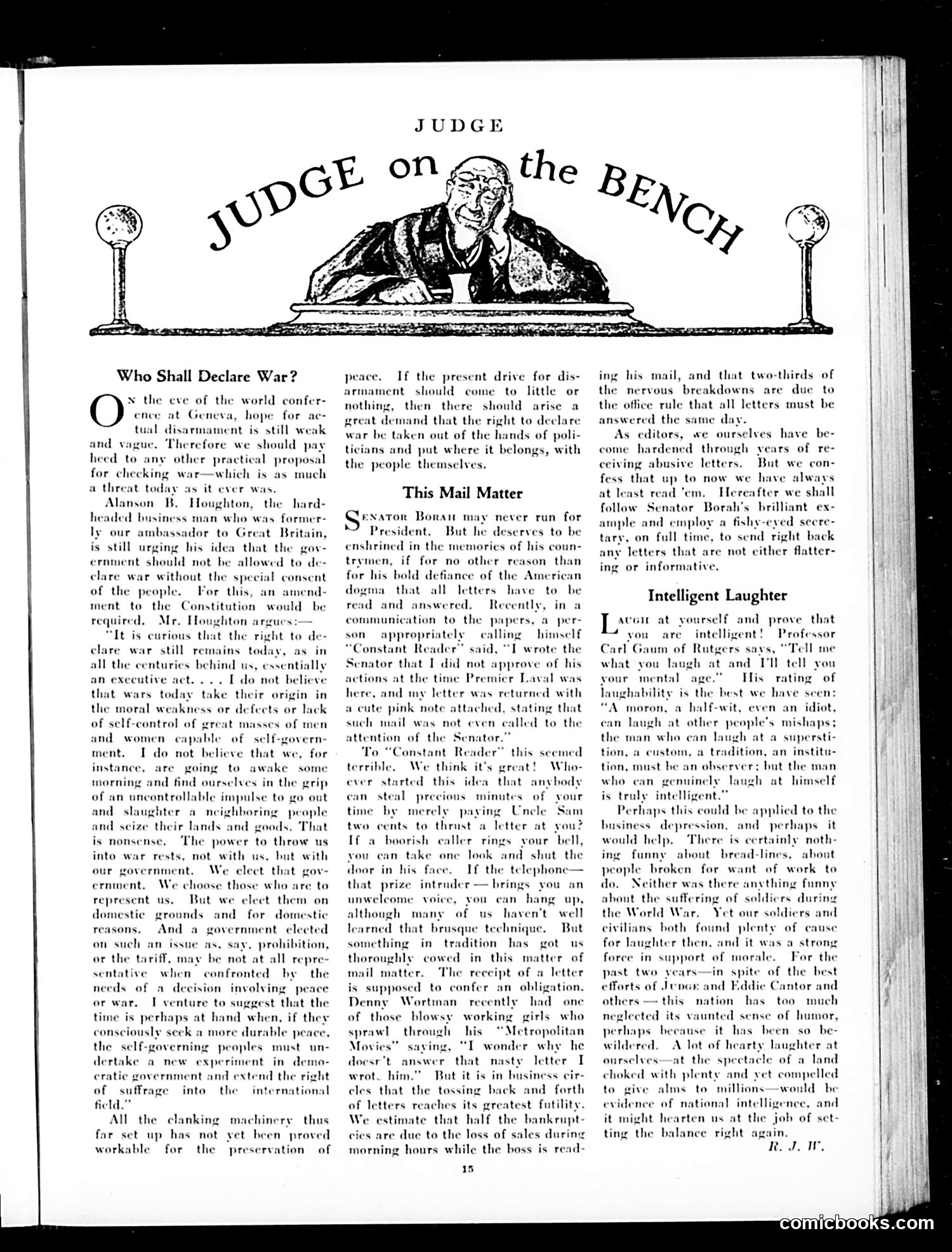
A restored page from Judge, 1932-01-16. Page through the whole issue in the reader above.
📄 Transcribed text from this page (OCR, searchable)
Machine-transcribed from the original scan — historical spelling and the odd misread are preserved.
Who Shall Declare War? N the eve of the world confer- O ence at Geneva, hope for tual disarmament is still w and vague. Therefore we should heed to any other practical proposa for checking war—which is as much a threat today as it ever was. Alanson B. Houghton, the hard- d business man who was former- ly our ambassador to Great Britain, is still urging his i that the gov- ernment should not be allowed to de- clare war without the special consent of the people. For this, an amend- ment to the Constitution would be required. Mr. Houghton argues: “It is curious that the right to de- clare war still remains today, as in all the centuries behind us, essentially an executive act. « Ido not believe that wars today take their origin in the moral weakness or defeets or lack of self-control of great masses of men and women capable of self-govern- ment. I do not believe that we, for instance, are going to awake nd find ourselves in the grip of an uncontrolls and slaughter a and seize their | some morning 4 le impulse to go out neighboring people nds and goods. That The power to throw us into war rests, not with us, but with our government. We elect that gov- erninent. We choose those who are to represent us. But we elect them on domestic grounds and for And a on such an issue or the tariff, m sentative is nonsense. domestic government elected say, prohibition, be not at all repre- confronted by the ision involvin I venture to suggest t time is perhaps at hand when, if they consciously seek a more durable peace, reasons. when needs of a or war. the self-governing peoples must un- dertake a new experiment in demo- cratic government and extend the right of suffrage into the international field.” All the clanking machinery thus far set up has not yet been proved workable for the ‘preservation of JUDGE peace. If the present drive for dis- armament should come to little or then there should arise a great demand that the right to decla r be taken out of the hands of pol ticians and put where it belongs, with the people themselves. This Mail Matter Gexstor Borst may never run for President. But he deserves to be enshrined in the memories of his coun- trymen, if for no other reason than for his bold defiance of the American dogma that all letters have to be read and answered. Recently, in a communication to the papers, a pe son appropriately calling himself “Constant Reader” said, “I wrote the Senator that I did not approve of his actions at the time Premier Laval was here, and my letter was returned with acute pink note attached, stating that such mail was not even called to the attention of the Se To “Constant Reader” this seemed terrible. We think it’s great! Who- ever started this idea that anybody canst minutes of your time by merely paying Uncle Sam two cents to thrust a letter at you? If boorish caller rings your bell, you can take one look and shut the ». If the telephone— or.” precious door in his fa that prize intruder — brings you an unwelcome voice, you can hang up, although pn haven't learned that brusque technique. But something in tradition has got us thoroughly cowed in this matter of mail matter. ‘The receipt of a letter is supposed to confer an obligation. Denny Wortinan recently had of those blowsy working girls who sprawl through his “Metropolitan Movies” saying, “I wonder why he doesr't that letter I wrot. him.” But it is in business cir- cles that the tossing back and forth of letters reaches its greatest futility. We estimate that half the bankrupt cies are due to the loss of sales duri morning hours while the boss is r iny of us well one answer nasty 15 ing his mail, and that two-thirds of the nervous breakdowns are due to the office rule th. I letters must be answered the same day. As editors, come hardened through years of re- ceiving abusive letters. But we con- fess that up to now we have always at least read ‘em. Hereafter we s follow Senator Borah’s brilliant ex- ample and employ a fis! -d seere- tary, on full time, to send right back any letters that are not cither flatter- ing or informa we ourselves have be- Intelligent Laughter [seat at yourself and prove + are intelligent! Pr Carl Gaum of Rutgers says, “Tell me what you laugh at and I'll tell you your mer ge.” His rating’ of laughability is the best we have seen: A moron, a half-wit, even an idiot, it other people’s mishaps; that you fessor can laug the man who can laugh at a supersti- tion, a custom, a tradition, an institu- tion, must be an observer: but the man who can genuinely laugh at himself is truly intellige Perhaps this could be applied to the business depression, and perhaps it would help. There is certainly noth- ing funny about bread-lines, about people broken for want of work to do. Neither was there anything funny about the suffering of soldiers du the World War. civilians both fi for lau Yet our soldiers and ind plenty of cause ter then, and it was a strong force in support of morale. For the past two years—in spite of the best efforts of Junge and Eddie Cantor and others — this much neglected its vaunted sense of humor, perhaps because it has been so be- wildered. A lot of hearty laughter at ourselves—at the spectacle of a land choked with plenty and yet compelled ce alms te would be evidence of national intelligence, and it might hearten us at the job ting the balance right in, R.JI.W. nation has too millions