
Judge, 1932-01-16 · page 12 of 36
Judge — January 16, 1932 — page 12: what you’re looking at
What you’re looking at
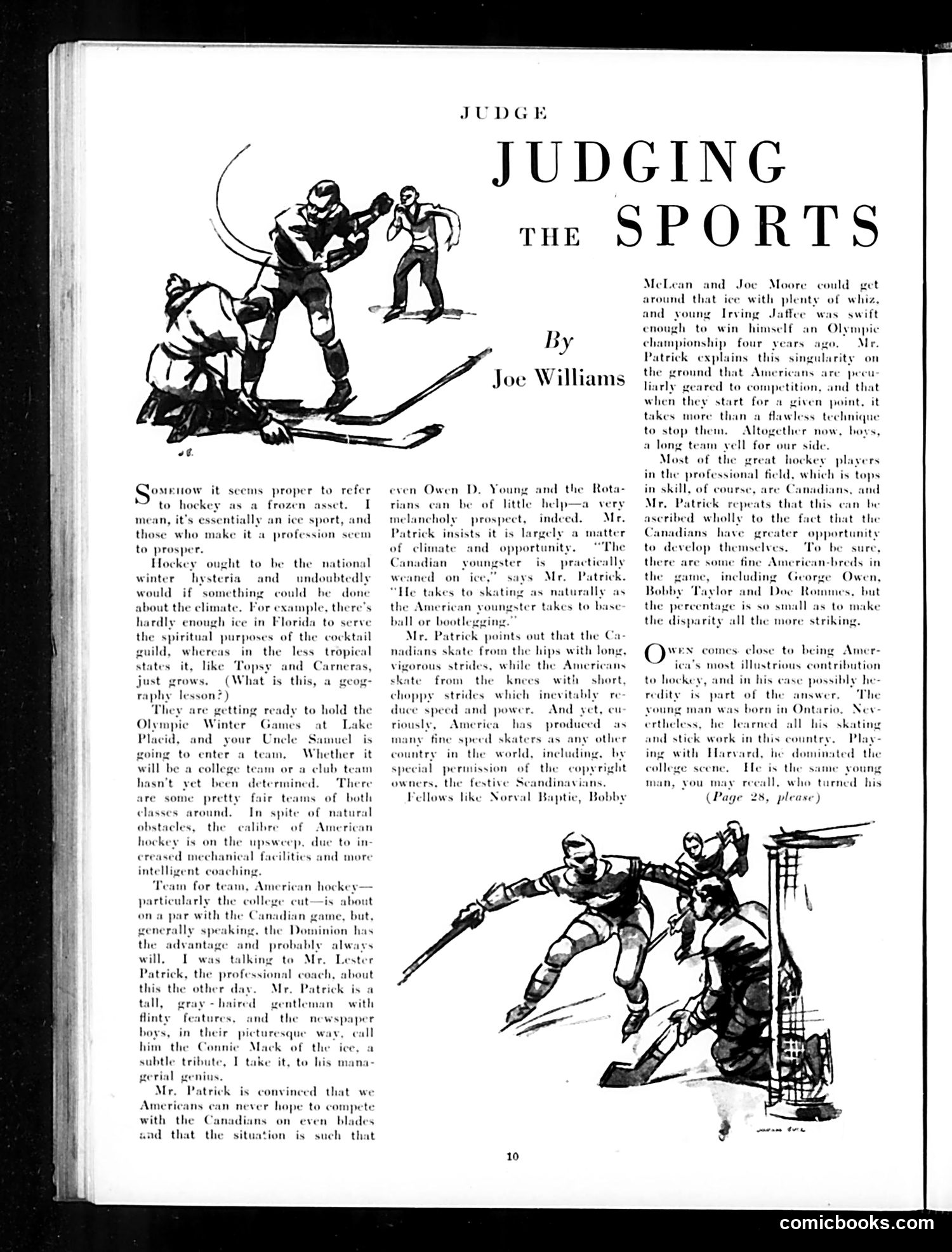
# "Judging the Sports" by Joe Williams This article discusses American versus Canadian hockey superiority ahead of the 1932 Winter Olympics at Lake Placid. The author interviews Lester Patrick, a prominent professional hockey coach (called "the Connie Mack of the ice"), who argues Americans can never match Canadians because Canadian children are "practically weaned on ice" and skate from the hips with superior technique, while Americans skate from the knees with less natural power. The satire targets American sporting pride: despite producing Olympic speed skaters and competitive athletes, America's hockey remains inferior due to climate and culture—Canadians simply have better conditions for developing the sport. The piece gently mocks this disparity while praising figures like Irving Jaffee and Oren (likely Frank Orem), exceptional American skaters who succeeded despite systemic disadvantages. The overall tone is wry acceptance that geography, not talent, determines hockey dominance.
📄 Transcribed text from this page (OCR, searchable)
Machine-transcribed from the original scan — historical spelling and the odd misread are preserved.
omeniow it seems proper to refer Ss to hockey as a fensen asset. I mean, it’s essentially an ice sport, and those who make it a profession seem to prosper. Hockey ought to be the national winter hysteria and undoubtedly would if something could be about the climate. For exam . there's hardly enough ice in Florida to serve the spiritual purposes of the cocktail guild, whereas in the less tropical states it, like Topsy and Carneras, just grows. (What is this, a geog- raphy lesson?) T tting ready to hold the Olympic Winter G ut Lake Placid, and Samuel is going to enter a Whether it will be a college amor a club team hasn't yet determined. There ire some fair teams of both classes around. In spite of natural obstacles, the American y ison the upsweep, due to in your team, been pretty calibre of creased mechanical facilities and more intelligent coaching. Team for team, American hockey— particularly the college cut ona par with the Canadian game, but, generally speaking. the Dominion has the advantage and probably always will, 1 talking to Mr. Lester Patrick, the professional coach, about this the other day. Mr. Patrick is a tall, gentleman with flinty features, and the newspaper boys, in their picturesque way, call him the Mack of the ice, a subtle tribute, I take it, to his mana- gerial i Mr. Patrick Americans can never h with the Cs and that the is about was gray - haired Connie is convinced that we © to compete blades. that adians on even situation is) sueh JUDGE JUDGING By Joe Williams even Owen D. Young and the Rota- rians can be of little help—a_ very elancholy prospect, indeed. Mr. Patrick insists it is largely a matter of climate and “The Canadian youngster is — practically weaned on ice Mr. Patrick. “He takes to skating as naturally as the American ball or booth 5 Mr. Patrick points out that the Ca- lians skate from the hips with long, vigorous strides, while the Americar from the knees with short, choppy strides which inevitably re And yet, cu produced as many fine speed skaters as any other country in the world, including. by special permission of the opportunity. says oungster takes to base skate duce speed and power. riously, America has copyright owners, the festive Scandinavians, Fellows like Norval Baptie, Bobby Joe Moore could get t ice with plenty of whiz, Irving Jaffee was swift win himself an Olympic championship four years ago. Mr. explains this singularity on the ground that Americans are pecu liarly geared to competition, and that when they start for a given point, it takes more than: to stop them. Altogether now, boys, a long team vell for our side. Most of the great hockey players in the professional field, whieh is tops in skill, of course, are Canadians, and Mr. Patrick repeats that this ean be ascribed wholly to the fact that the Canadians have greater opportunity to develop themselves. To be sure, there American-breds in the game, including Gee Owen, Bobby lor and Doc Rommes, but the percentage is so small as to make around tl and enough to young flawless technique are some fin the disparity all the more striking. Ores comes close to being Amer- ica’s most illustrious contribution to hockey, and in his case possibly he- redity is part of the The young man was born in Ontario, Nev- ertheless, he learned all his) skating and stick work in this country. Play- ing with Harvard, he dominated scene. He answer, is the I, who turned his , please) same young ou may re comicbooks.com