
Judge, 1932-01-09 · page 34 of 36
Judge — January 9, 1932 — page 34: what you’re looking at
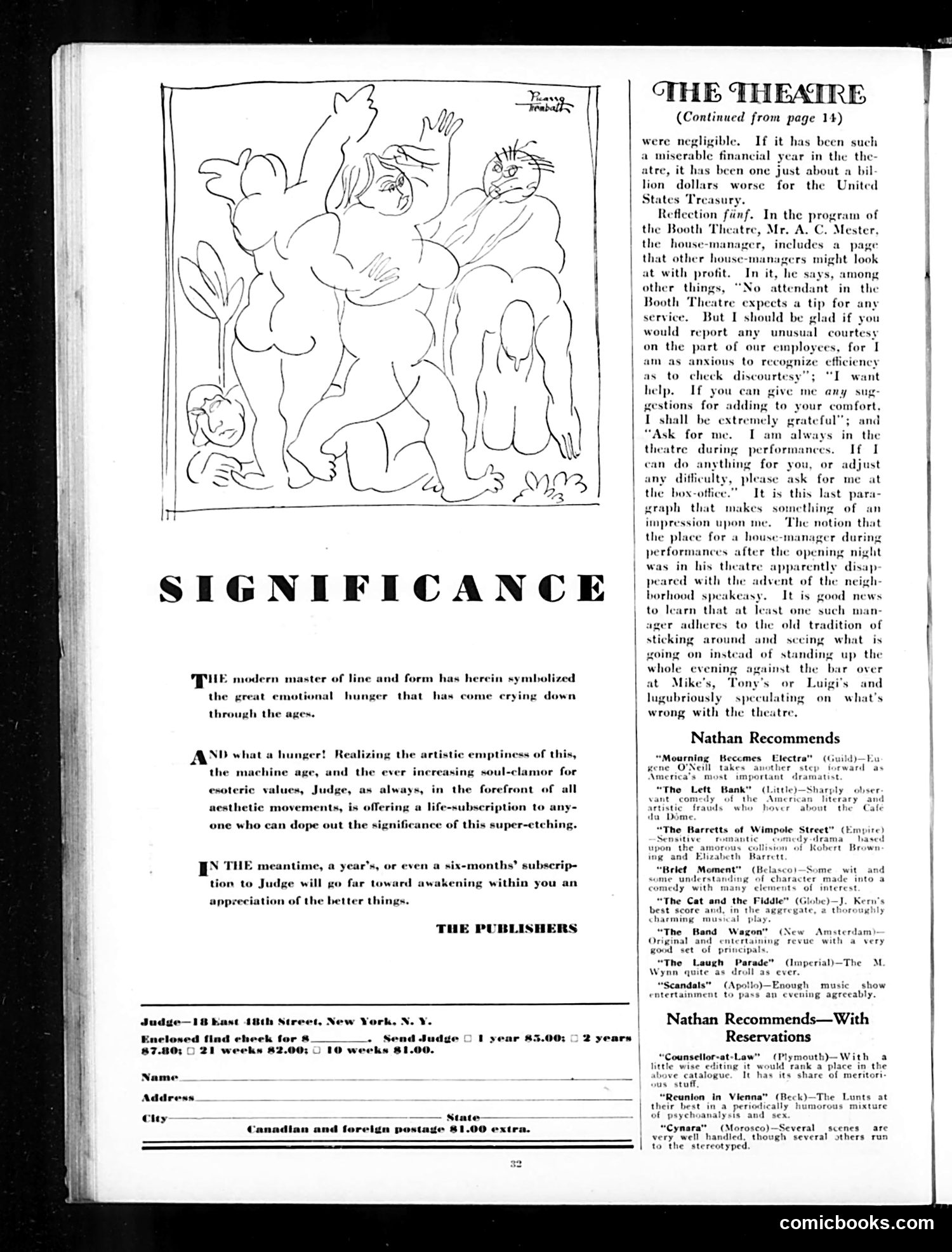
A restored page from Judge, 1932-01-09. Page through the whole issue in the reader above.
📄 Transcribed text from this page (OCR, searchable)
Machine-transcribed from the original scan — historical spelling and the odd misread are preserved.
SIGNIFICANCE ue modern master of line and form has herein symbolized the great emot nal hunger that has come crying down through the a ANY what a hunger! Realizing the artisti «3 of this, 1 esoteric values, Judge, as always, in the forefront of all the m ine age, and the ever increasing soul-clamor for aesthetic movements, is offering a life-subseription to any- one who can dope out the si ce of this super-ctching. JN THE meantime, a year's, or even a six-months’ subserip- tion to Judge will go far toward awakening within you an appreciat of the better things. (Continued from page 14) atre, it has been one just about a bil lion dollars worse for the United States Treasury. Reflectio: the Booth TI the house fiinf. In the program of tre, Mr. A. C. Mester. anager, includes a page that other house-managers might look at with profit. In it, he says, among other things, “No attendant. in the Booth Theatre expects a tip for any service, But I should be glad if you would report any unusual courtesy on the part of our employees, for I am as anxious to recognize efficiency ck diycourtesy"; “I want help. If you can give me any sug- gestions for adding to your comfort, I shall be extremely grateful’; and “Ask for me. [ am always in the tre during performances. If 1 1 do anything for you, or adjust any difficulty, please ask for me at the box-ottice.” It is this last: para- graph that makes something of an ie as to ch impression upon me, ‘The notion that the place for a house-manager during performances after the opening night was in his theatre apparently disap peared with the advent of the nei borhood speakeasy. It is good news to learn that at least one such man- ager adheres to the old tradition of sticking around and sceing. w is yoing on instead of standing up the whole evening against the bar over at Mike’s, Tony’s or Luigi's and lugubriously speculating on what's wrong with the theatre, Nathan Recommends journing Becomes Electra” (Guild)—Eu gene O'Neill takes another step forward as America’s most important dramatist “The Lett Bank" (Little)—Sharply obser nt comedy the Amer literary and tic frauds who hover it da Dome “The Barretts of Wimpole Street” (Empire) Sensitive romantic — ¢ y-drama — hased upon the am i ‘ Kobert: Brown ing and Elizabeth Barrett “Brief Moment” (Belas - understanding of character made into a comedy with y elements of interest “The Cat and the Fiddle” (Globe)—J best score and, in the aggre a thoroughly ming cal p “The Band Wagon’ Original and entertain good set of princip “The Laugh Parade (Imperial)—The M ‘as droll as ever. “Scandals” (Apotlo)—Enough music show entertainment to pass an evening agreeably, }—Some wit and (New Amsterdam ng revue with a very dudge—18 hast 18th Street, New York, Enclosed find cheek for 8 ___ Send Judge © 1 year 85.00; © 2 years 87.80; 0 21 w 6 82.00; 0 10 weeks 81.00. i. We Name _ —_ Address chy ——— State p and foreign postage $1.00 extra. Nathan Recommends—With Reservations “Counsello aw" (Plymouth)—With a little wise e it w nk a place in the above catalogue. It has its share of meritori- ous stuf “Reunton in Vienna” (Beck)—The Lunts at | their best in a periodically fous mixture of psychoanalysis and. sex “Cynara (Morosco)—Several scenes are very well handled, though several others run | to the stereotyped EE comicbooks.com