
Judge, 1932-01-09 · page 16 of 36
Judge — January 9, 1932 — page 16: what you’re looking at
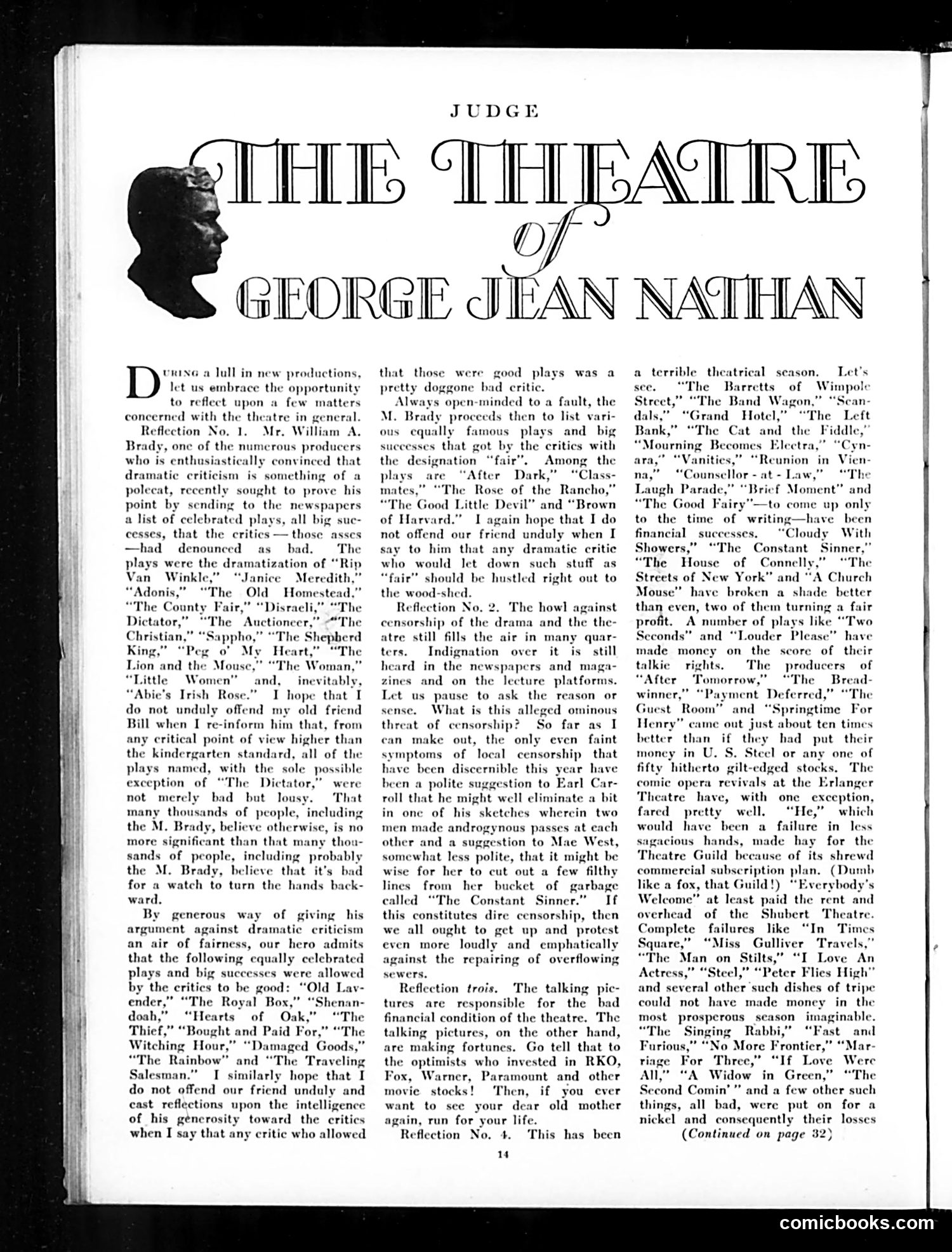
A restored page from Judge, 1932-01-09. Page through the whole issue in the reader above.
📄 Transcribed text from this page (OCR, searchable)
Machine-transcribed from the original scan — historical spelling and the odd misread are preserved.
vine a lull in new productions, let us embrace the opportunity to reflect upon a few matters concerned with the theatre in general. Reflection No. 1. Mr. William A. Brady, one of the numerous producers who is enthusiastically convinced that dramatic criticism is something of a polecat, recently sought to prove his point by sending to the newspapers a list of celebrated plays, all big suc- cesses, that the critics —those asses denounced as bad. The were the dramatization of “Rip Winkle,” “Janice Meredith,” “The Old Homestead.” Van “Adonis,” oT he County Fair,” “Disraeli The tor,” “The Auctionee “The Christ Sappho,” “The Shepberd ¢ o' My Heart,” “The Woman,” inevitably, I hope that I “Little “Abie's Irish Ros: do not unduly offend my old friend Bill when I re-inform him that, from any critical point of view higher than the kindergarten standard, all of the named, with the exception of “The Dictator,” were not merely bad but lousy. ‘That many thousands of people, including the M. Brady, believe otherwise, is no more significant than that many thou- sands of people, including probably the M. Brady, believe that it’s bad for a watch to turn the hands back- ward, By generous way of giving his argument against dramatic criticism an air of fairness, our hero admits that the following equally celebrated plays and big successes were allowed by the critics to be good: Ge ender The Royal Box,” “Shenan- “Hearts of Oak,” “The and Paid For,” “The “Damaged Goods,” “The Rainbow” and “The Traveling Salesman.” TI similarly hope that I do not offend our friend undul id cast reflections upon the intelligence of his génerosity toward the critics when I say that any critic who allowed sole possible Witching Hour, Ib SAL JUDGE that those were good plays was a pretty doggone bad critic. s open-minded to a fault, the dy proceeds then to list vari- ous equally famous plays and big successes that got by the critics with the designation ", Among the plays “After Dark,” “Clas: mates,” “The Rose of the Rancho,’ “The Good Little Devil” and “Brown of Harvard.” I again hope that I do not offend our fricnd unduly when I say to him that any dramatic critie who would let down such stuff as “fair” should be hustled right out to the wood-shed. Reflection No. 2. The howl against censorship of the drama and the the- atre still filly the air in many quar- ters. Indignation over it is still heard in the newspapers and mag zines and on the lecture platforms. Let us pause to ask the reason or sense. What is this alleged ominous threat of censorship? So far as I can make out, the only even faint of local censorship that been discernible this been a polite s roll that he m in one of his Bketahios, wherele cin two men made androgynous passes at cach other and a suggestion to Mac West, somewhat less polite, that it might be wise for her to cut out a few filthy lines from her bucket of garbage called “The Constant Sinner.” If this constitutes dire censorship, then we all ought to get up and protest even more loudly and emphatically against the repairing of overflowing sewers. Reflection trois. The talking pic- tures are responsible for the bad financial condition of the theatre. The talking pictures, on the other hand, are making fortunes. Go tell that to the optimists who invested in RKO, Fox, Warner, Paramount and other movie stocks! Then, if you ever want to see your d old mother again, run for your life. Reflection No, 4. This has been 4 symptoms have EAITIRE: GEORGE JEAN NATHAN a terrible theatrical season, Let's see. the Barretts of Wimpol: Street,” “The Band Wagon,” “Sean- dals,” “Grand Hotel,” “The Left Bank,” “The Cat and the Fiddle,’ “Mourning Becomes Electra,” “Cyn- ‘i “Vanities, “Counsell na,” Laugh Parade. “Brief Moment” an to come up only time of writi we—have 1 successes. “Cloud Showers,” “The Constant “The House of Connelly Streets of New York” and “A Church Mouse” have broken a shade better than even, two of them turning a fair profit. A number of plays like “Two Seconds” and “Louder Please” have made moncy on the score of their “The Good talkie rights. The producers of “After morrow,” “The Bre winner, ment Deferred,” Guest R and “Springtime Henry” came out just about ten times better than if they had put. their moncy in U. S. Steel or any one of fifty hitherto gilt-edged stocks. The comic opera revivals at the Erlanger Theatre have, with one exception, fared pretty well. “He,” which would have been a failure in’ less sagacious hands, made hay for the Theatre Guild because of its shrewd commercial subscription plan. (Dumb like a fox, that Guild!) “Everybody's Welcome” at least paid the rent and overhead of the Shubert T J Complete failures i “In “Miss Gulliver Travels,” ilts,” “I Love An “Peter Flies High” and several other such dishes of tripe could not have made money in the most prosperous son imaginable. “The Singing Rabbi,” “Fast and Furious,” “No More Frontier,” “Mar- riage For Thre: ‘If Love Were All,” “A Widow in Green,” “The Second Comin’ ” and a few other such things, all bad, were put on for a nickel and consequently their losses (Continued on page 32) comicbooks.com