
Judge, 1932-01-09 · page 13 of 36
Judge — January 9, 1932 — page 13: what you’re looking at
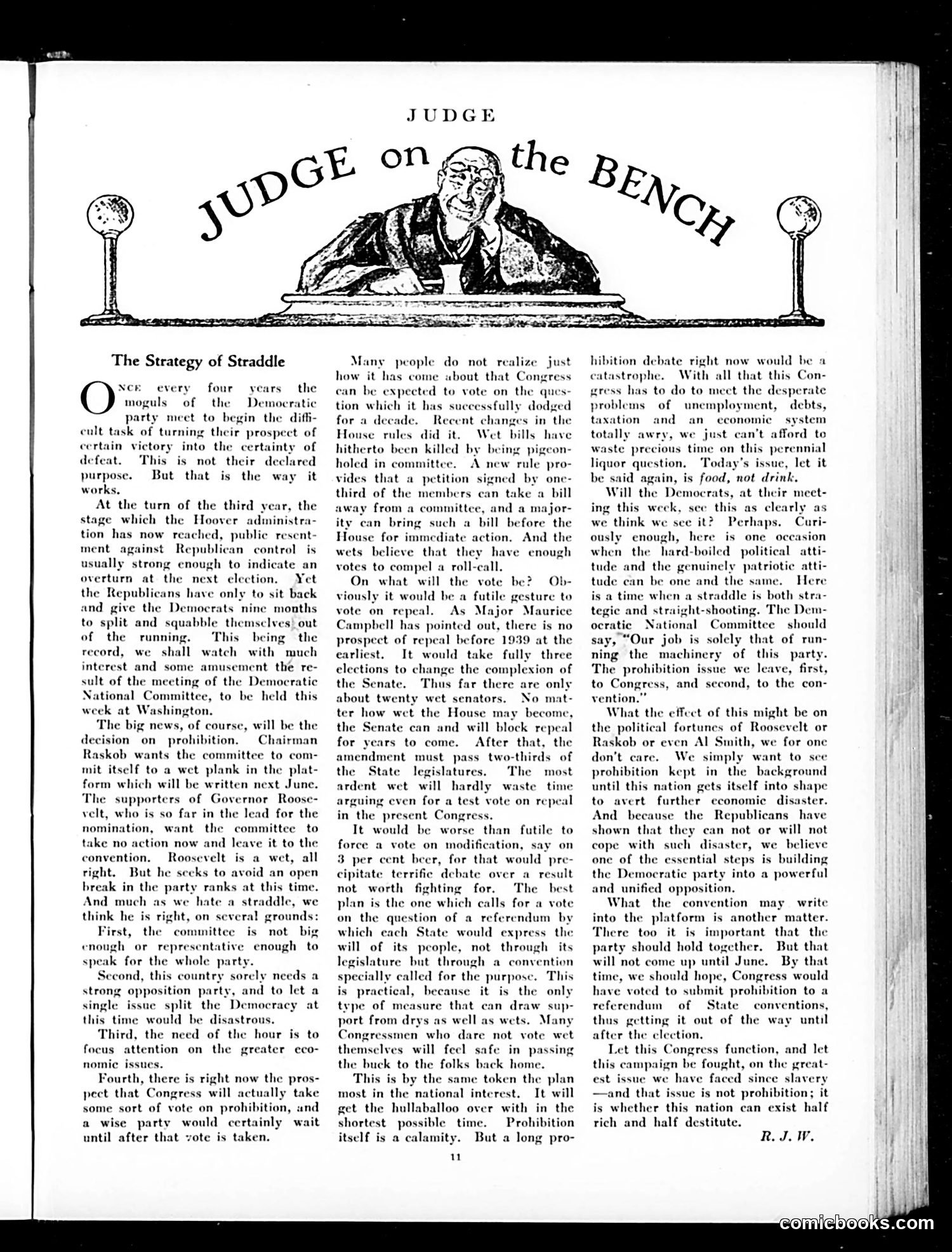
A restored page from Judge, 1932-01-09. Page through the whole issue in the reader above.
📄 Transcribed text from this page (OCR, searchable)
Machine-transcribed from the original scan — historical spelling and the odd misread are preserved.
The Strategy of Straddle Nek every four years the moguls of the Democratic party meet to begin the diffi- cult task of turning their prospect of certain victory into the certainty of defeat. This is not their declared purpose. But that is the way it works. At the turn of the third year, the stage which the Hoover administra- tion now reached, public resent- ment against Republican control is usually strong enough to indicate an overturn at the next election, Yet the Republicans have only to sit back and give the Democrats nine months to split and squabble themsclves! out of the running. This being the record, we shall watch with much interest and some amusement the re- sult of the meeting of the Democratic National Committee, to be held this week at Washingto The big news, of course, will be the decision on prohibition. Chairman Raskob wants the committee to com- mit itself to a wet plank in the plat- form which will be written next June. The supporters of Governor Roose- velt, who is so far in the lead for the nomination, want the committee to take no action now and | i convention. Roosevelt is right. But he secks to avoid break in the party And much as we h think he is right, on several grounds: First, the committee is not big or representative enough to k for the whole party. Second, this country sorely needs a strong opposition party, and to let a single issue split the Democracy at this time would be disastrous, Third, the need of the hour is to focus attention on the greater eco- nomic issues. Fourth, there is right now the pros- pect that Congress will actually take some sort of vote on prohibition, and a wise party would certainly wait until after that vote is taken. n open anks at this time. straddle, we JUDGE Many people do not realize just how it has come ubout that Congress can be expected to vote on the q tion which it has successfully dodged for a de Recent changes in the House rules did it. Wet bills have hitherto been killed by being pigeon- holed in committee. A new rule pro- vides that a petition signed by one- third of the members can take a bill y from a committee, and a major- ity can bring such a bill before the House for immediate action. And the wets believe that they enough votes to compel a roll- On what will the vote be? Ob- viously it would be a futile gesture to vote on repeal. As Major Maurice Campbell has pointed out, there is no prospect of repeal before 1939 at the earliest. It would take fully three elections to change the complexion of the Senate. Thus far there are only about twenty wet senators. No mat- ter how wet the House may become, the Senate can and will block repeal for years to come. After that, the amendment must pass two-thirds of the State legislatures. The most ardent wet will hardly waste time arguing even for a test vote on repeal in the present Congress. It would be worse than futile to force a vote on modification, say on 3 per cent beer, for that would pre- cipitate terrific debate over a result not worth fighting for. The best plan is the one which calls for a vote on the question of a referendum by which each State would express the will of its people, not through its legislature but through a convention specially called for the purpose. This is practical, because it is the only type of measure that can draw sup- port from drys as well as wets. Many Congressmen who dare not vote wet themselves will feel safe in passi the buck to the folks back home. This is by the same token the plan most in the national interest. It will get the hullaballoo over with in the shortest possible time. Prohibition itself is a amity. But a long pro- hibition debate right now would be a catastrophe. With all that this Con- gress has to do to meet the desperate problems of unemployment, debts, taxation and an economic system wry, We just can’t afford to waste precious time on this perennial liquor question. Today's issue, let it be said again, is food, not drink. Will the Democrats, at their meet- this week, see this as clearly as we think we see it? Perhaps. Curi- ously enough, here is one occasion when the hard-boiled political atti- tude and the genuinely patriotic atti- tude can be one and the same. Here is a time when a straddle is both stra- tegic and straight-shooting. The Dem- ocratic National Committee should say, “Our job is solely that of run- ning the machinery of this party. The prohibition isste we leave, first, to Congress, and second, to the con- vention.” What the effect of this might be on the political fortunes of Roosevelt or Raskob or even Al Smith, we for one don’t care. We simply want to see prohibition kept in the background until this nation gets itself into shape to avert further economic disaster. And because the Republicans have shown that they can not or will not cope with such disaster, we believe one of the essential steps is building the Democratic party into a powerful and unified opposition. What the convention may write into the platform is another matter. There too it is important that the party should hold together. But that will not come up until June. By that time, we should hope, Congress would have voted to submit prohibition to a referendum of State conventions, thus getting it out of the way until after the election, Let this Congress function, and let this campaign be fought, on the great- est issue we have faced since slavery and that issue is not prohibition; it is whether this nation can exist half rich and half destitute. R.JLW.