
Judge, 1932-01-02 · page 20 of 36
Judge — January 2, 1932 — page 20: what you’re looking at
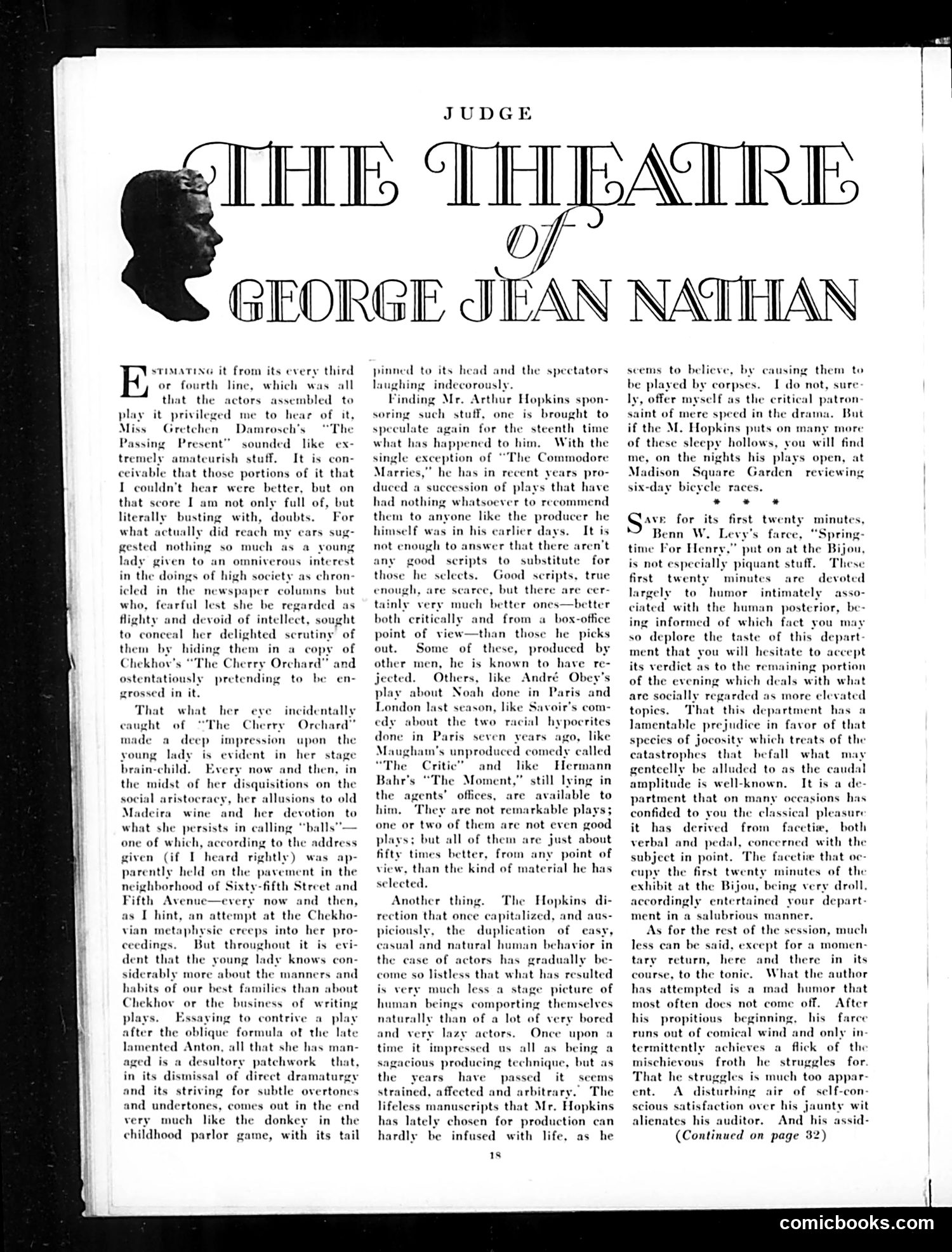
A restored page from Judge, 1932-01-02. Page through the whole issue in the reader above.
📄 Transcribed text from this page (OCR, searchable)
Machine-transcribed from the original scan — historical spelling and the odd misread are preserved.
STIMATING it from its every third or fourth line, which was all that the actors assembled to play it privileged me to hear of it, Miss Gretchen Damrosch's “The Passing Present” sounded like ex- tremely amateurish stuff. It is con- ceivable that those portions of it that I couldn't hear were better, but on that score I am not only full of, but literally busting with, doubts. For what actually did reach my cars sug- gested nothing so much as young lady given to an omniverous interest in the doings of high society ay chron- icled in the newspaper columns but who, fearful lest she be regarded as flighty and devoid of intelle to conceal her delighted them by hiding them in a copy of Chekhov's “The Cherry Orchard” and ostentatiously pretending to be en- grossed in it. That what her eye incidentally caught of “The Cherry Orchard” made a deep impression upon. the young lady is evident in her stage brain-child. Every now and then, in the midst of her disquisitions on the social aristocracy, her allusions to old and her devotion to at she persists in calling “balls” of which, according to the address wine given (if I heard rightly) was ap- parently held on the pavement in the neighborhood of Sixty-fifth Street and Fifth Avenue—every now and then, as I hint, « vi v attempt at the Chekho- n metaphysic creeps into her pro- ceedings. But throughout it is evi- dent that the young lady knows con- siderably more about the manners and habits of our best families than about Chekhov or the writing plays. saying to contrive a after the oblique formula of the lamented Anton, all that she has man- aged is a desultory patchwork that, in its dismissal of direct dramaturgy and its striving for subtle overtor and undertones, comes out in th very much like the donkey in childhood parlor game, with its tail business of JUDGE O pinned to its head and the spectators laughing indecorously. Finding Mr. Arthur Hopkins spon- soring such stuff, one is brought to speculate again for the steenth time what has happened to him, With the single exception of “The Commodore Marries,” he has in recent years pro- duced a succession of plays that have had nothing whatsoever to recommend them to anyone like the producer he himself was in his carlier days. It is not enough to answer that there aren't any good scripts to substitute for those he selects. Good scripts, true enough, are scarce, but there are cer- tainly very much better ones—better both critically and from a box-offic point of view—than those he picks out. Some of these, produced by other men, he is known to have ri jected. Others, like André play about Noah done in Ps London last season, like Savoir’s com- edy about the two racial hypocrites like done in Paris seven years ago. Maughain’s unproduced comedy called “The Critic” and like Hermann Bahr’s “The Moment,” still lying in the ents’ offic are available to him. ‘They are not remarkable plas one or two of them are not ¢ plays; but all of them « fifty times better, from view, than the kind of mater selected. Another thi cen good just about point of The has The Hopkins di- rection that once capitalized, and aus- piciously, the duplication of casual and natural human behavior in the case of actors has gradually be- come so listless that what has resulted is very much less a picture of human beings comporting themselves naturally than of a lot of very bored y lazy actors. Once upon a it impressed us all as being a acious producing technique, but as years have passed it seems ined, affected and arbitrary. The nuscripts that Mr. Hopkins has lately chosen for production can hardly be infused with i as he 18 TALS SWAUERACIRIE GEORGE JEAN NATHAN seems to believe, by causing them to be played by corpses. I do not, sure offer myself as the critical int of mere speed in the draw if the M. Hopkins puts on many more of these sleepy hollows, you will find me, on the nights his plays open, at Madison Square Garden reviewing six-day bicy ron But cle ra *“ 2 * Sate for its first twenty minutes, Benn W. Levy's farce, “Spring: time For Henry.” put on at the Bijou, is not especially piquant stuff. These first twenty minutes are devoted rgely to humor intimately ciated with the human posterior, be- ing informed of which fact you may so deplore the taste of this depart ment that you will hesitate to accept its verdict as to the rer x portion of the evening which deals with what are socially re, topics. That this department has a lamentable prejudice in favor of that species of jocosity which treats of the catastrophes that befall) what m genteclly be alluded to as the amplitude is well-known. It is a de- partment that on man. sions has confided to you the classical pleasure it has derived from tie, both verbal and pedal, concerned with the subject in point. The facetiw that oc- cupy the first twenty minutes of the exhibit at the Bijou, being very droll, according ained your depart: ment in ubrious manner. As for the rest of the session, much less can be said, except for a mom tary return, here and there in_ its course, to the tonic. What the author has attempted is a mad humor that most often does not come off. After his propitious beginning, his farce runs out of al wind and only in termittently flick of the mischievous froth he struggles for. That he struggle much too appar- ent. A disturbi air of self-con- scious satisfaction over his jaunty wit alienates his auditor. And his assid- (Continued on page 32) asso- garded as more elevated y enter! chieves a comicbooks.com