
Judge, 1932-01-02 · page 17 of 36
Judge — January 2, 1932 — page 17: what you’re looking at
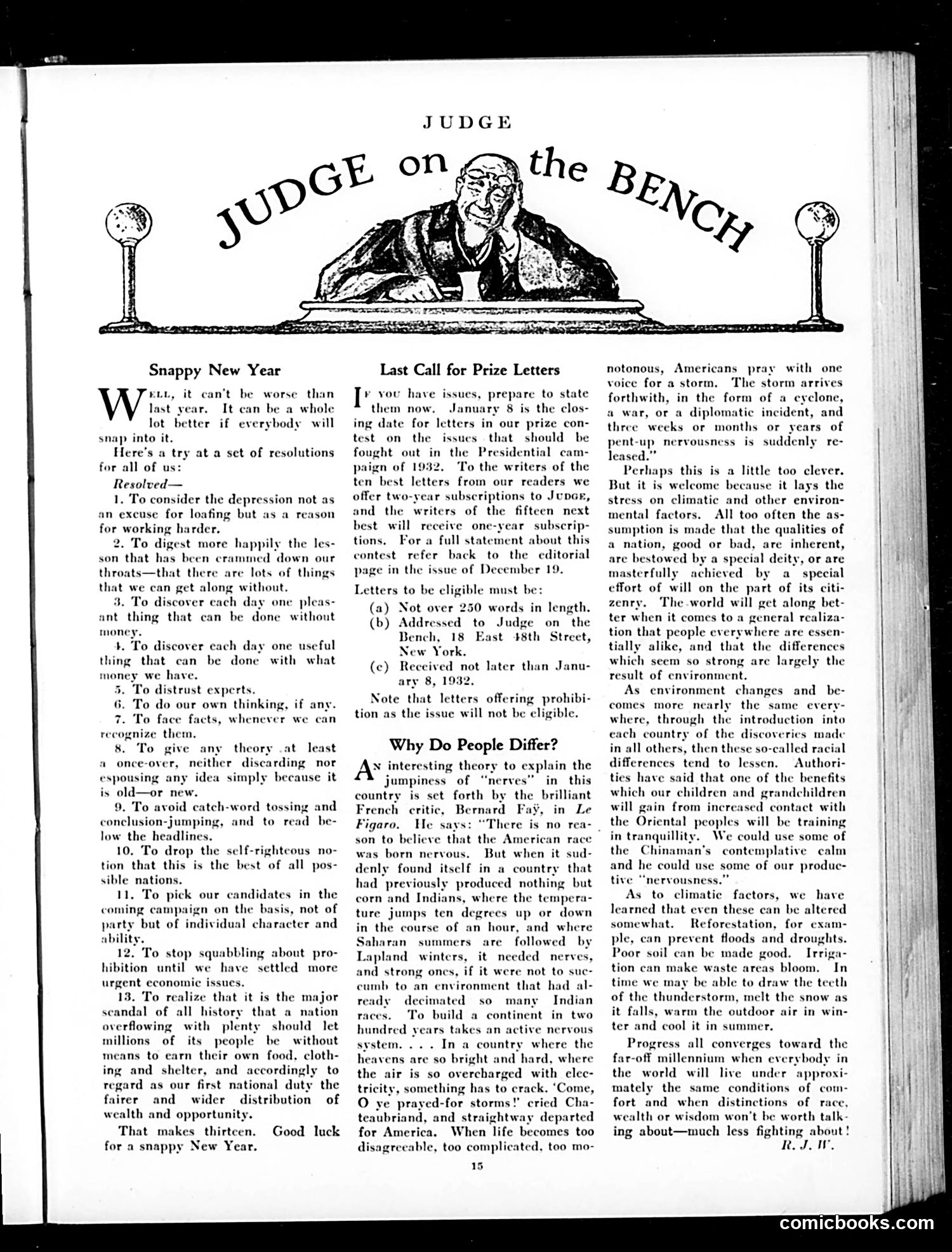
A restored page from Judge, 1932-01-02. Page through the whole issue in the reader above.
📄 Transcribed text from this page (OCR, searchable)
Machine-transcribed from the original scan — historical spelling and the odd misread are preserved.
Snappy New Year it can't be than It can be a whole ter if everybody will worse snap into it. Here's a try at a set of resolutions for all of us: Resolved— 1, To consider the depression not as an excuse for loafing but as a reason for working harder. To digest more happily the les- son that has been crammed down our throats—that there are lots of things that we can get along without. - To discover each day one pleas- ‘0 discover each day one useful thing that can be done with what money we have. 5. To distrust experts. 6. To do our own thinking, if any. To f. facts, whenever we ca ze them. To give any theory .at least a once-over, neither discarding nor espousing any idea simply because it is old—or new. 9. To avoid catch-word tossing and conclusion-jumping, and to read be- low the headlines, 10. To drop the self-righteous no- tion that this is the best of all pos- sible nations. 11. To pick our candidates in the coming campaign on the basis, not of party but of individual character and ability: 12. To stop squabbling about pro- hibition until we settled more urgent econom 13. To realize that it is the major scandal of all history that a nation overflowing with plenty should let millions of its people be without means to earn their own food, cloth- ing and shelter, and accordingly to ‘das our first national duty the fairer and wider distribution of wealth and opportunity. That makes thirteen. for a snappy New Year. Good luck Last Call for Prize Letters I you have issues, prepare to state them now. January 8 is the clos- ing date for letters in our prize con- test on the issues that should be fought out in the Presidential cam- paign of 1 To the writers of the ten best letters from our readers we offer two-year subscriptions to Junge, and the writers of the fifteen next best will receive one-year subscrip- tions. For a full statement about this contest refer back to the editorial page in the issue of December 19, Letters to be cligible must be: (a) (b) Not over 250 words in length. Addressed to Judge on the Bench, 18 East 48th Street, New York. (c) Received not later than Janu- ary 8, 1932. Note that letters offering prohibi- tion as the issue will not be cligible. Why Do People Differ? interesting theory to explain the jumpiness of “nerv n_ this is set forth by the brilliant critic, Bernard ¥, in Le He s: “There is no rea son to believe that the American ra was born nervous. But when it sud- denly found itself in a country that had previously produced nothing but corn and Indians, where the tempera- ture jumps ten degrees up or down in the course of an hour, and where Saharan summers are followed by Lapland winters, it needed nerves, and strong ones, if it were not to suc- cumb to an environment that had al- ready decimated so many Indian races. To build continent in two hundred years takes an active nervous system... . In a country where the heavens are so bright and hard, where the air is so overcharged with clec- tricity, something has to crack. ‘Come, O ye prayed-for storms!’ cried Cha- teaubriand, and straightway departed for America. When life becomes too disagreeable, too complicated, too mo- 15 notonous, Americans pray with one voice for a storm. The storm arrives forthwith, in the form of a cyclone, a war, or a diplomatic incident, and three weeks or months or years of pent-up nervousness is suddenly re- leased.” Perhaps this is a little too clever. But it is welcome because it lays the stress on climatic and other environ- mental factors. All too often the as- sumption is made that the qualities of a nation, good or bad, are inherent, are bestowed by a special deity, or are masterfully achieved by a special effort of will on the part of its citi zenry. The-world will get along bet- ter when it comes to a general realiza- tion that people everywhere are essen- tially alike, and that the differences which seem so strong are largely the result of environment. As environment changes and be- comes more nearly the same every- where, through the introduction into each country of the discoveri in all others, then these so- differences tend to lessen, Authori- ties have said that one of the benefits which our children and grande will gain from increased contact with the Oriental peoples will be tra in tranquillity. We could use some of the Chinaman’s contemplative calm and he could use some of our produc- tive “nervousness.” As to climatic learned that even th somewhat. Reforest ple, can prevent floods Poor soil can be made good. tion can make waste areas bloom. In time we may be able to draw the tecth of the thunderstorm, melt the snow it falls, warm the outdoor air in w ter and cool it in summer. have Progress all converges toward the far-off millennium when everybody in the world will live under approxi- mately the same conditions of com- fort and when distinctions of rac wealth or wisdom won't be worth talk ing about—much less fighting about! RILW. comicbooks.com