
Judge, 1931-12-26 · page 28 of 37
Judge — December 26, 1931 — page 28: what you’re looking at
A restored page from Judge, 1931-12-26. Page through the whole issue in the reader above.
📄 Transcribed text from this page (OCR, searchable)
Machine-transcribed from the original scan — historical spelling and the odd misread are preserved.
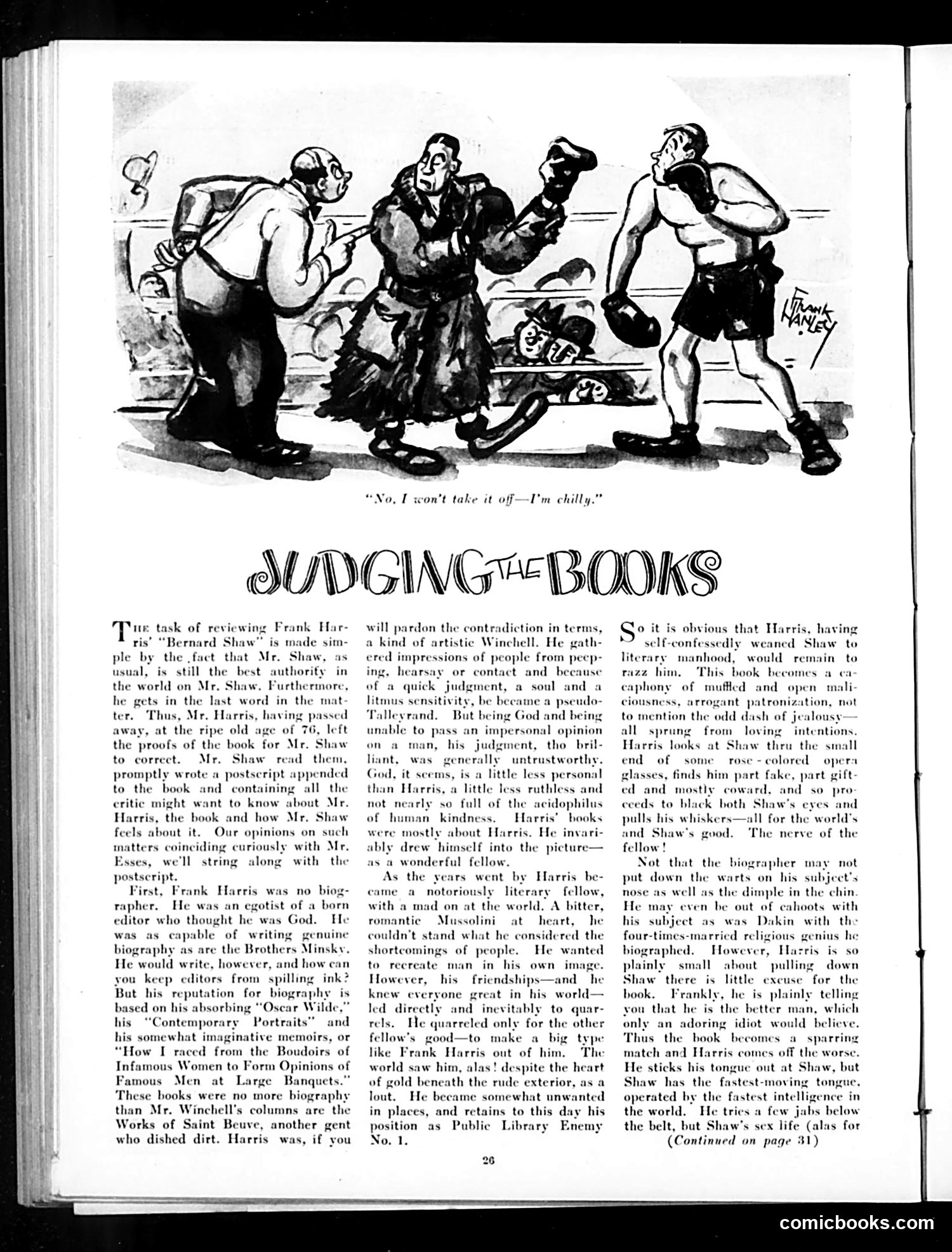
“No, [ won't take it off—I'm chilly.” JUDGING“ BOOKS ne task of reviewing Frank Har- ris’ “Bernard Shaw” is made sim- ple by the .fact that Mr. Shaw, as still the best authority in the world on Mr. Shaw, Furthermore, he gets in the last word in the mat ter. Thus, Mr. Harris, having passed away, at the ripe old age of left the proofs of the book for Mr. Shaw to correct. Mr. Shaw read them, promptly wrote a postscript appended to the book and containing all the critic might want to know about Mr. Harris, the book and how Mr. Shaw feels about it. Our opinions on such tters coinciding curiously with Mr. es, we'll string along with the cript. First, Frank Harris was no biog- rapher. He was an egotist of a born editor who thought he was God. He was as capable of writing genuine biography as are the Brothers Minsky. He would write, however, and how can you keep editors from spilling ink? But his reput based on his absorbing “ his “Contemporar. his somewhat imagins “How I raced from the Boudoirs of Infamous Women to Form Opinions of mous Men at Large Banquets.” These books were no more biography than Mr. Winchell’s columns are the Works of Saint Beuve, another gent who dished dirt. Harris was, i usual, is ion for biography. is car Wilde,” you will pardon the contradiction in terms, a kind of artistic Winchell. He gath- ered impressions of people from peep- ing, hearsay or contact and because of a quick judgment, a soul and a litmus sensitivity, be became a pseudo- Talleyrand, But being God and be unable to pass an impersonal opinion ona man, his judgment, tho bril- untrustworthy. little less personal than Harris, a little less ruthless and not nearly so full of the acidophilus of human kindness. Harris’ books were mostly about Harris. He invari- ably drew ‘himself into the picture— as a wonderful fellow. As the years went by Harris be- notoriously literary fellow, with a mad on at the world. A bitter, romantic Mussolini at heart, he couldn't stand what he considered the shortcomings of people. He wanted to recreate man in his own image. However, his friendships—and he knew everyone great in his world— led directly and inevitably to quar- rels. He quarreled only for the other fellow’s good—to make a big type like Frank Harris out of him. The world saw him, alas! despite the heart of gold beneath the rude exterior, as a lout. He became somewhat unwanted in places, and retains to this day his position as Public Library Enemy No. 1. liant, was generally God, it seems, is a came a S° it is obvious that Harris, having self-confessedly weaned Shaw to literary manhood, would remain. to razz him, This book becomes a ea aphony of muffled and open mali ciousne arrogant patronization, not to mention the odd dash of jealousy all sprung from loving intentions. Harris looks at Shaw thru the small end of rose - colored glasses, finds him part f some opera c, part gift ed and mostly coward, and so pro ceeds to black both Shaw's eyes and pulls his whiskers—all for the world’s and Shaw's good. The nerve of the fellow! Not that the biographer may not put down the warts on his subject's nose ay well as the dimple in the chin He may even be hoots with his subject as was with the four-times-marricd religious genius he biographed. However, Harris is so inly small about pulling down Shaw there is little excuse for the book. Frankly, he is plainly telling you that he is the better man, which only an adoring idiot would believe. Thus the ok match and Harris comes off the worse He sticks his tongue out at Shaw, but Shaw has the fastest-moving tor operated by the fastest intel the world. He tries a few the belt, but Shaw’s sex life (alas for (Continued on page 31) becomes comicbooks.com