
Judge, 1931-12-26 · page 20 of 37
Judge — December 26, 1931 — page 20: what you’re looking at
A restored page from Judge, 1931-12-26. Page through the whole issue in the reader above.
📄 Transcribed text from this page (OCR, searchable)
Machine-transcribed from the original scan — historical spelling and the odd misread are preserved.
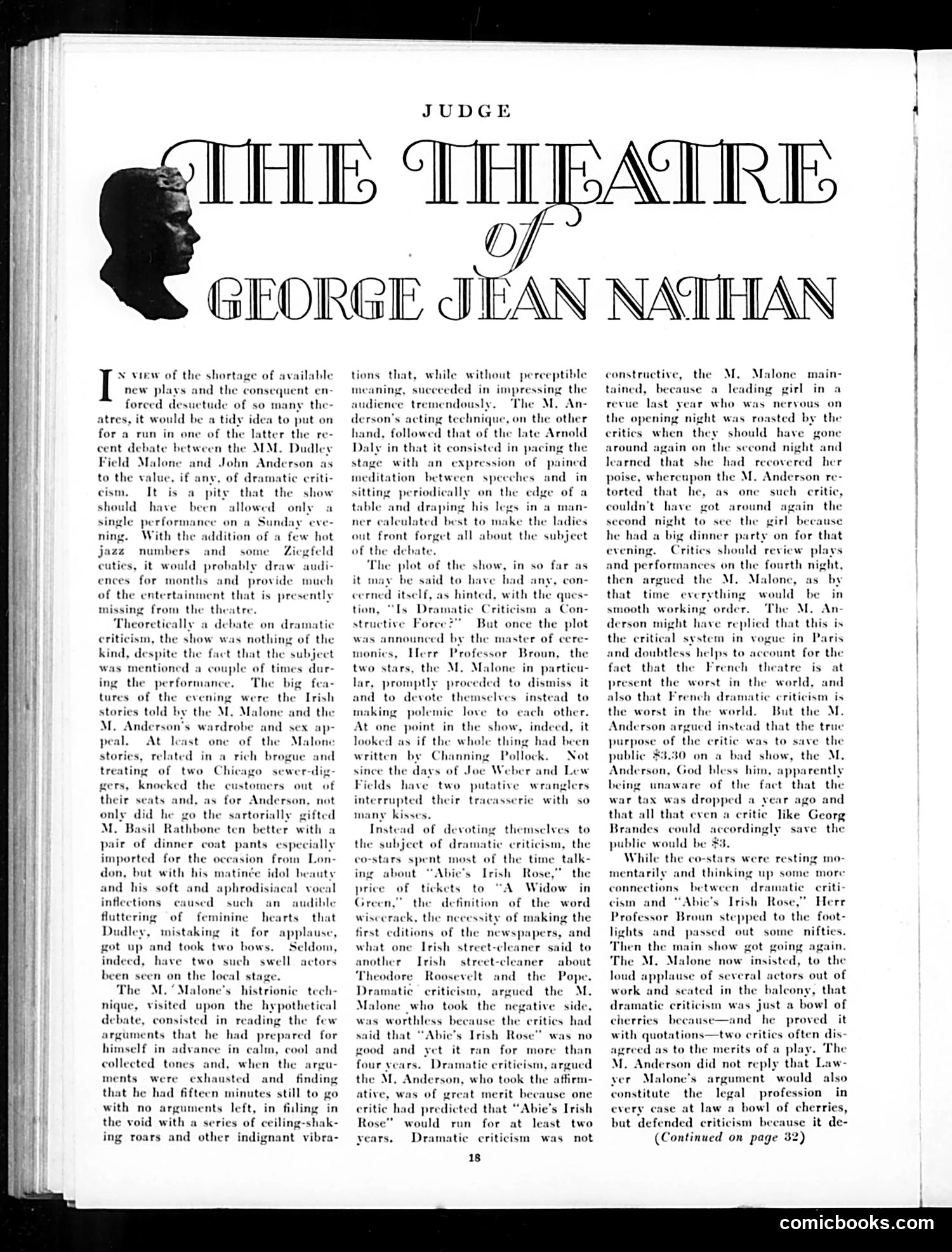
JUDGE Ib “OADRACIIRE: —hO 6 GEORGE JEAN NATHAN N view of the shortage of available new plays and the consequent en forced desuctude of so many the- atres, it would be a tidy idea to put on for a run in one of the latter the re- cent debate between the MM. Dudley Field Malone and John Anderson as to the value, if any, of dramatic criti- cism, It is a pity that the show should have been allowed only a single performance on a Sunday ‘eve- ning. With the addition of a few hot jazz numbers and some cuties, it would probably ences for months and provide much of the entertainment that is presently missing from the theatre. Theoretically a debate on dramatic ism, the show was nothing of the kind, despite the fact that the subject was mentioned a couple of times dur- The big fea- ing the performance. tures of the were the Trish stories told by the M. Malone and the M. Anderson's wardrobe and sex : peal. At least stories, related in a rich brogue treating of two Chi gers, knocked the their seats « evening one of the sewer astomers out . as for Anderson, only did he go the sartorially gifted M. Basil Rathbone ten better with a pair of dinner coat pants especially imported for the occasion from Lon- don, but with his matinée idol beauty and his soft and aphrodisiacal vocal inflections caused such an fluttering of feminine that Dudley, mistaking it for applause, got up and took two bows. Seldom, audible hearts indeed, have two such swell actors been seen on the local stage. The M.‘Malone’s histrionic tech- nique, visited upon the hypothetie: debate, consisted in reading the few arguments that he had prepared for himself in advance in collected tones cali, cool and d, when the argu- ments were exhausted and_ finding that he had fifteen minutes still to go with no arguments left, in filing in the void with a series of ceiling-shak- ing roars and other indignant vibra- while without perceptible ded in impressing the ously. The M. An- derson's acting technique, on the other hand, followed that of the late Arnold Daly in that it consisted in pacing the stage with an expression of pained meditation between speeches and in sitting periodically on the edge of a table and draping his legs in a man- ner calculated best to make the ladies out front forget all about the subject of the debate. The plot of the show, in so far as it may be said to have had any, con- cerned itself, as hinted, with the ques- tion, “Is natic Criticism a Con- structive Fore But once the plot was announced by the master of cere- Herr Professor Broun, the two stars, the M. Malone in particu- lar, promptly proceded to dismiss it and to devote instead to making polemic love to each other. At one point in the show, indeed, it looked as if the whole thing had been written by Channing Pollock. Not since the days of Joe Weber and Lew Fields have two putative wranglers interrupted their tracasserie with so many kisses. audienc monies, themselves Instead of devoting themselves to the subject of dramatic criticism, the co-stars spent most of the time talk- ing about “Abie’s Irish) Rose,” the price of tickets to “A> Widow in Green,” the definition of the word wiseerack, the necessity of making the first editions of the newspapers, what one Irish street-cleaner another Trish street-cles pout Theodore Roosevelt and the Pope. criticism, argued the M. : who took the negative side, was worthless because the critics had said that “Abie’s Irish Rose” was no good and yet it ran for more than four years. Dramatic criticism, argued the M, Anderson, who took the affirm- ative, was of great merit because one critic had predicted that “Abie’s [rish Rose” would run for at least two Dramatic criticism was not 18 years. constructive, the M. Malone main- tained, beeause a leading in a revue last year who was nervous on the opening night was roasted by the crities when they should have around again on the second night « learned that had her poise, whereupon the M. Anderson re- she recovered torted that he, as one such critic, couldn't have got around again the second night to see the girl bee he had a big dinner party on for tha evening. Critics should ‘review plays and performances on the fourth night, then argued the M. Malone, as by that time everything would be in smooth working order. The M. An derson might have replied that this is the critical system in vogue in Paris nd doubtless helps to account for the et that the French theatre is at present the worst in the world, and also that French dramatic criticism is the worst in the world. But the M. Anderson argued instead that the true purpose of the critic was to save the public $3.30 on a bad show, the M. Anderson, God bless him, apparently of the fact that the war tax was dropped a year ago and that all that even a critic like Georg Brandes could accordingly save the public would be While the co-stars were resting mo- ments being unaware ily and thinking up some more connections dram. criti- cism and “Abie’s Irish Rose Herr Professor Broun stepped to the foot- lights and passed out some nifties. Then the main show got going again. The M. Malone now insisted, to the loud applause of several actors out of work and seated in the balcony, that dramatic criticism was just a bowl of nd he proved it ritics often dis- s to the merits of a play. The M. Anderson did not reply that Law- yer Malone's argument would also constitute the legal profession — in every case at law a bowl of cherries, but defended criticism because it de- (Continued on page 32) between ic comicbooks.com