
Judge, 1931-12-19 · page 26 of 36
Judge — December 19, 1931 — page 26: what you’re looking at
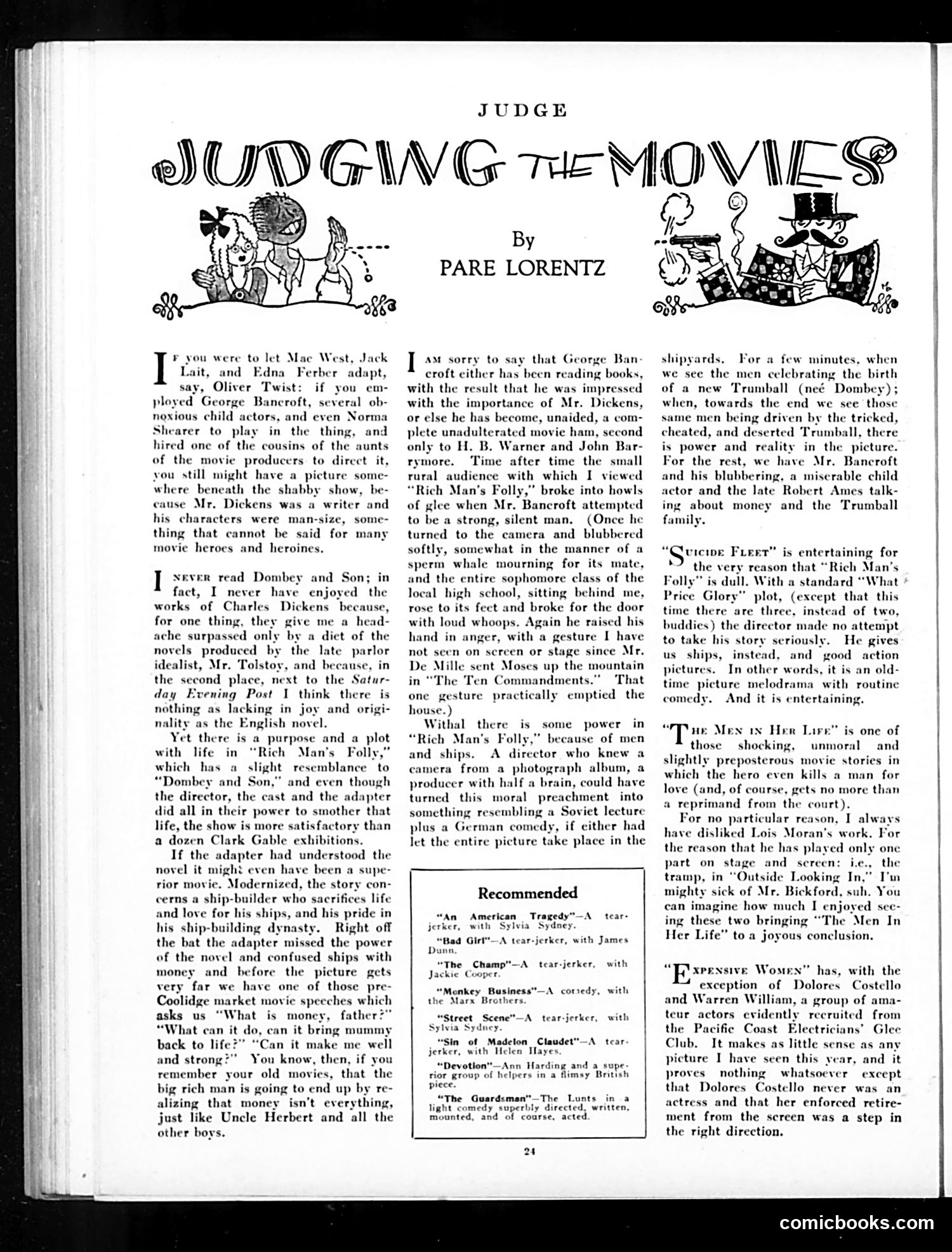
A restored page from Judge, 1931-12-19. Page through the whole issue in the reader above.
📄 Transcribed text from this page (OCR, searchable)
Machine-transcribed from the original scan — historical spelling and the odd misread are preserved.
SAD SSS SSIS eee F you were > West, Jack I Lait, and rber adapt, say, Oliver Twist: if you em- ployed George Bancroft, several ob- noxious child actors, and even Norma Shearer to play in the thing, and hired one of the cousins of the aunts of the movie producers to direct it, you still might have a picture some- where beneath the shabby show, be- cause Mr. Dickens was a writer and his characters were man-size, some- thing that cannot be said for many movie heroes and heroines. never read Dombey and Son; in fact, I ne enjoyed the works of Charles Dickens because, for one thing, they give me a head- ache surpassed only by a dict of the novels produced by the late parlor idealist, Mr. Tolstoy, and because, in the second place, next to the Satur- day Evening Post 1 think there is nothing as lacking in joy and origi- nality as the English novel. Yet there is a purpose and a plot with life in “Rich Man's Folly,” which has a slight resemblance to “Dombey and Son,” and even though the director, the cast and the adapter did all in their power to smother that life, the show is more satisfactory than a dozen Clark Gable exhibitions. If the adapter had understood the novel it might even have been a supe- rior movie. Modernized, the story con- cerns a ship-builder who sacrifices life and love for his ships, and his pride in his ship-building dy: y. Right off the bat the adapter missed the power of the novel and confused ships with money and before the picture gets very far we have one of those pre- Coolidge market movie speeches which asks us “What is money, father?” “What can it do, can it bring mummy back to life?” “Can it make me well and strong?" You know, then, if you remember your old movies, that the big rich man is going to end up by re- alizing that money isn’t everything, just like Uncle Herbert and all the other boys. JUDGE I AM sorry to say that ( croft either has been reading books, with the result that he was impressed with the importance of Mr. Dickens, or else he has become, unaided, a com- plete unadulterated movie ham, second only to H. B. Warner and John Bar- rymore. Time after time the small rural audience with which I viewed “Rich Man's Folly,” broke into howls of glee when Mr. Bancroft attempted to be a strong, silent man, (Once he turned to the camera and blubbered softly, somewhat in the manner of a sperm whale mourning for its mate, and the entire sophomore class of the local high school, sitting behind me, rose to its feet and broke for the door with loud whoops. Again he raised his hand in anger, with a gesture I have not seen on screen or stage since Mr. De Mille sent Moses up the mountain in “The Ten Commandments.” That one gesture practically emptied the house.) Wit is some power in “Rich Man's Folly,” because of men and ships. A director who knew a camera from a photograph album, a producer with half a brain, could have turned this moral preachment into something resembling a Soviet lecture plus a German comedy, if cither had let the entire picture take place in the Recommended “An American Tragedy” jerker, with Sylvia Sydney. “Bad Girt"—A tear-jerker, with James Dunn, A tears “The Champ"—A_ tear-jerker, with Jackie Cooper. “Monkey Business"—A corsedy, with the Marx Brothers, “Street Scene"—A tear-jerker, with elon Claudet"—A tear. | len Hayes. “Devotion"—Ann Harding and a supe- rior group of helpers in a flimsy British piece. “The Guardsman”—The Lunts in a medy superbly directed, written, mounted, and of course, acted. 4 shipyards. For a few minutes, when we see the men celebrating the birth of a new Trumball (neé Dombey) ; when, towards the end we see those same men being driven by the tricked, cheated, and deserted Trumball, there is power and reality in the picture. For the rest, we have Mr. Bancroft and his blubbering, a miserable child actor and the late Robert Ames talk- about money and the Trumball family. vicioe Freer” is entertaining for the very reason that “Rich Man's is dull. With a standard “What plot, time there are three, instead of two, buddies) the director made no attempt to take his story seriously. He gives us ships, instead, and good action pictures. In other words, it is an old- time picture melodrama with routine comedy. And it is entertaining. Hy ‘Tne Men ix Her Lire” is one of those shocking, unmoral and slightly preposterous movie stories in which the hero even kills a man for love (and, of course, gets no more than a reprimand from the court). the reason that he has played on part on stage and screen: i tramp, in “Outside Lookin, mighty sick of Mr. Bickford, suh. You can imagine how much I enjoyed see- ing these two bringing “The Men In Her Life” to a joyous conclusion. “Tl xpensive Women” has, with the M4 exces of Dolores Costello and Warren William, a group of ama- teur actors evidently reeruited from the Pacific Coast Electricians’ Glee Club. It makes as little sense as any picture I have seen this year, and it proves nothing whatsoever except that Dolores Costello never was an actress and that her enforced retire- ment from the sereen was a step in the right direction. 3 comicbooks.com