
Judge, 1931-12-19 · page 20 of 36
Judge — December 19, 1931 — page 20: what you’re looking at
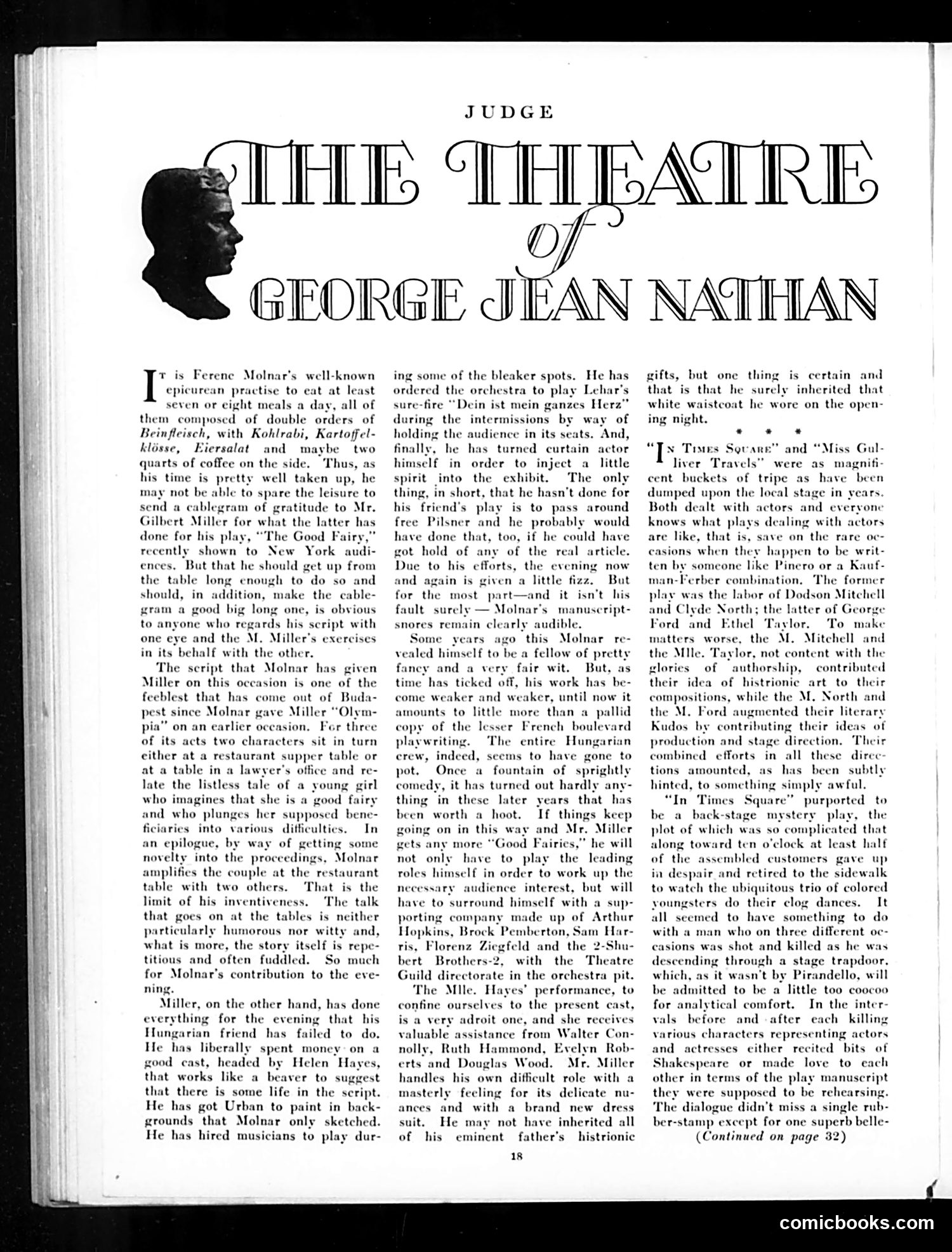
A restored page from Judge, 1931-12-19. Page through the whole issue in the reader above.
📄 Transcribed text from this page (OCR, searchable)
Machine-transcribed from the original scan — historical spelling and the odd misread are preserved.
t is Ferenc Molnar’s well-known epicurean practise to eat at least seven or eight meals a day, all of them composed of double orders of Beinfle with Kohlrabi, Kartoffel- klosse, Eiersalat’ and maybe two quarts of coffee on the side. Thus, as his time is pretty well taken up, he may not be able to spare the leisure to send a cablegram of gratitude to Mr. Gilbert Miller for what the latter has done for his play, “The Good Fairy,” recently shown to New York audi- ences, But that he should get up from the table long enough to do so and should, in addition, make the cable- gram a good big long one, is obvious to anyone who regards his script with one eye and the M. Miller’s exercises in its behalf with the other, The script that Molnar has given Miller on this occasion is one of the feeblest tl has come out of Buda- pest since Molnar gave Miller “Olym- pia” on an earlier occasion, For three of its acts two characters sit in turn either at a restaurant supper table or at a table in a lawyer's office late the listless tale of a young who imagines that she is a good f: 1 who plunges her supposed bene ies into various difficulties. In y of getting some novelty into the proceedings, Molnar amplifies the couple at the restaurant table with two others. That is the limit of his inventiveness. The talk that goes on at the es is neither particularly humorous nor witty and, what is more, the story itself is repe- titious and often fuddled. So much for Molnar’s contribution to the eve- ning. Miller, on the other hand, has done everything for the evening that his Hungari friend has failed to do. ly spent money: on ded by Helen Hayes, that works like a beaver to suggest that there is some life in the script. He has got Urban to paint in back- grounds that Molnar only sketched. He has hired musicians to play dur- fic an epilogue, by w JUDGE ing some of the bleaker spots. He has ordered the orchestra to play Lehar’s sure-fire “Dein ist mein ganzes Herz” during the intermissions by way of holding the audience in its seats. And, finally, he has turned curtain actor himself in order to inject a_ little spirit into the exhibit. The only thing, in short, that he hasn't done for his friend’s play is to pass around free Pilsner and he probably would have done that, too, if he could have got hold of any of the real articl Due to his efforts, the evening now and again is given a little fizz. But for the most part—and it isn’t his fault surely — Molnar’s manuseript- snores remain clearly audible. Some years ago this Molnar re- led himself to be a fellow of pretty and a very fair wit. But, as ed off, his work has be- come weaker and weaker, until now it amounts to little more than a pallid copy of the lesser French boulevard playwriting. The entire Hun crew, indeed, seems to have pot. Once a fountain of sprightly comedy, it has turned out hardly any- thing in these later years that has been worth a hoot. If things keep going on in this way and Mr. Miller gets any more “Good Fairies,” he will not oniy have to play the leading roles himself in order to work up the necessary audience interest, but will have to surround himself with a sup- porting company made up of Arthur Hopkins, Brock Pemberton, Sam Har- ris, Florenz Ziegfeld and the 2-Shu- bert Brothers with the Theatre Guild directorate in the orchestra pit. The Mile. Hayes’ performance, to confine ourselves to the present cast, droit one, and she re sistance from Walter Con- nolly, Ruth Hammond, elyn Rob- erts and Douglas Wood. Mr. Miller handles his own difficult role with a masterly feeling for its delicate nu- ances and with a brand new dress suit. He may not have inherited all of his eminent father’s histrionic 18 B THEATRE | GEORGE JEAN NATHAN gifts, but one thing is certain and that is that he surely inherited that white waistcoat he wore on the open- ing night. * * « “TS Times Sgvare” and “Miss Gul- liver Travels” were as rt iti cent buckets of tripe as dumped upon the local s Both dealt with actors knows what plays dealing are like, that is, save on the rare oc- casions when they happen to be writ- ten by someone like Pinero or a Kauf- man-Ferber combination, The former play was the labor of Dodson Mitchell and Clyde North; the latter of George Ford and Ethel Taylor, To make matters worse, the M. Mitchell and Mlle. Taylor, not content with the glories of “authorship, contributed their idea of histrionie art to their compositions, while the M. North and the M. Ford augmented their literary Kudos by contributing their ideas of production and stage direction. ‘Their combined efforts in all these direc tions amounted, as has been. subtly hinted, t awful, In Times Square” purported to be a back-stage mystery play, the plot of which was so complicated that along toward ten o'clock at least half of the assembled customers gave up in despair and retired to the sidew to watch the ubiquitous trio of colored youngsters do their clog dances. It all seemed to have something to do with a man who on three different oc- casions was shot and killed as he was descending through a stage trapdoor, which, as it wasn’t by Pirandello, will be admitted to be a little too coocoo for analytical comfort. In the inter- vals before and after th killing various characters representing actors f been ge in years. nd everyon: with actors something simply and actresses either r Shakespeare or made 1 other in terms of the play manuscript they were supposed to be rehearsing. The dialogue didn’t miss a single rub- ber-stamp except for one superb belle- (Continued on page 32) comicbooks.com