
Judge, 1931-12-19 · page 17 of 36
Judge — December 19, 1931 — page 17: what you’re looking at
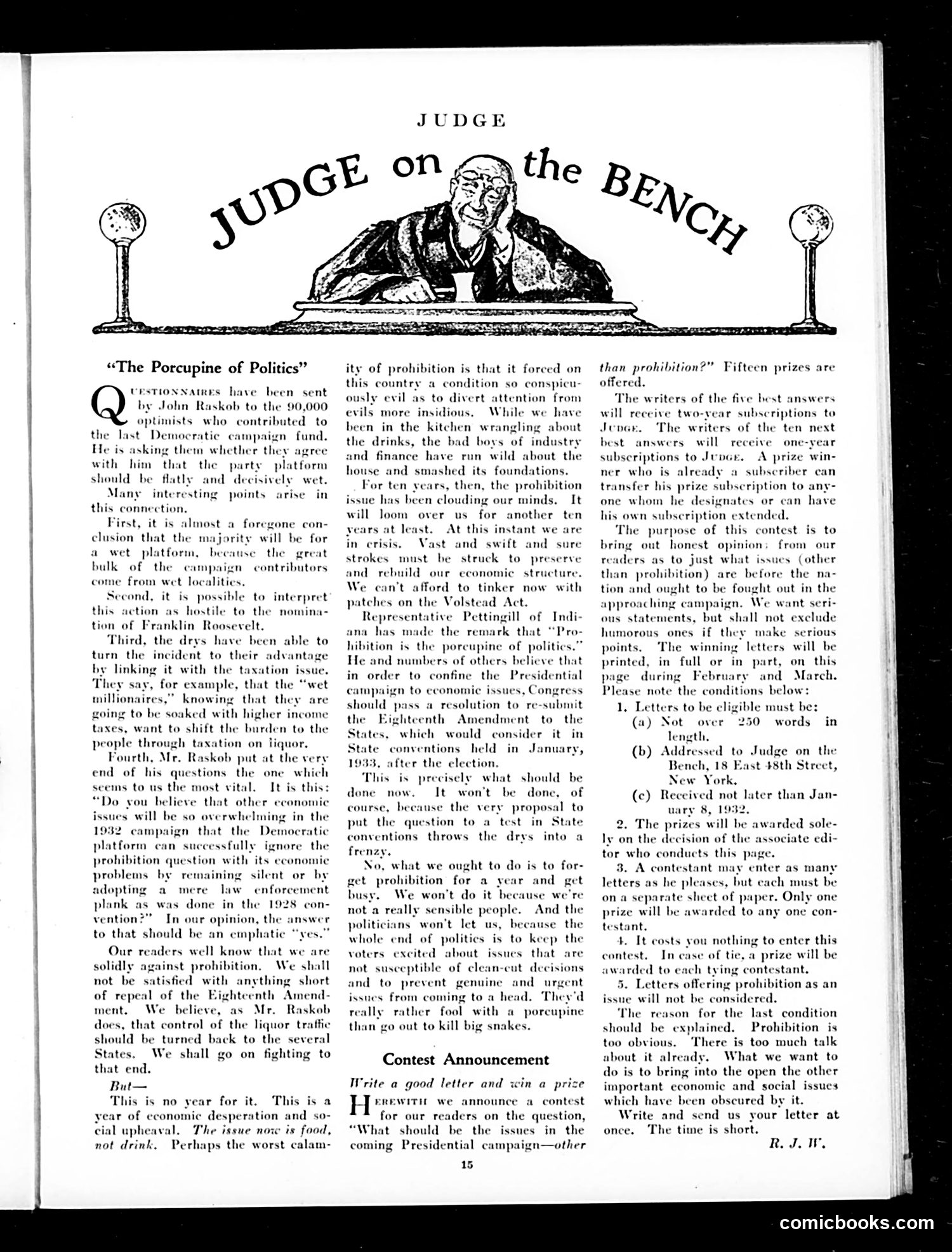
A restored page from Judge, 1931-12-19. Page through the whole issue in the reader above.
📄 Transcribed text from this page (OCR, searchable)
Machine-transcribed from the original scan — historical spelling and the odd misread are preserved.
JUDGE rs “The Porcupine of Politics” vestionNairtes have been sent by John Raskob to the 90,000 optimists who contributed to the last Democratic campaign fund. He is asking them whether they agree with him that the party platform should be flatly and decisively wet. Many interesting points arise in this connection. First, it is almost a foregone con- clusion that the majority will be for a wet platform, because the great bulk of the campaign contributors come from wet localities. Sec nd, it is possible to interpret this action as hostile to the nomina- tion of Franklin Roosevelt. Third, the drys have been able to turn the incident to their advantage by linking it with the taxation issue. They say, for example, that the “wet millionaires,” knowing t goin to be soaked with higher income taxes, want to shift the burden to the people through taxation on liquor, Fourth, Mr. Raskob put at the very end of his questions the one which seems tous the most vital. [tis this: Jo you believe that other ¢ issues will be so overwhelmir ronomic: in the 932 campaign that the Democratic platform can successfully ignore the prohibition question with its economic problems by remaining silent or by adopting a mere law enforcement plank as was done in the 1 vention?” In our opinion, th to that should be an emphatic “yes.” con- answer Our readers well know that we are solidly against prohibition, We shall not be satisfied with anything short of repeal of the Eighteenth Amend- ment. V believe, as Mr. Raskob does, that control of the liquor trattic should be turned back to the several States. We shall go on fighting to that end. But— This is no year of econom cial upheaval. not drink. Perhaps the worst calam- ar for it. This is a ¢ desperation and so- The issue now is food, SS ae ea ity of prohibition is that it forced on this country a condition so conspicu- ously evil as to divert attention from evils more insidious, While we have been in the kitchen wrangling about the drinks, the bad boys of industry and finance have run wild about the house and smashed its foundations. For ten years, then, the prohibition issue has been clouding our minds, It will loom over us for another ten y t least. At this instant we in ec Vast and swift and sure strokes must be struck to preserve re and rebuild our economic structure. We can’t afford to tinker now with patches on the Volstead Act. Representative Pettingill of Indi- ana has made the remark that “Pro- hibition is the porcupine of polities. He and numbers of others believe that in order to confine the Presidential campaign to economic issues, Congress should pass a resolution to re-submit the htcenth Amendment to the which would consider it’ in mventions held in J after the clection. This is precisely what should be done now. It won't be done, of course, because the very proposal to put the question to a test in’ State conventions throws the drys into a frenzy. . What we ought to do is to for- get prohibition for a year and busy. We won't do it because we're And the politicians won't let us, because the whole end of politics is to keep the voters excited about issues that are not susceptible of cle: and to prevent genuine and urgent issues from coming toa head. They'd really rather fool with a porcupine than go out to kill big snakes. uary, not a really sensible people. n-cut decisions Contest Announcement Write a good letter and Heer we announce a contest for our readers on the question, “What should be the issues in the coming Presidential campaign—other 15 in a prize than prohibition?” Fifteen prizes are offered. The writers of the five best answers will receive twe Jeper. ar subscriptions to The writers of the ten next best answers will receive one-year subscriptions to June. A prize win- ner who is already a subscriber c ny in have transfer his prize subscription to one whom he designates or his own subscription extended. The purpose of this contest is to bring out honest opinion; from our readers as to just what issues (other than prohibition) are before the na- tion and ought to be fought out in the approaching campaign. We want seri- ous statements, but shall not exclude nes if they make serious points. he winning letters will be printed, in full or in part, on this during February and March. e note the conditions below: + Letters to be eligible must be: (a) Not over 0 words in length, (b) Addressed to Judge on the Bench, 18 East 48th Street, New York, (c) Received not later than Jan- uary 8, 1 The prizes will be awarded sole- ly on the decision of the associate edi- tor who conducts this ps humorous 3. A contestant may enter as many letters as he pleases, but cach must be ona separate sheet of paper. Only one prize will be awarded to any one con- testant. +. It costs you nothing to enter this contest. In case of tie, a prize will be awarded to each tying contestant. 5. Letters offering prohibition as an issue will not be considered. The reason the last condition should be explained. Prohibition is too obvious. There is too much talk about it already. What we want to do is to bring into the open the other important economic and social issues which have been obscured by it. Write and send us your letter at The time is short. R. once. WW, comicbooks.com