
Judge, 1931-12-12 · page 26 of 36
Judge — December 12, 1931 — page 26: what you’re looking at
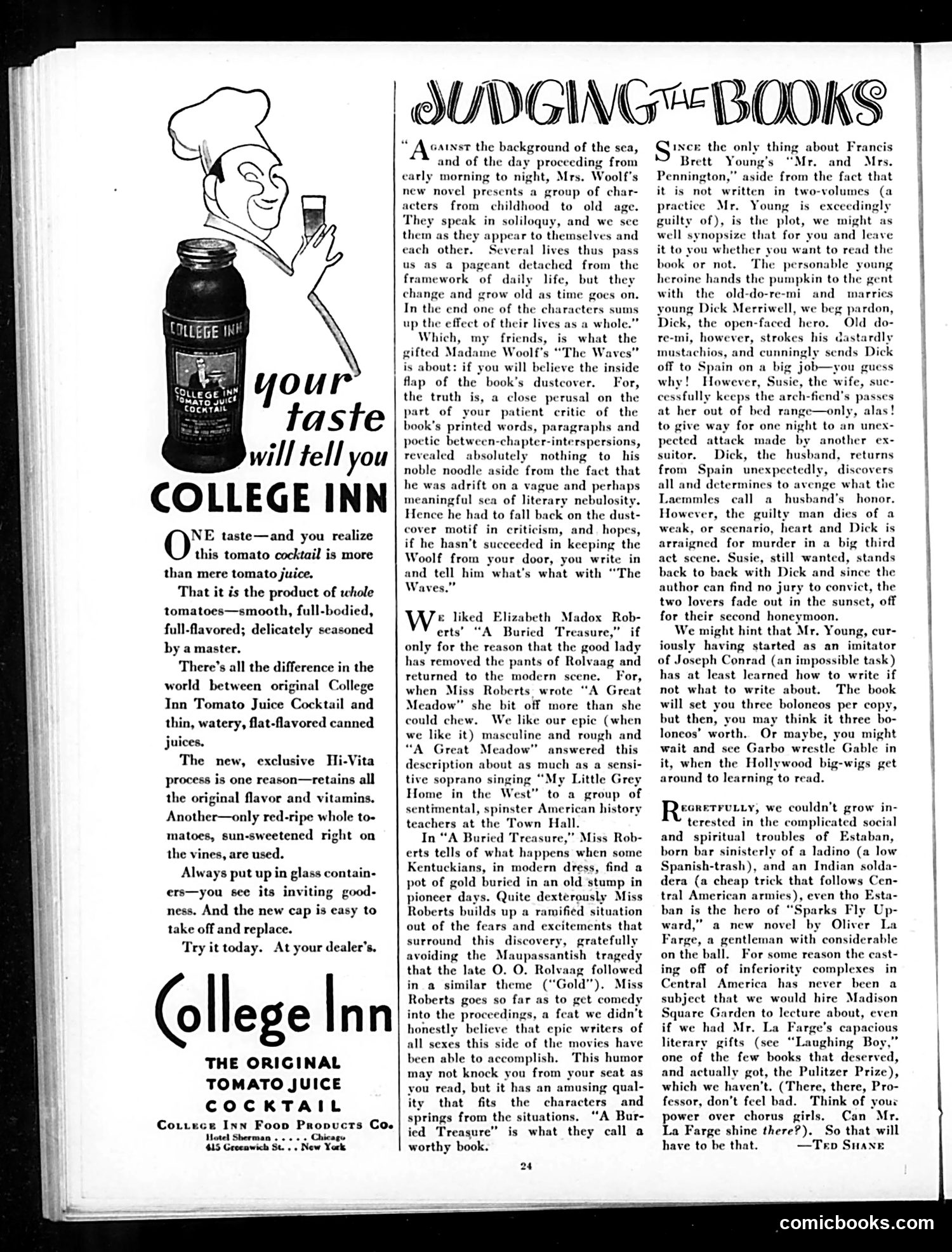
A restored page from Judge, 1931-12-12. Page through the whole issue in the reader above.
📄 Transcribed text from this page (OCR, searchable)
Machine-transcribed from the original scan — historical spelling and the odd misread are preserved.
aS aes will fell you COLLEGE INN O E taste—and you realize this tomato cocktail is more than mere tomato juice. That it is the product of whole tomatoes—smooth, full-bodied, full-flavored; delicately seasoned by a master. There's all the difference in the world between original College Inn Tomato Juice Cocktail and thin, watery, flat-flavored canned juices. The new, exclusive Hi-Vita process is one reason—retains all the original flavor and vitamins. Another—only red-ripe whole to- matoes, sun-sweetened right on the vines, are used. Always put up in glass contain- ers—you see its inviting good- ness. And the new cap is easy to take off and replace. Try it today. At your dealer's. College Inn THE ORIGINAL TOMATO JUICE COCKTAIL Co.tece Inn Foopo Propucts Co. Hotel Sherman + Chicage 415 Greenwich St... New York st the b: kground of the sca, nd of the day proceeding from x morning to night, Mrs. Woolf's new novel presents a group of char- acters from childhood to old age. They speak in soliloquy, and we sce them as they appear to themselves and cach other. Several lives thus pass us as a pageant detached from the framework of daily life, but. they change and grow old as time gocs on. In the end one of th aracters sums up the effect of their | whole.” Which, my friends, is what the gifted Madame Woolf's “The V is about: if you will believe the inside flap of the book's dustcover. For, the truth is, a close pe tusal on the part of your patient critic of the book’s printed words, paragraphs and poctic between-chapter-interspersions, revealed absolutely nothing to his noble noodle aside from the fact t he was adrift on a vague and perh meaningful sea of literary nebulosity. Hence he had to fall back on the dust- cover motif in criticism, and. hopes, if he hasn't succeeded in keeping the Woolf from your door, you write in and tell him what's what with “The Waves.” W: liked Elizabeth Madox Rob- erts’ “A Buried Treasure,” if only for the reason that the good lady has removed the pants of Rolvaag and returned to the modern scene. For, when Miss Roberts. wrote “A Great Meadow” she bit off more than she could chew. We like our epic (when we like it) masculine and rough and “A Great Meadow” answered this description about as much as a sensi- tive soprano singing “My Little Gri Home in the West” to a group of sentimental, spinster American history teachers at the Town Hall In “A Buried Treasure,” Miss Rob- erts tells of what happens when some Kentuckians, in modern dress, find a pot of gold buried in an old stump in pioneer day: ite dexterously M Roberts builds up a ramified situation out of the fears and excitements that surround this discov gratefully avoiding the Maupassantish tragedy that the late O. O. Rolvaag followed in a similar theme (“Gold”). Roberts goes so far as to get comedy into the proceedings, a feat we didn’t honestly believe that epic writers of all sexes this side of the movies have been able to accomplish. ‘This humor may not knock you from your seat as you read, but it has an amusing qual- ity that fits the characters and springs from the situations. “A Bur- ied Treasure” is what they call a worthy book. OUDGING™ BOOKS S nce the only thing about Francis Brett. Young’s “Mr. and Mrs. Pennington,” aside from the fact that it is not written in two-volumes (a practice Mr. Young is exceedingly guilty of), is the plot, we might as well synopsize that for you and leave it to you whether you want to read the book or not. The personable young heroine hands the pumpkin to the gent with the old-do-re-mi and marries young Dick Merriwell, we beg pardon, Dick, the open-faced hero, Old do- re-mi, however, strokes his dastardly mustachios, and cunningly sends Dick off to Spain on a big job—you guess why! However, Susie, the wife, suc- cessfully keeps the arch-fiend’s passes at her out of bed range—only, to give way for one night to an une pected attack made by another ex- suitor. Dick, the husband, returns from Spain unexpectedly, discovers all and determines to avenge what the Laemmles call a husband's honor. However, the guilty man dies of a weak, or scenario, heart and Dick is arraigned for murder in a big third act scene. Susie, still wanted, stands back to back with Dick and since the author can find no jury to convict, the two lovers fade out in the sunset, off for their second honeymoon. We might hint that Mr. Young, cur- iously having started as an imitator of Joseph Conrad (an impossible task) has at least learned how to write if not what to write about. The book will set you three boloneos per copy, but then, you may think it three bo- loneos’ worth. Or maybe, you might wait and sce Garbo wrestle Gable in it, when the Hollywood big-wigs get around to learning to read. R BRETFULLY, we couldn't grow in- terested in the complicated social and spiritual troubles of Estaban, born bar sinisterly of a ladino (a low Spanish-trash), and an Indian solda- dera (a cheap trick that follows Cen- tral American armies), even tho Esta- ban is the hero of “Sparks Fly Up- ward,” a new novel by Oliver La Farge, a gentleman with considerable on the ball. For some reason the cast- ing off of inferiority complexes in Central America has never been a subject that we would hire Madison Square Garden to lecture about, even if we had Mr. La Farge’s capacious literary gifts (see “Laughing Boy,” one of the few books that deserved, and actually got, the Pulitzer Prize), which we haven't. (There, there, Pro- fessor, don’t feel bad. Think of your power over chorus girls. Can Mr. La Farge shine there?). So that will have to be that. —Tep Suane s! comicbooks.com