
Judge, 1931-12-12 · page 20 of 36
Judge — December 12, 1931 — page 20: what you’re looking at
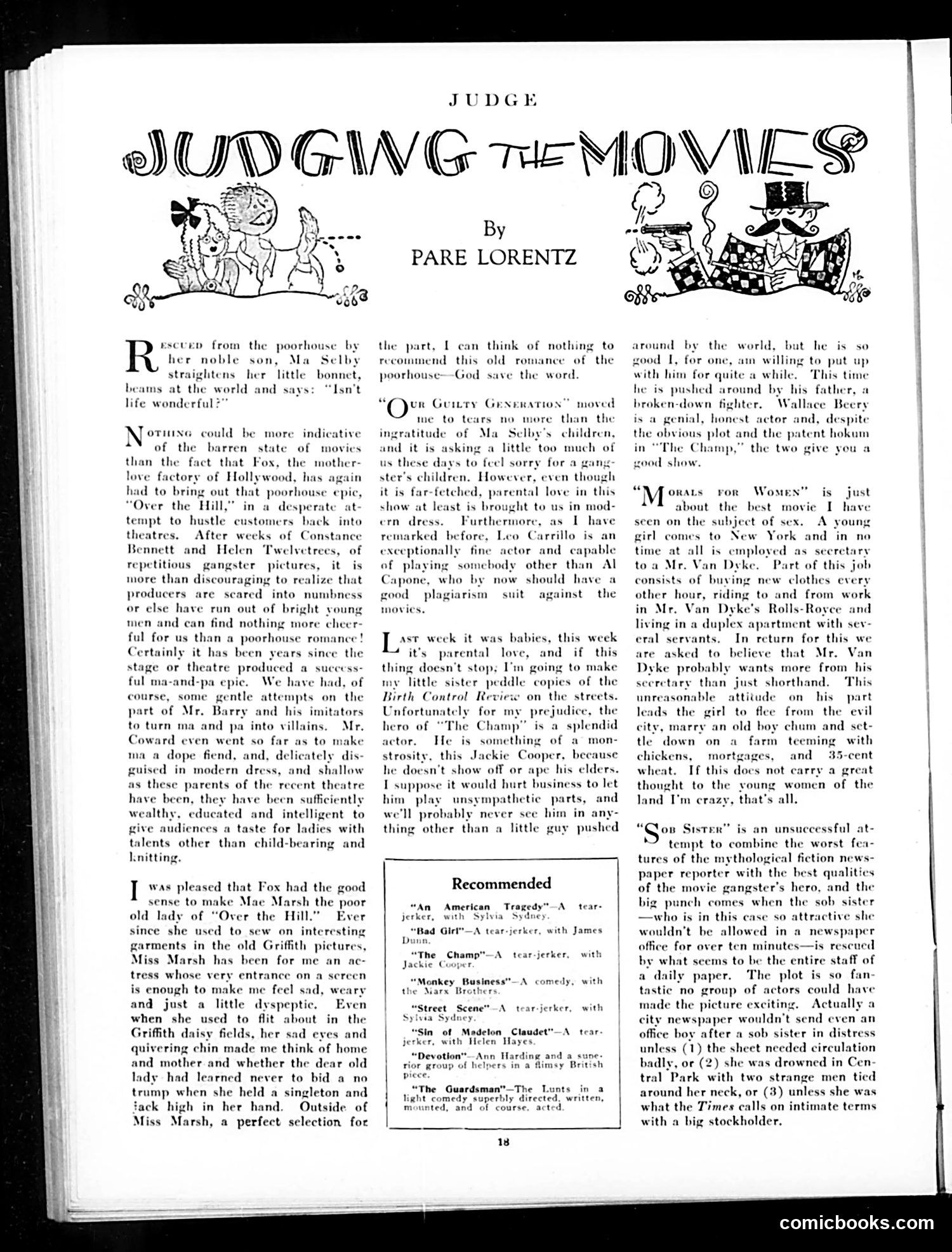
A restored page from Judge, 1931-12-12. Page through the whole issue in the reader above.
📄 Transcribed text from this page (OCR, searchable)
Machine-transcribed from the original scan — historical spelling and the odd misread are preserved.
) t rsevep from the poorhouse by her noble son, Ma Selby straightens her little bonnet, beams at the world and says: “Isn't life wonderful?” otmiNnG could be more indicative of the barren state of movies than the fact that Fox, the mother- love factory of Hollywood, has again had to bring out that poorhouse epic, “Over the Hill,” in a desperate at tempt to hustle customers back into theatres. After weeks of Constance Bennett and Helen Twelvetrees, of repetitious gangster pictures, it is more than discouraging to realize that producers are scared into numbness or else have run out of bright young men and can find nothing more cheer- ful for us than a poorhouse romance! Certainly it has been years since the stage or theatre produced a success- ful ma-and-pa epic. We have had, of course, some gentle attempts on the part of Mr. Barry and his imitators to turn ma and pa into villains. Mr. Coward even went so far as to 1 ma a dope fiend, and, delicately dis- guised in modern dress, and shallow as these parents of the recent th i tre have been, they have been sufficiently wealthy, educated and intelligent. to give audiences te for ladies with talents other ths knitting. I was pleased that Fox had the good sense to make Mae Marsh the poor old lady of “Over the Hill.” Ever since she used to sew on interesting garments in the old Griffith pictures, Miss Marsh has been for me an ac- tress whose very entrance on a serecn is enough to make me feel sad, we: and just a little dyspeptic. child-t ng and ven when she used to flit about in the Griffith daisy fields, her sad eyes and quivering chin made me think of home and mother and whether the dear old Indy had learned never to bid a no trump when she held a singleton and jack high in her hand. Outside of Miss Marsh, a perfect selection for JUDGE the part, L can think of nothing to recommend this old romance of the poorhouse--God save the word. a ur Guirty Generation” moved me to tears no more than the ingratitude of Ma Selby's children, and it is asking a little too much of us these days to feel sorry for a gang ster’s children. However, even though it is far-fetched, parental love in this show at least is brought to us in mod- ern dress. Furthermore, as I have remarked before, Leo Carrillo is an exceptionally fine actor and capable ing somebody other than Al , who by now should have a good plagiarism — suit inst the movies. L’* week it was babies, this week it’s parental r, and if this thing doesn't stop, I'm going to make my little sister peddle copies of the Birth Control Review on the streets. Unfortunately for my prejudice, the hero of “The Champ” is a splendid actor. He is something of a mon- strosity, this J ie Cooper, because he doesn't show off or ape his elders. I suppose it would hurt business to let him play unsympathetic parts, and we'll probably never see him in any- thing other than a little guy pushed Recommended “An American Trai jerker, with Sylvia 3: “Bad Girt"—A tear-jerker, with James Dunn. A. tears “The Champ"—A_ tear-jerker, with Jackie Cooper “Monkey Business"—A comedy, with the Marx Brothers eet Scene"—A_ tear-jerker, with a Sydney in of Madelon Claudet"—A tear jerker, with Helen Hayes. “Devotion"—Ann Harding and a sune- rior group of helpers in a flimsy British “The Guardsman”—The Lunts in a {tight comedy superbly directed, written, m. course, acted. 13 OV te around by the world, but he is so good I, for one, am willing to put up with him for quite a while. This time he is pushed around by his father, a broken-down fighter. Wallace Beery is a genial, honest actor and, despite the obvious plot and the patent hokum in “The Champ,” the two give you a good show. a pats ror Women” is just M about the best movie I ha ren on the subject of sex. A young girl comes to New York and in no time at all is employed as seerctary toa Mr. Van Dyke. Part of this job consists of buying new clothes every other hour, riding to and from work in Mr. Van Dyke's Rolls-Royce and living ina duplex apartment with sev- eral servants. In return for this we are asked to believe that Mr. Van Dyke probably wants more from his seeretary than just shorthand. ‘This unreason. attitude on his part leads the girl to flee from the evil city, marry an old boy chum and set- tle down on farm t with chickens, — mor wheat. If this docs not carry a gr thought to the young women of the land I'm crazy, that's all, “Se Sister” is an unsuccessful at- tempt to combine the worst fea- tures of the mythological fiction news- paper reporter with the best qualities of the movie ngster’s hero, and the big punch comes when the sob sister —who is in this case so attractive she wouldn't be allowed in a newspaper office for over ten minutes—is rescued by what scems to be the entire staff of daily paper. The plot is so tastic no group of actors could have de the picture exciting, Actually y newspaper wouldn't send even office boy after a sob sister in distress unless (1) the sheet needed circulation badly, or (2) she was drowned in Cen tral Park with two strange men tied around her neck, or (3) unless she was what the Times calls on intimate terms with a big stockholder. comicbooks.com