
Judge, 1931-12-12 · page 18 of 36
Judge — December 12, 1931 — page 18: what you’re looking at
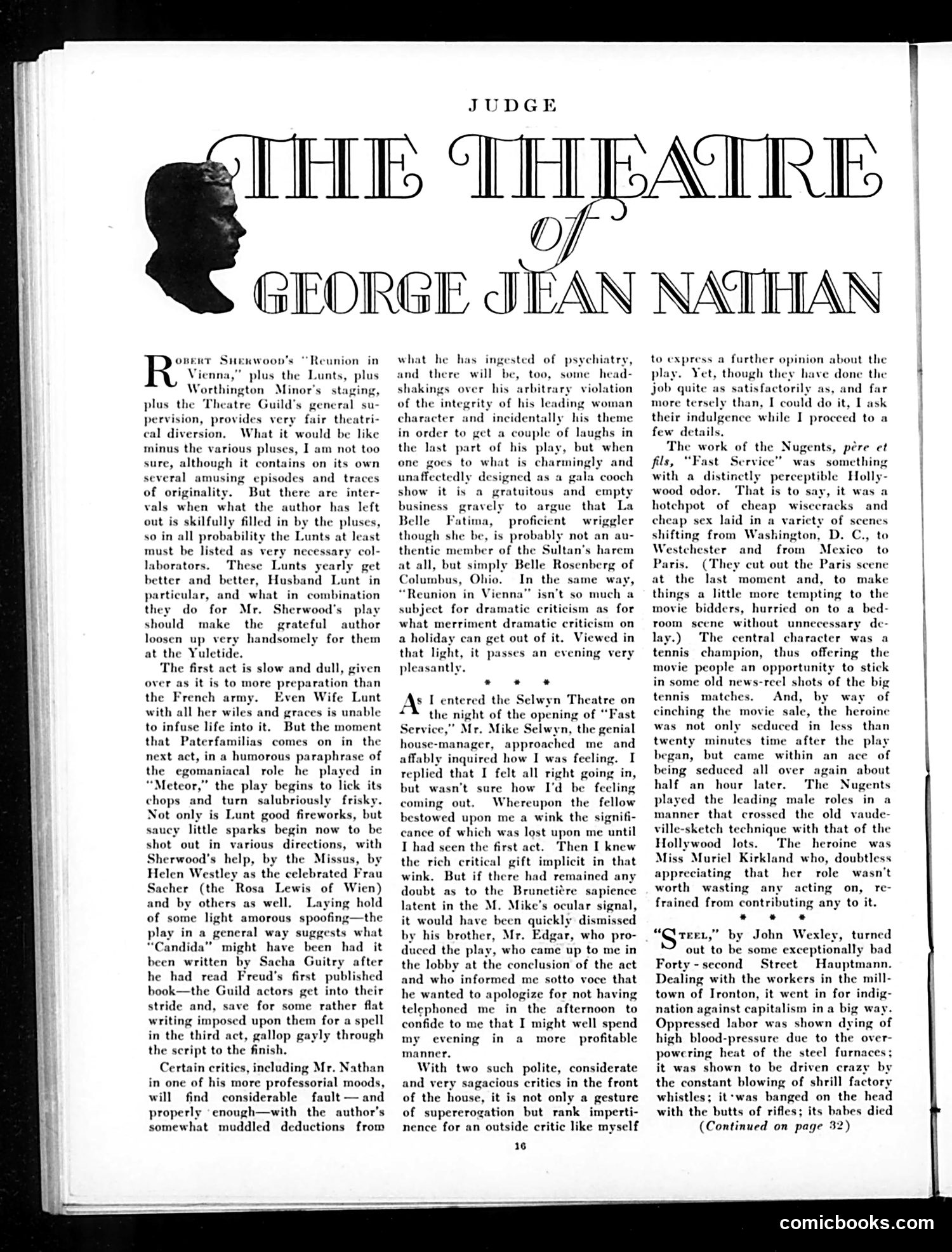
A restored page from Judge, 1931-12-12. Page through the whole issue in the reader above.
📄 Transcribed text from this page (OCR, searchable)
Machine-transcribed from the original scan — historical spelling and the odd misread are preserved.
~ oe a — a nenemenemenaedadl onert Siexwooo's “Reunion in R Vienna,” plus the Lunts, plus Worthington Minor's staging, plus the Theatre Guild's general su- pervision, provides very fair theatri- cal diversion. What it would be like minus the various pluses, I am not too sure, although it contains on its own several amusing episodes and traces of originality. But there are inter- vals when what the author has left out is skilfully filled in by the pluses, so in all probability the Lunts at least must be listed as very necessary col- laborators. These Lunts yearly get better and better, Husband Lunt in particular, and what in combination they do for Mr. Sherwood’s play should make the grateful author loosen up very handsomely for them at the Yuletid The first act is slow and dull, given over as it is to more preparation than the French army. Even Wife Lunt with all her wiles and graces is unable to infuse life into it. But the moment that Paterfamilias comes on in the next act, in a humorous paraphrase of the egomaniacal role he played in “Meteor,” the play begins to lick its chops and turn salubriously frisky. Not only is Lunt good fireworks, but saucy little sparks begin now to be shot out in various directions, with Sherwood’s help, by the Missus, by Helen Westley as the celebrated Sacher (the Rosa Lewis of Wien) and by others as well. Laying hold of some light amorous spoofing—the play in a general way suggests what “Candida” might have been had it been written by Sacha Guitry after he had read Freud's first published book—the Guild actors get into their stride and, save for some rather flat writing imposed upon them for a spell in the third act, gallop gayly through the script to the finish. Certain critics, including Mr. Nathan in one of his more professorial moods, will find considerable fault — and properly ‘enough—with the author's somewhat muddled deductions from JUDGE gl ans GEORGE JEAN NATHAN what he has ingested of psyc s and there will be, too, some head- shakings over his arbitrary violation of the integrity of his leading woman character and incidentally his theme in order to get a couple of laughs in the last part of his play, but when one goes to what is charmingly and unaffectedly designed as a gala cooch show it is a gratuitous and empty business gravely to argue that La Belle Fa wriggler though she bi not an au- thentic member of the Sultan’s harem at all, but simply Belle Rosenberg of Columbus, Ohio. In the same way, “Reunion in Vienna” isn’t so much a subject for dramatic criticism as for what merriment dramatic cri a holiday can get out of it. Viewed in that light, it passes an evening very pleasantly. iatry, -_ * As I entered the Selwyn Theatre on 4 night of the opening of “Fast 5 Mr. Mike Selwyn, the genial house-manager, approached me and affably inquired how I was feeling. I replied that I felt all right going in, but wasn’t sure how I'd be feeling coming out. Whereupon the fellow bestowed upon me a wink the signifi cance of which was lost upon me un I had seen the first Then I knew the rich critical gi wink. But if there had r doubt as to the Brunet it would have been quickly by his brother, Mr. Edgar, who pro- duced the play, who came up to me in the lobby at the conclusion of the act and who informed me sotto voce that he wanted to apologize for not having telephoned me in the afternoon to confide to me that I might well spend my evening in a more profitable manner. With two such polite, considerate and very sagacious critics in the front of the house, it is not only a gesture of supererogation but rank imperti- nence for an outside critic like myself 16 to express a further opinion about the play. Yet, though they have done the job quite as satisfactorily as, and far more tersely than, I could do it, I ask their indulgence while I proceed to a few details. The work of the Nugents, pére et fils, “Fast Service” was something with a distinctly perceptible Holly- wood odor. That is to say, it was a hotchpot of cheap wisecracks and cheap sex laid in a variety of scenes shifting from Washington, D. C., to Westchester and from Mexico to Paris. (They cut out the Paris scene at the last moment and, to make things a little more tempting to the movie bidders, hurried on to a bed- room scene without unnecessary de- lay.) The central cha cr was a tennis champion, thus offering the movie people an opportunity to stick in some old news-reel shots of the big tennis matches. And, by of cinching the movie sale, the heroine was not only seduced in less than twenty minutes time after the play began, but came within e of being seduced all over in about half an hour later. The Nugents played the leading male roles in a manner that crossed the old vaude- ville-sketch technique with that of the Hollywood lots. The heroine was Miss Muriel Kirkland who, doubtless appre: that her role wasn't worth wasting any acting on, re- frained from contributing any to it. * * « “Green,” by John Wexley, turned out to be some exceptionally bad Forty-second Street Hauptmann. Dealing with the workers in the mill- town of Ironton, it went in for indig- nation against capitalism ina big way. Oppressed labor was shown dying of high blood-pressure due to the over- powcring heat of the steel furnaces; it was shown to be driven crazy by the constant blowing of shrill factory whistles; it‘was banged on the head with the butts of rifles; its babes died (Continued on page 32) comicbooks.com