
Judge, 1931-12-12 · page 15 of 36
Judge — December 12, 1931 — page 15: what you’re looking at
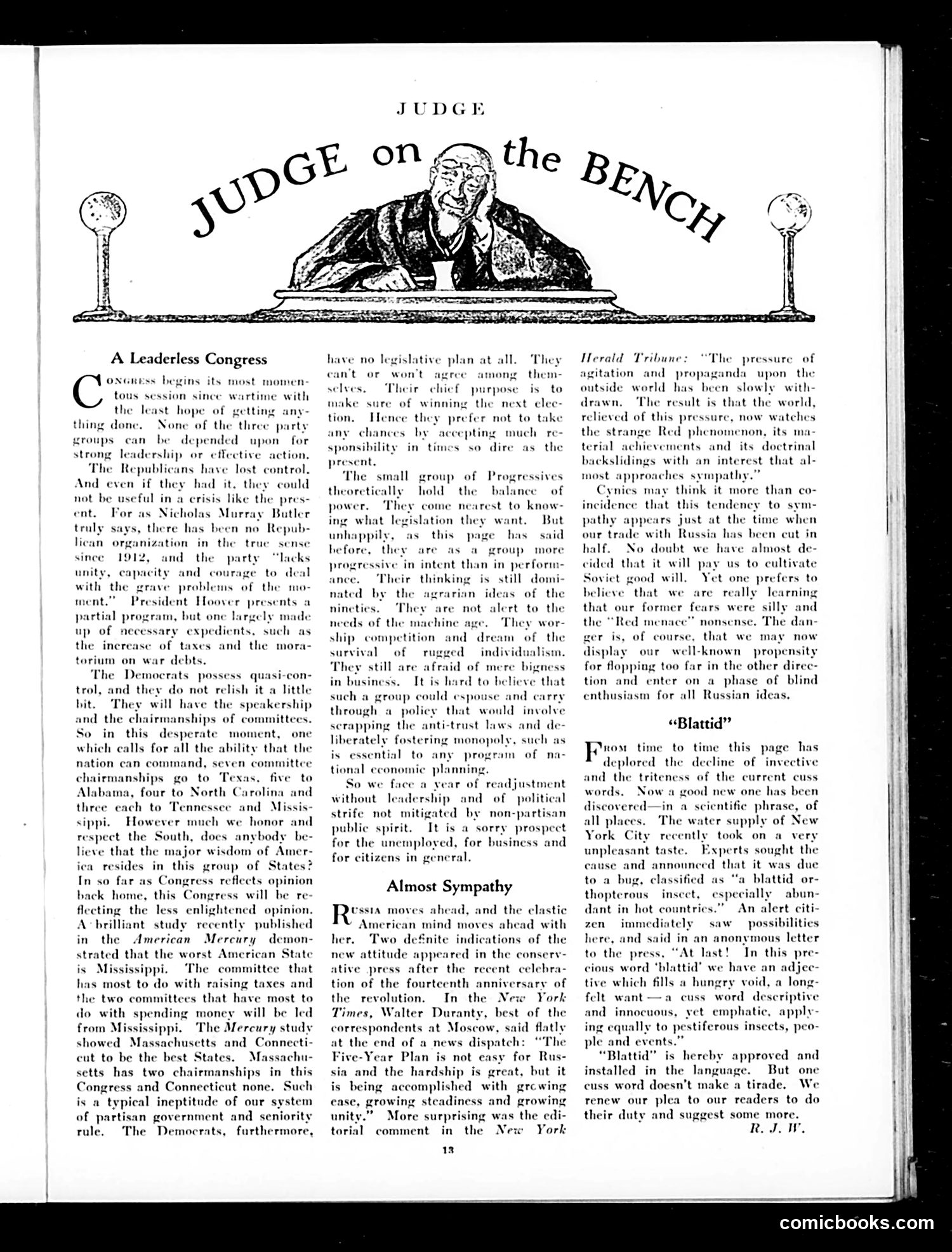
A restored page from Judge, 1931-12-12. Page through the whole issue in the reader above.
📄 Transcribed text from this page (OCR, searchable)
Machine-transcribed from the original scan — historical spelling and the odd misread are preserved.
JUDGE A Leaderless Congress ONGKESS begins its most momen- tous session since wartime with the least hope of getting any- thing done. None of the three party groups can be depended upon for strong leadership or effectiv ction. The Republicans have lost control. And even if they had it. they could not be useful in a crisis like the pres- ent. For as Nicholas Murray Butler truly says, there has been no Repub- lican organization in the true sense and the party “lacks dd courage to deal with the ave problems of the aw ment.” President Hoover presents a partial program, but one largely made up of necessary expedients, such as the increase of taxes and the mora- torium on war debts. The Demo trol, and they do not relish it a little hit. They will have the speakership and the chairmanships of committees. So in this desperate moment, one which calls for all the ability that the nation can command, seven committee since 1 unity, ¢ ats possess quasi-con- chairmanships go to Texas, five to Alabama, four to North Carolina and three each to Tennessee Missis- sippi. However much we honor and respect the South, does anybody be- lieve that the major wisdom of Amer- ica resides in this group of States? In so far as Congress reflects opinion back home, this Congress will flecting the less enlightened opinion, Avbrilliant study recently published in the American Mercury demon- strated that the worst American St is Mississippi. The committee that has most to do with raising taxes and the two committees that have most to do with spending money will be led from Mississippi. The Mercury study showed Massachusetts and Connecti- cut to be the best States. Ma hu- setts has two chairmanships in this Congress and Connecticut none. Such is a typical ineptitude of our system of partisan government and seniority tule. The Democrats, furthermore, have no legislative plan at all. They can’t or won't © among them- selves. Their chief purpose is to make sure of winning the next elec- tion, Hence they prefer not to take any chances by accepting much re- sponsibility in times so dire as the present. The small group of Progressives theoretically hold) the balance of power. ‘They come nearest to know- ing what legislation they want. But unhappily, as. this p: hefore, they are as a. group more ressive in intent than in perform Their thinking is still domi- nated by the agrarian ideas of the nineties. They are not alert to the needs of the machine They wor- ship competition and dream of the survival of rugged — individualism. They still are af in business. It is hard to believe that such a group could espouse and carry through a policy that would involve scrapping the anti-trust laws and de- liberately fosterin is essent monopoly, such as } to any program of na- inning. So we face a year of readjustment Without leadership and of political strife not mitigated by non-partisan public spirit. It is a sorry prospect for the unemployed, for business and for citizens in general. tional economic ] Almost Sympathy Re moves ahead, and the elastic American mind moves ahead with her. Two de&nite indications of the new attitude appeared in the conserv- ative press after the rec nt celebra- tion of the fourteenth anniversary of the revolution. In the New York Times, Walter Duranty, best of the correspondents at Moscow, said flatly at the end of a news dispatch: “The Five-Year Plan is not y for Rus- sia and the hardship is great, but it is being accomplished with grewing ease, growing steadiness and growing unit More surprising was the edi- il comment in the New York 18 Herald Tribune: tion and propaganda upon the outside world has been slowly with- drawn, The result is that the world, relieved of this pressurc, now watches the strange Red phenomenon, its ma- terial achievements and its doctrinal backslidings with an interest that al- most approaches sympathy. Cynics may think it mor incidence that this tendeney to sym- pathy appears just at the time when our trade with Russia has been cut in half. No doubt we have almost de- cided that it will pay us to cultivate Soviet good will, Yet one prefers to helieve that we are really learning that our former fears were silly and the “Red menace” nonsense, The dan- ger is, of course, that we may now display our well-known propensity for flopping too far in the other direc- tion and enter on a phase of blind enthusiasm for all Russian ideas, “Blattid” Fr time to time this page has deplored the decline of invective and the trite words. Now “The pressure of than co- ess of the current cuss good n ne has been red—in a scientific phrase, of The water supply of New York City recently took on a very unpleasant taste. Experts sought the cause and announced that it was due to a bug, classified as “a blattid or- thopterous — inse ally abun- dant in hot countries.” An alert citi- zen immediately saw possibilit here, and said in an anonymous letter to the press, “At last! In this pre- cious word ‘blattid’ we have an adjec- tive which fills a hungry void, a long- felt. want —a_ cuss word descriptive and innocuous, yet emphatic, apply- ing equally to pestiferous insects, p ple and events.” “Blattid” is hereby approved and installed in the language. But one cuss word doesn’t ma tirade. We renew our plea to our readers to do their duty and suggest some more. , RJ. WV. s comicbooks.com