
Judge, 1931-11-07 · page 18 of 36
Judge — November 7, 1931 — page 18: what you’re looking at
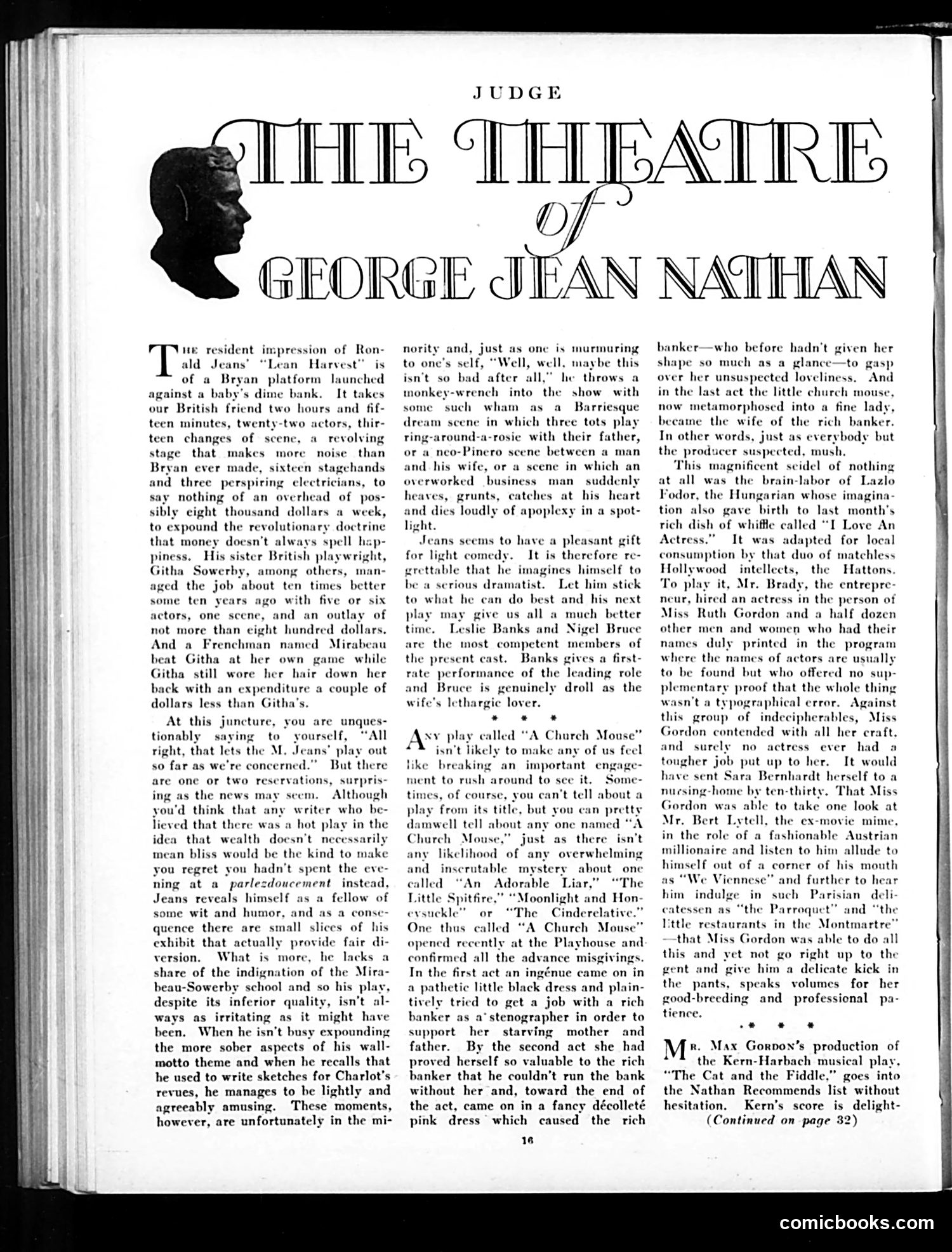
A restored page from Judge, 1931-11-07. Page through the whole issue in the reader above.
📄 Transcribed text from this page (OCR, searchable)
Machine-transcribed from the original scan — historical spelling and the odd misread are preserved.
JUDGE lie GEORGE J ite resident impression of Ron- Tia Jeans’ “Lean Harvest” is of a Bryan platform launched against a baby’s dime bank. It takes our British friend two hours and fif- teen minutes, twenty-two actors, thir- teen changes of scene, a revolving stage that makes more noise than Bryan ever made, sixteen stagehands and three perspiring electricians, to say nothing of an overhead of pos- sibly eight thousand dollars a week, to expound the revolutionary doctrine that money doesn’t always spell hap- piness. His sister British p! Githa Sowert wright, , among others, m aged the job about ten times better some ten years ago with five or six actors, one scene, and an outlay of not more than eight hundred dollars. And a Frenchman named Mirab beat Githa at her own game wi Githa still wore her hair down her back with an expenditure a couple of dollars less than Githa’s. At this juncture, you are unques- tionably saying to” yourself, “All right, that lets the M. Jeans’ play out so far as we'r But there are one or two reservations, surpris- ing as the news may seem. Although you'd think that any writer who be- lieved that there was a hot play in the idea that wealth doesn’t necessarily mean bliss would be the kind to make you regret you hadn't spent the eve- at a parlezdoucement instead, Jeans reveals himself as a fellow of some wit and humor, and as a conse- quence there are small slices of his exhibit that actually provide fair di- version. What is more, he lacks a share of the indignation of the Mira- beau-Sowerby school and so his play, despite its inferior quality, isn’t al- ways as irritating as it might have been. When he isn’t busy expounding the more sober aspects of his wall- motto theme and when he recalls that he used to write sketches for Charlot’s revues, he manages to be lightly and agreeably amusing. These moments, however, are unfortunately in the mi- concerned,” 0; nority and, just as one is murmuring to one’s self, “Well, well, maybe this isn't so bad after all,” he throws a monkey-wrench into the show with some ‘such wham as a Barriesque dream scene in which three tots play ring-around-a-rosie with their father, or a neo-Pinero scene between and his wife, or a scene in which an overworked business. man suddenly heaves, grunts, catches at his heart and dies loudly of apoplexy in a spot- lig Jeans seems to have a pleasant gift for light comedy. It is therefore re- grettable that he imagines himself to be a serious dramatist. Let him stick to what he can do best and his next may give us much better Leslie Banks » the most compe present cast. Banks gives a first- - performance of the leading role and Bruce is genuinely droll as the wife's lethargic lover. «ee Ap pls nt members of led “A Church Mouse” isn’t likely to make aking an. imports ment to rush around to see it. $ times, of course, you can't tell about a play from its title, but you can pretty damwell tell about any one named “A Church Mouse,” just as there isn’t ny likelihood of any overwhelming nd inscrutable mystery about one called “An Adorable Liar,” “The Little Spitfire.” “Moonlight and Hon- eysuckle” or “The Cinderelative.” One thus called “A Church Mouse” opened recently at the Playhouse and confirmed all the advance misgivings. In the first act an ingénue came on in a pathetic little black dress and pl tively tried to get a job with a rich banker as a‘ stenographer in order to support her starving mother and father. By the second act she had proved herself so valuable to the rich banker that he couldn’t run the bank without her and, toward the end of the act, came on in a fancy décolleté pink dress which caused the rich 16 AIRE | NATHAN banker—who before hadn't given her shape so much as a glance—to gasp over her unsuspected loveliness. And in the last act the little church mouse, now metamorphosed into a fine lady, became the wife of the rich banker. In other words, just as everybody but the producer suspected, mush, tion also gave birth to last month's rich dish of whiffle called “I Love An Actress.” It was adapted for local consumption by that duo of matchless Hollywood intellects, the Hattons. To play it, Mr. Brady, the entrepre- neur, hired an actress in the person of Miss Ruth Gordon and a half dozen other men and women who had their names duly printed in the prog where the names of actors are usually to be found but who offered no sup- plementary proof that the whole thing wasn't a typographical error. Against this group of indccipherables, Miss Gordon contended with all her craft. and surely no actress ever had a tougher job put up to her. It would e sent Sara Bernhardt herself to a ng-home by ten-thirty. That Miss tordon was able to take one look at Mr. Bert Lytell, the ex-movie mime, in the role of a fashionable Austrian millionaire and listen to him allude to himself out of a corner of his mouth as “We Viennese” and further to hear him indulge in such Parisian deli catessen as “the Parroquet” and “the little restaurants in the Montmartre” that Miss Gordon was able to do all this and yet not go right up to the gent and give him a delicate kick in the pants, speaks volumes for her good-breeding and professional pa- tience. -* 8 &@ Mr: Max Gorvon’s production of ‘s the Kern-Harbach musical play, “The Cat and the Fiddle,” goes into the Nathan Recommends list without hesitation. Kern’s score is delight- (Continued on page 32) comicbooks.com