
Judge, 1931-10-31 · page 8 of 36
Judge — October 31, 1931 — page 8: what you’re looking at
What you’re looking at
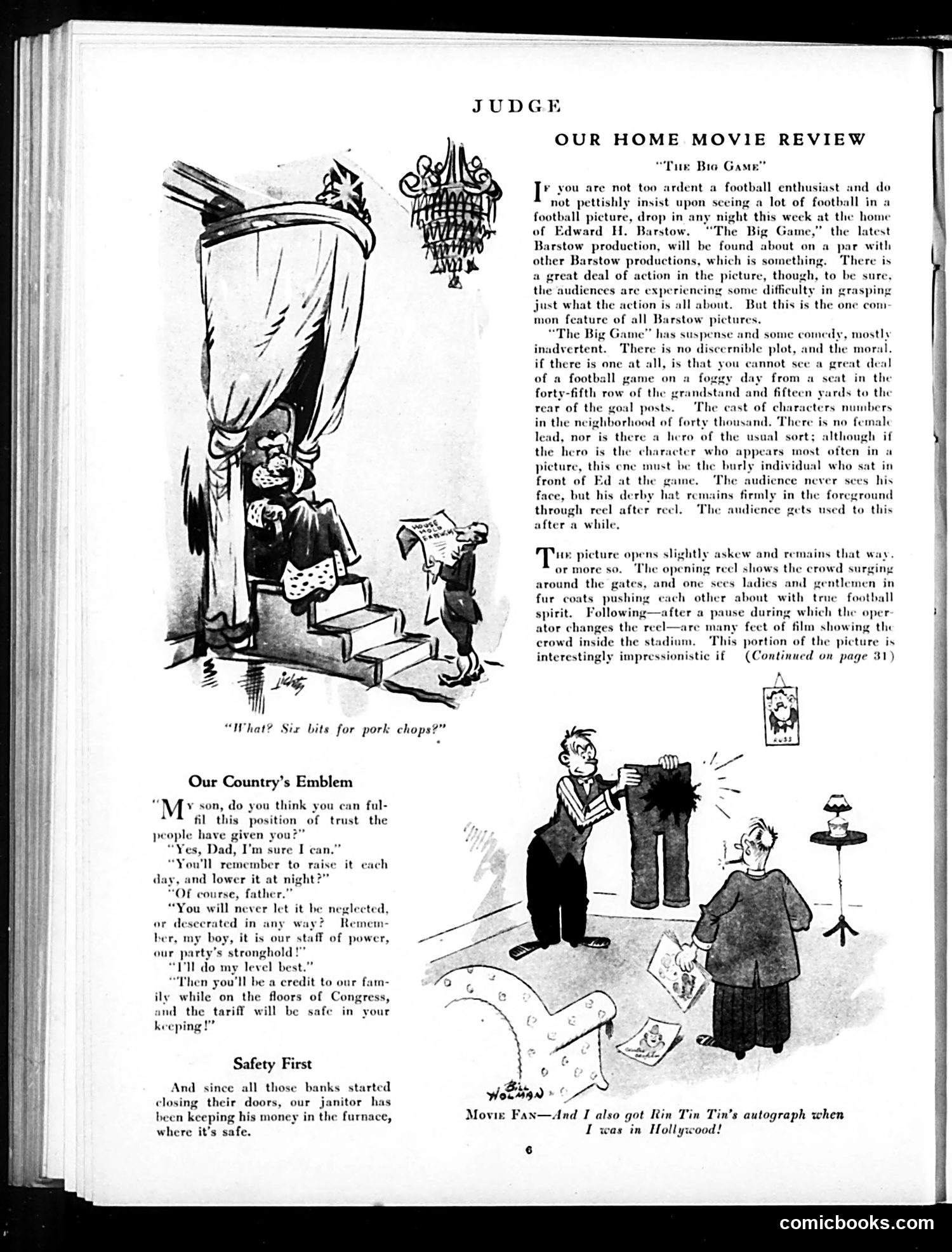
# Analysis of Judge Magazine Page This page contains three separate items: 1. **"The Big Game" movie review**: A critique of an Edward H. Barstow film about football. The review notes the picture lacks clear plot and moral instruction—common complaints about movies of this era. 2. **"What? Six bits for pork chops?"**: A cartoon showing a figure (appears to be Uncle Sam, based on the hat) shocked at prices, reflecting post-WWI inflation concerns that affected American consumers. 3. **"Our Country's Emblem" and "Safety First"**: A dialogue between father and son about patriotic duty and financial responsibility, alongside a cartoon about citizens keeping money "safe" in furnaces during bank closures—referencing the financial anxiety of the 1920s banking crisis period. The page reflects early 1920s American concerns: entertainment standards, economic inflation, and financial instability.
📄 Transcribed text from this page (OCR, searchable)
Machine-transcribed from the original scan — historical spelling and the odd misread are preserved.
Our Country’s Emblem “JY ¥ son, do you think you ean ful- AYE fil this position of trust the people have given you?” “Yes, Dad, I’m sure I can. “You'll remember tor: day, and lower it at night ‘Of course, father.” “You will never let it be neglected, or desecrated in any way? Remem- ber, my boy, it is our staff of power, our party’s stronghold!” “Tl do my level best.” “Then you'll be a credit to our fam- ily while on the floors of Congress, and the tariff will be safe in your keeping!” r it each Safety First And since all those banks started closing their doors, our janitor has been keeping his money in the furnace, where it’s safe. “What? Six bits for pork chops?” JUDGE Weeitgn 7 Movie Fan—And J also got Rin OUR HOME MOVIE REVIEW “Tue Bro Game” F you are not too ardent a football enthusiast and do not pettishly insist upon seeing a lot of football in a Il picture, drop in any night this week at the home of Edward H. Barstow, “The Big G. ” the latest Barstow production, will be found about on a par with other Barstow productions, which is something. There is a great deal of action in the picture, though, to be sure, the audiences are experiencing some difficulty in grasping just what the action is all about. But this is the one com mon feature of rstow pictures. § suspense and some comedy, mostly inadvertent. There is no discernible plot, and the moral. if there is one at all, is that you cannot sce a great deal of a football game on a f ; rat in the forty-fifth row of the grandstand and fifte rds to the rear of the goal posts. ‘The cast of ch: s numbers in the neighborhood of forty thousand, There is no femal lead, nor is there a hero of the usual sort; although if the hero is the character who appears most often picture, this ene must be the burly individual who sat in front of Ed at the game. The audience never sees his face, but his derby hat remains firmly in the foreground through reel after reel. The audience gets used to this after a while, tly askew and remains that way. or more so. ‘The opening reel shows the crowd surging around the gates, and one sees ladies and gentlemen in fur coats pushing each other about with true football spirit. Following—after a pause during which the oper ator changes the reel—are many fect of film showing the crowd inside the stadium, This portion of the picture is interestingly impressionistic if (Continued on page 31) ie picture opens sli "in Tin’s autograph when I was in Hollywood! comicbooks.com