
Judge, 1931-10-31 · page 18 of 36
Judge — October 31, 1931 — page 18: what you’re looking at
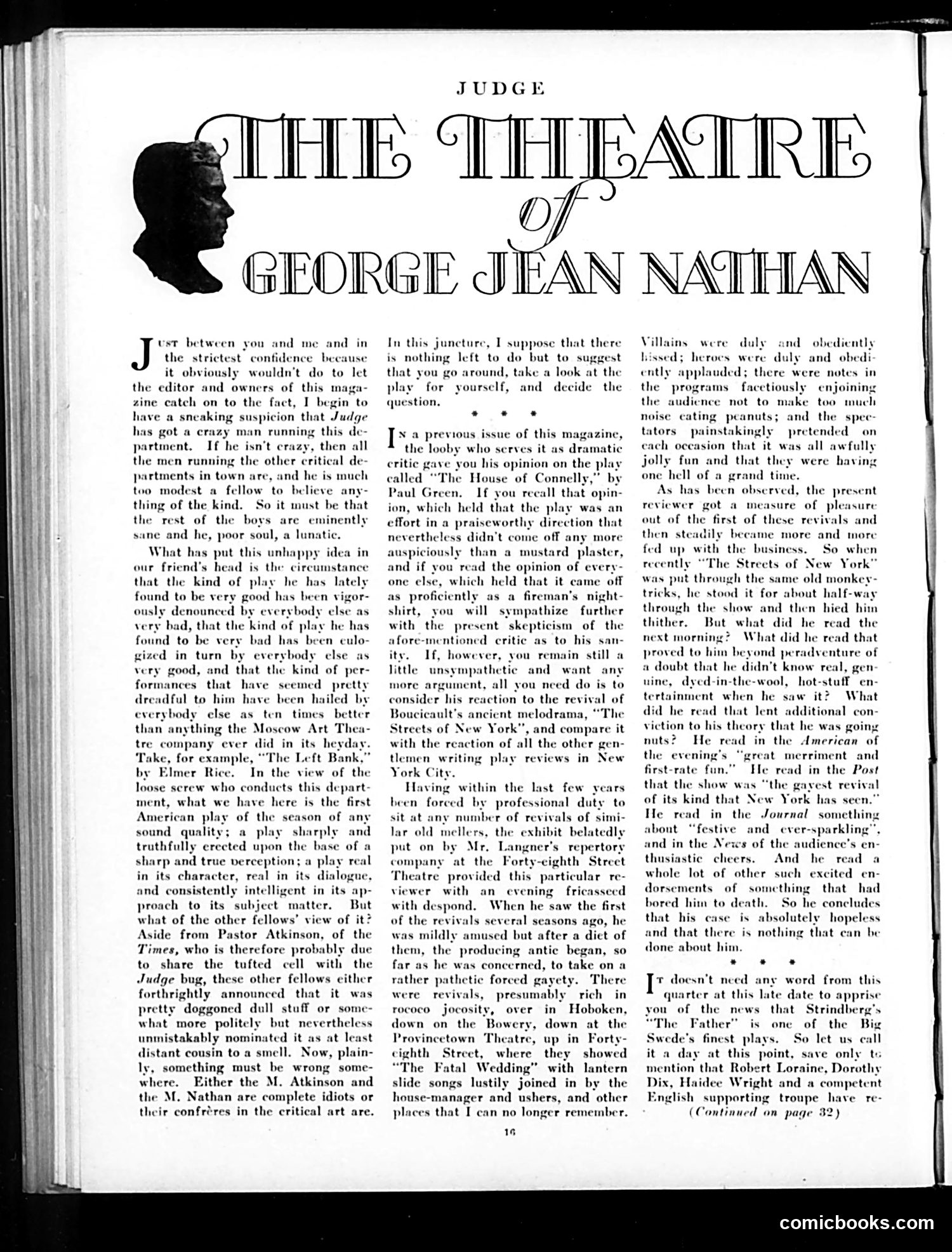
A restored page from Judge, 1931-10-31. Page through the whole issue in the reader above.
📄 Transcribed text from this page (OCR, searchable)
Machine-transcribed from the original scan — historical spelling and the odd misread are preserved.
a ee TN aC eebepeneerem nea ce vst between you and me and in J the strictest’ confidence because it obviously wouldn't do to let the editor and owners of this ms i ch on to the fact, I begin to sneaking suspicion that Judge got a crazy man running this de- If he isn’t ¢ then all the men running the other critical de- partments in town are, and he is much too modest a fellow to believe thing of the kind. So it must be that the rest of the boys sane and he, poor soul, What has put this unt our friend's head is the circumstance that the kind of play he has found to be very good has been ously denounced by everybody else as very bad, that the kind of play he has found to be very bad has been culo- gized in turn by everybody else as very good, and that the kind of per- formances that have seemed pretty dreadful to him have been hailed by everybody else as ten times better than anything the Moscow Art Thea- tre company ever did in its heyday. Take, for example, “The Left Bank,” by Elmer Rice. In the view of the loose screw who conducts this depart- ment, what we have here is the first American play of the season of any sound quality; a play sharply and truthfully erected upon the sharp and true verception; in its character, real in its d and consistently intelligent in its ap- proach to its subject matter. But what of the other fellows’ view of it? Aside from Pastor Atkinson, of the Times, who is therefore probably due to share the tufted cell with the Judge bug, these other fellows either forthrightly announced that it was pretty doggoned dull stuff or some- what more polit but nevertheless unmistakably nominated it as at least distant cousin to a smell. Now, plain- ly, something must be wrong some- where. Either the M. Atkinson and the M. Nathan are complete idiots or their confréres in the critical art are. are eminently lunatic. JUDGE O GEORGE J In this juncture, I suppose that there is nothing left to do but to suggest that you go around, take a look at the play’ for yourself, and decide the question. oe Is a previous issue of t the looby who serves it as dramatic critic gave you his opinion on the play called “The House of Connelly,” by Paul Green. If you recall that opin- ion, which held that the play was an effort in a praiseworthy direction that nevertheless didn’t come off any more auspiciously than a mustard plaster, and if you read the opir one else, which held that it cam as proficiently as a fireman's night- shirt, you will sympathize further with the present skepticism of the fore-mentioned critic as to his san- ity. If, however, you remain still a little unsympathetic and) want any more argument, all you need do is to consider his reaction to the revival of Boucicault’s ancient melodrama, “The Strects of New York”, and compare with the reaction of all the other g tlemen writing play reviews in New York City. Having within the last few years been forced by professional duty. to sit at any number of revivals of simi- lar old mellers, the exhibit belatedly put on by Mr, Langner's repertory company at the Forty-cighth Street Theatre provided this particul: viewer with an evening fri with despond. When he saw the first of the revivals several seasons ago, he was mildly amused but after a dict of them, the producing antic began, so far as he was concerned, to take on a rather pathetic foreed ga There were revivals, presumably rich in rococo jocosity, over in’ Hoboken, down on the Bowery, down at the Provincetown Theatre, up in Forty- cighth Street, where they showed “The Fatal Wedding” with lantern slide songs lustily joined in by the house-manager and ushers, and other places that I can no longer remember. 14 AIRE: NAIHIAN Villainy were duly and obediently hissed; heroes were duly and obedi ently applauded; there were notes in the programs facetiously enjoir the audience not to make too mui noise cating peanuts; and the spec- tators painstakingly pretended on h occasion that it was all awfully jolly fun and that the one hell of a grand time. As has been observed, the pre were having ont reviewer got a measure of pleasure out of the first of these rev s and then steadily beeame more and more fed up with the business. So when recently “The Streets of New York” was put through the same old monkey- tricks, he stood it for about half-way through the show and then hied him thither, But what did he re next morning? What did he re proved to him nd peradventure of a doubt that he didn’t know real, gen uine, dyed-in-the-wool, hot-stuff en- tertainment when he saw it?) What did he read that lent additional con- viction to his theory that he was going nuts? He read in the American of the evening's “great merriment and first-rate fun.” Hle read in the Post that the show was “the gayest revival of its kind that New York has se He read in the Journal somethi about “festive and ever-sparkling din the News of the audience's en- thusiastic cheers. And he read a whole lot of other such excited en- dorsements of something that had bored him to death. So he concludes that his case is absolutely hopeless and that there is nothing that can be done about hin * 8 © + doesn't need any word from this quarter at this late date to apprise you of the news that Strindberg’s “The her” is one of the Big Swede's finest plays. So let us call it a day at this point, save only te mention that Robert Loraine, Dorothy Dix, Haidee Wright and a competent English supporting troupe have re- (Continued on page 32) comicbooks.com