
Judge, 1931-10-24 · page 30 of 36
Judge — October 24, 1931 — page 30: what you’re looking at
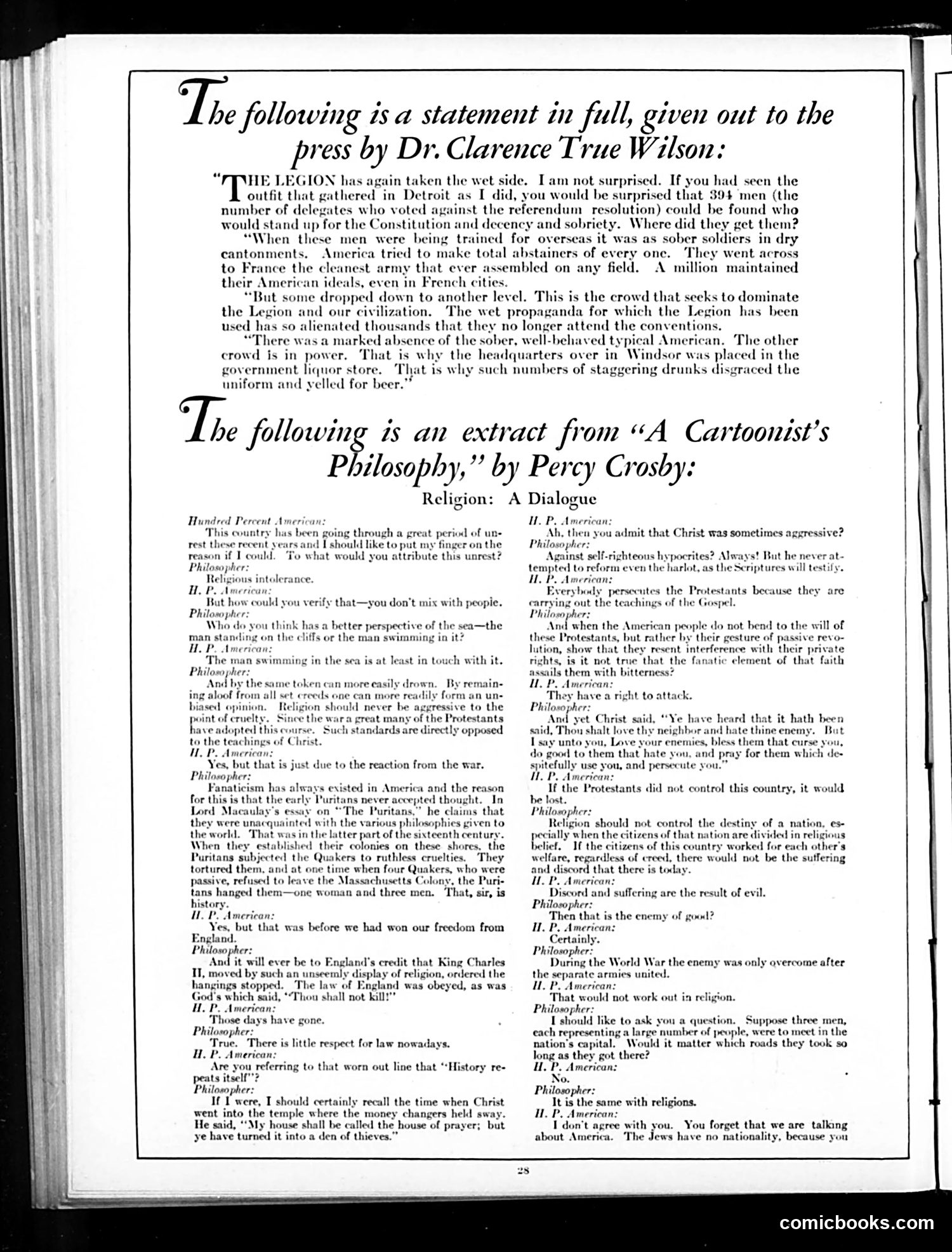
A restored page from Judge, 1931-10-24. Page through the whole issue in the reader above.
📄 Transcribed text from this page (OCR, searchable)
Machine-transcribed from the original scan — historical spelling and the odd misread are preserved.
he following is a statement in full, given out to the press by Dr. Clarence True Wilson: HE LEGION has a uin taken the wet side. Tam not surprised. If you had seen the outfit that gathered in Detroit as I did, you would be surprised that 394 men (the number of delegates who voted against the referendum resolution) could be found who would stand up for the Constitution and decency and sobriety. “When these men were being trained for overseas it w cantonments. America tried to make totd to France the ¢ their American ils, even in French cities. abstainers of every one. nest army that ever assembled on any field. Where did they get them? s as sober soldiers in dry They went across A million maintained “But some dropped down to another level. This is the crowd that seeks to dominate the Legion and our civilization. The wet propaganda for which the Legion has been used has so alienated thousands that they no longer attend the conventions. “There was a marked absence of the sober, well-behaved typical American. crowd is in power, That government liquor store. T uniform and yelled for bee: e followin is an extract The other s why the headquarters over in| Windsor was placed in the itis why such numbers of staggering drunks disgraced the from “A Cartoonist’s P hilosophy, ” by Percy Crosby: Religion: Hundred Percent American: This country has been going through a great period of un- rest these re t years and I should like to put m nthe a could. To what would you attribute this unrest? pher as intolerance. pould you verify that—you don’t mix with people. n better perspective of the sea—the sor the man swimming in it? ng in the sea is at least in touch with it. n more easily drown. By remain- n more readily form an un= opini« f cruelty. Since th of the Protestants Such standards are directly opposed “Yes, but that is just due Philosopher: F the reaction from the war. ns never accepted thought. In he Puritans,” he claims that with the various philosophies given to. .e latter part of the sixteenth century. their colonies on these Puritans subjected the Quakers to ruthless crueltie ‘y tortured them, at one time when four Quakers, who were passive, refused to leave the Massachusetts Colony, the Puri- tans hanged them—one woman and three men. That, sir, is history HP. America Yes, but that was before we had won our freedom from England. Philosopher: ‘And it will ever be to England's credit that King Charles II, moved by such an unseemly display of religion, ordered the hangings stopped. The law of England was obeyed, as was God's which said, hou shall not kill! HL. P., American: ‘Those days have gone. Philosopher: True. There is little respect for law nowadays. H. P. American: Are you referring to that worn out line that “History re- peats itsell Philosopher: If I were, I should certainly recall the time when Christ went into the temple where the money changers held sway. He said, ‘My house shall be called the house of prayer; but ye have turned it into a den of thieves.” A Dialogue HH. P. American: Ah, then you admit that Christ was sometimes aggressive? Philos inst self-righteous hypocrites? Always! But he never at- 1 to reform even the harlot, as the Scriptures will testify. American: y persecutes the Protestants because they are carrying out the teachings of the Gospel. Philosopher: And when the American people do not bend to the will of these Protestants, but rather by their gesture of passive rev lution, show that they resent interference with their private rights, is it not true that the je clement of that faith assails them with bitterness? HP, American: Th ve a right to attack. Phitoso} And yet Christ said, “Ye have heard that it hath been said, Thou shalt love thy neighbor and hate thineenemy. But I say unto y -s, bless them that curse you, do good t e) nd pray for them which de- spitefully use you, and persecut HP, American: If the Protestants did not control this country, it would be lost. Philosopher: on should not control the ; y itizens of that 1 relief. If the citizens of this country worked f welfare, regardless of creed, there would not be the suffering and discord that there is today. U.P. American: Discord and suffering are the result of evil. Philosopher: Then that is the enemy of good? HW. P, American: Certainly. Philosopher During the World War the enemy was only overcome after the separate armies united. HP. American: ‘That would not work out in religion. Philosopher I should like to ask you a question. Suppose three men, each representing a large number of people, were to meet in the nation’s capital. Would it matter which roads they took so long as they got there? . American: estiny of a nation, es- led j No. Philosopher: Iti y) the same with religions. H. P. American: 1 Be n't agree with you. You forget that we are talking about America. ‘The Jews have no nationality, because you comicbooks.com