
Judge, 1931-10-24 · page 20 of 36
Judge — October 24, 1931 — page 20: what you’re looking at
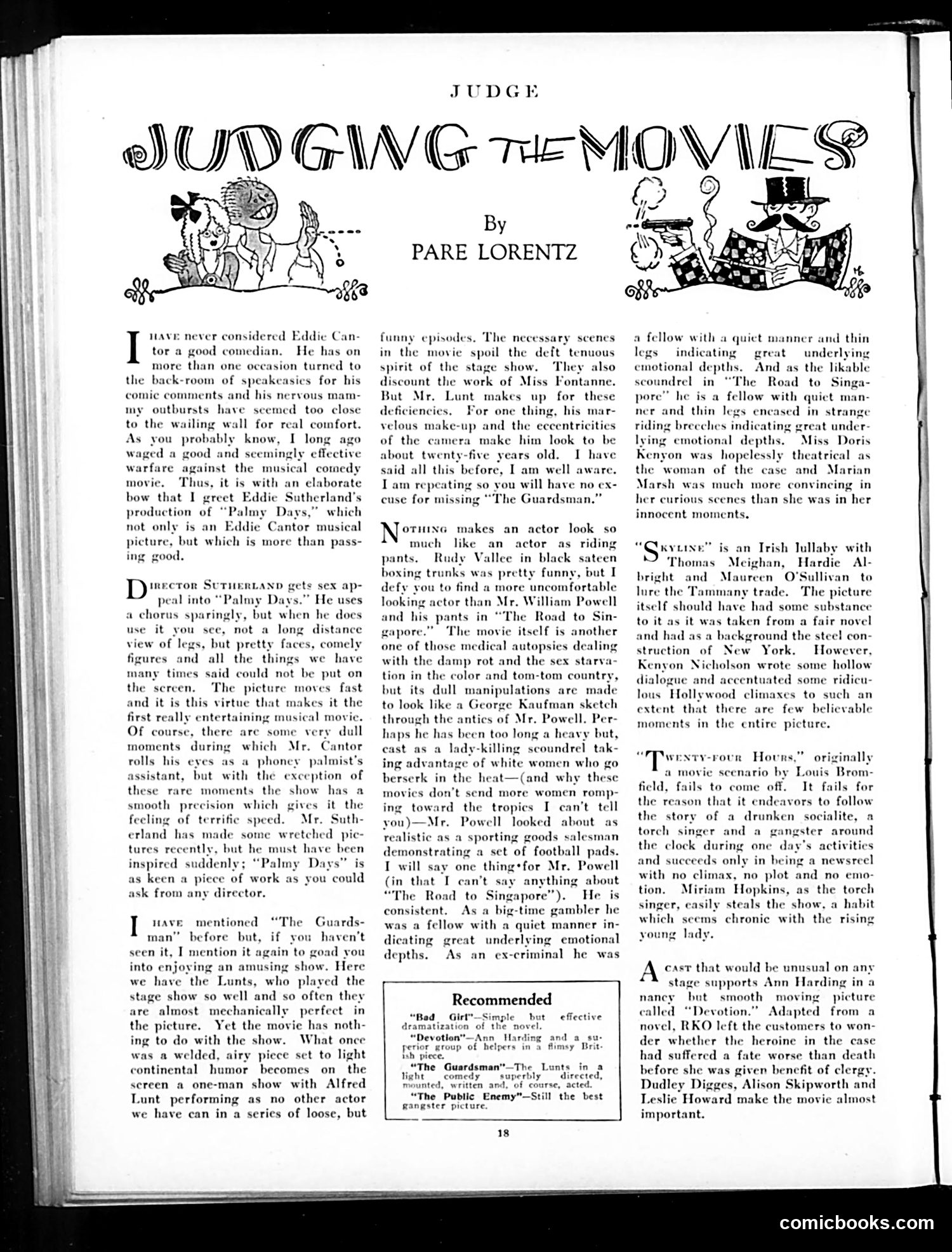
A restored page from Judge, 1931-10-24. Page through the whole issue in the reader above.
📄 Transcribed text from this page (OCR, searchable)
Machine-transcribed from the original scan — historical spelling and the odd misread are preserved.
WAVE never considered Eddie Can- tor a good comedian. He has on more than one occasion turned to the back-room of speakeasies for his comic comments and his nervous mam- my outbursts have seemed too close to the wailing wall for real comfort. As you probably know, I long ago nd seemingly effective gainst the musical comedy movie. Thus, it is with an elaborate bow that I greet Eddie Sutherland's production of “Palmy D which not only is an Eddie Cantor musical picture, but which is more than pass- ing good. good ineetor SUTHERLAND sex ap- peal into “Palmy Days.” He uses a chorus sparingly, but when he d use it you see, not a long distanc view of legs, but pretty f. figures and all the things we have many times said could not be put on the sercen. The picture moves fast and it is this virtue that makes it the first really entertaining musical movie. Of course, there are some very dull moments during which Mr. Cantor ces, comel. rolls his eyes as a phoncy palmist's assistant, but with the exception of these rare moments the show has a smooth precision which gives it the feeling of terrific speed. Mr. Suth- erland has made some wretched pic- tures recently, but he must have been inspired suddenly; “Palmy Days” is as keen a piece of work as you could ask from any director. ee Guards- if you haven't I Have mentioned ma before but, seen it, I mention i in to goad you ing an amusing show. Here e the Lunts, who played the show so well and so often they are almost mechanically perfect in the picture. Yet the movie has noth- ing to do with the show. What once a welded, airy piece set to light continental humor becomes on the sereen a one-man show with Alfred Lunt performing as no other actor we have can in a series of loose, but into en. we h JUDGE funny episodes. The necessary scenes in the movie spoil the deft tenuous spirit of the stage show. They also discount the work of Miss Fontanne. But Mr. Lunt makes up for these deficiencies, For one thing, his 1 velous 1 -up and the eccentricities of the camera make him look to be about twenty-five years old. I have said all this before, I am well aware. Tam repeating so you will have no ex- cuse for missing “The Guardsman.” Notse makes an actor look so much like an actor as riding pants. Rudy lee in sateen boxing trunks was pretty funny, but I defy you to find a more uncomfortable looking actor than Mr. William Powell and his pants in “The Road to Sin- apore The movie itself is another one of those medical autopsies dealing with the damp rot and the sex starva- tion in the color and tom-tom country but its dull manipulations are made to look like Kaufman sketch through the antics of Mr. Powell. Per- haps he has been too long a heavy but, tas a scoundrel tak- ing advantage of white women who go berserk in the heat—(and why these movies don’t send more women romp- ing toward the tropics I can't tell you)—Mr. Powell looked about as realistic as a sporting goods salesman demonstrating a set of football pads. I will say one thing+for Mr. Powell (in that I can’t nything about “The Road to Singapore”). He is consistent. As a big-time gambler he was a fellow with a quiet manner in- dicating great underlying emotion depths. As an ex-criminal he ws ay Recommended “Bed Girt*—Simp but effective dramatization of the ovel. “Devotion”"—Ann Harding and a su- perior group of helpers in a flimsy Brit ED plese. “The Guardsman”—The Lunts in a light comedy sup thly directed, mounted, written and, © ec, acted. “The Public Enemy"—Still the best gangster picture. a fellow with a quict manner and thin | indicating great underlying emotional depths. And as the likable scoundrel “The Road to Singa fellow with quiet man- ner and thin legs encased in strange riding breeches indi eat under lying emotional depths. Miss Doris Kenyon was hopelessly theatrical the woman of the case and Mari Marsh was much more convin pore” he is ing in her curious scenes than she was in her innocent moments, kyttne” is an Trish lullaby with Thomas Meighan, Hardie Al- bright and Maur O'Sullivan to lure the Tammany trade. The picture itself should have had some substance i n from a fair novel and had as a background the steel con- struction of New York. K dialogue and accentuated some ridicu- lous Hollywood climaxes to such an extent that there are few believable moments in the entire picture. “rPwesty-roun Hovns,” originally movie scenario by Louis Brom- field, fails to come off. It fails for the reason that it endeavors to follow the story of a drunken socialite, a torch singer and a gangster around the clock during one day's activities and succeeds only in being a newsreel with no climax, no plot and no emo- tion. Miriam Hopkins, as the torch singer, easily steals the show, a habit which seems chronic with the rising young lady, However, on Nicholson wrote some hollow A cast that would be unusual on any stage supports Ann Harding in a nancy but smooth moving picture alled “Devotion.” Adapted from a novel, RKO left the customers to won- der whether the heroine in the case had suffered a fate worse than death before she was given bencfit of clergy. Dudley Digges, Alison Skipworth and Leslie Howard make the movie important. most ow comicbooks.com