
Judge, 1931-10-24 · page 18 of 36
Judge — October 24, 1931 — page 18: what you’re looking at
A restored page from Judge, 1931-10-24. Page through the whole issue in the reader above.
📄 Transcribed text from this page (OCR, searchable)
Machine-transcribed from the original scan — historical spelling and the odd misread are preserved.
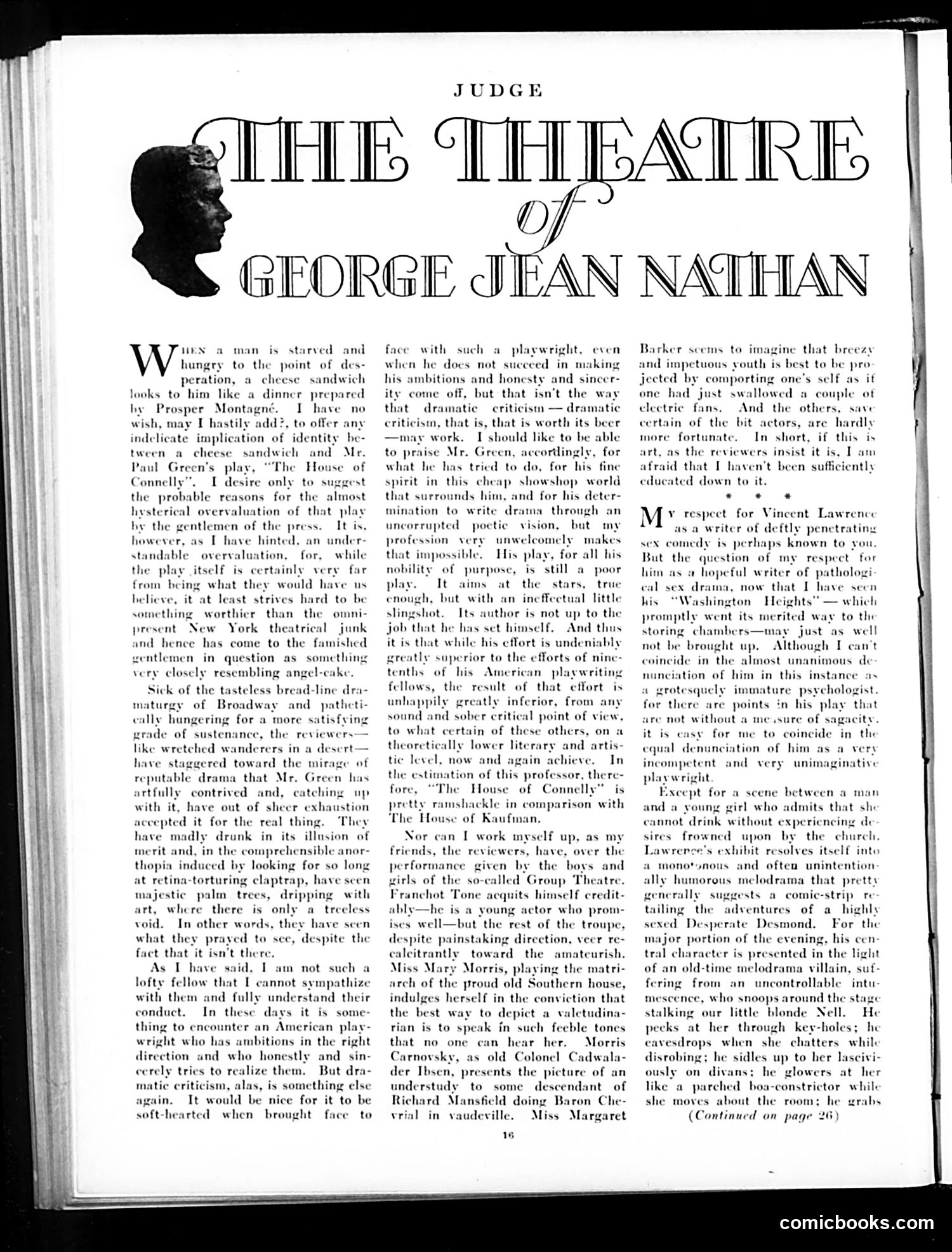
JUDGE B THEATRE GEORGE JEAN NATHAN HEN a starved and point of des- cheese sandwich looks to him like a dinner prepared by Prosper Montagné. I have no wish, may I hastily add?, to offer any indelicate implication of identity be- tween cheese sandwich and Mr. Paul Green's play, “The House of Connelly”. I desire only to suggest the probable rea for the almost hysterical overvaluation of that play hy the gentlemen of the press. It is, however, as TI have hinted. an under- standable overvaluation, for, while the play itself is certainly very far from being what they would have us believe, it at least strives hard to be worthicr than the omni- York theatrical junk ind hence has come to the famished gentlemen in question as something leeake. I-line dra- nd patheti- more satisfying grade of sustenance, the reviewers like wretched wanderers in a desert— have staggered toward the mirage of reputable drama that Mr. Gre artfully contrived and, catching up with it, have out of sheer exhaustion accepted it for the real thing. ‘They have madly drunk in its illusion of merit and, in the comprehensible anor- thopia induced by looking for so long at retina-torturing claptrap, have scen majestic palm trees, dripping with art, where there is only a treeless void. In other words, they have seen what they prayed to see, despite the fact that it isn’t there. As I have said, I am not such a lofty fellow that I cannot sympathize with them and fully understand their conduct. In_ these thing to encounter man is hungry to the peration, a something present New very closely resembling an Sick of the tasteless bre: maturgy of Broadway cally hungering for n has days it is some- » American pl ht who has ambitions in the ri But dra . is something el nice for it to be ought face to cerely tries to realize them. c criticism, ald again. It would be soft-hearted when 1 face with such a playwright, even when he does not succeed in making his ambitions and honesty and sincer- ity come off, but that isn't the way that dramatic criticism — dramatic criticism, that is, that is worth its beer —may work. I should like to be able to praise Mr. Green, accortlingly, for what he has tried to do, for his fine spirit in this cheap showshop world that surrounds him, and for his deter- mination to write drama through an uncorrupted poctic vision, but my profession very unwelcomely makes that impossible. His play, for all his nobility of purpose, is still a poor play. It true aims at the stars, enough, but with an ineffectual little slingshot. Its author is not up to the job that he has set himself. And thus it is that while his effort is undeniabl greatly superior to the efforts of nine- tenths of his American playwriting fellows, the result of that effort is unhappily greatly inferior, from sound and sober critical point of view, to what certain of these others, on a theorctically lower literary tie level, now and a, nd artis- in achieve. In the estimation of this professor, there- fore, “The House of Connelly" is retty ramshackle in comparison with The House of Kaufman. Nor can I work myself up, as my friends, the reviewers, have, over the performance given by the boys and rls of the so-called Group Th nchot Tone acquits himself eredit- he is a young actor who pro well—but the rest of the troupe despite painstaking direction, veer re- calcitrantly toward the Miss Mar. ing the matri- arch of the proud old Southern house, indulges herself in the conviction that the best way to depict a valetudir rian is to speak in such feeble tones that no one can hear her. Morris Carnovsky, as old Colonel Cadwala- der Ibsen, presents the picture of an understudy to some descendant of Richard Mansfield doing Baron Che- vrial in vaudeville. Miss Margaret amateurish, 16 Barker scems to imagine that breezy and impetuous youth is best to be pro jected by comporting one’s self as it one had just swallowed ac electric fans. And tl certain of the bit more fortunate. In short, rt. as the reviewers insist it i fraid that I haven't been suffic educated down to it. neent: Lawrence * 8 « M* ANA asa writer of deftly penetratir for V sex comedy is perhaps known to you. But the question of my respect fe him as a hopeful writer of pathole cal sex drama, now that I have his “Washington Heights’ — which promptly went its merited way to the storing chambers—may just as well not be brought up. Although I can't in the almost unanimous de nunciation of him in this instance as a grotesquely immature psychologist. for there are points in his play that without « it is easy ple of others, save hardly this is Tam ently actors, respect seen coincid are nM mesure of s for me to coincide in equal denunciation of him a incompetent and unimaginative playwright very ixcept for a scene between a man and a young girl who admits that she cannot drink without experiencing de sires frowned upon by the Lawren: church, ‘s exhibit resolves itself into a monotynous and often unintention ally humorous melodrama that pretty generally suggests a comic-strip re tailing the adventures of a highly sexed Desperate Desmond. For the major portion of the evening, his cen tral character is presented in the light of an old-time melodrama villain, suf- fering from an uncontrollable intu- nce, Who snoops around the stage our little blonde Nell. He peeks at her through key-holes; he cavesdrops when she chatters whik disrobing; he sidles up to her lascivi- ously on divans; he pwers at her like a parched boa-constrictor while she moves about the room; he grabs (Continued on page 2 comicbooks.com