
Judge, 1931-10-10 · page 20 of 36
Judge — October 10, 1931 — page 20: what you’re looking at
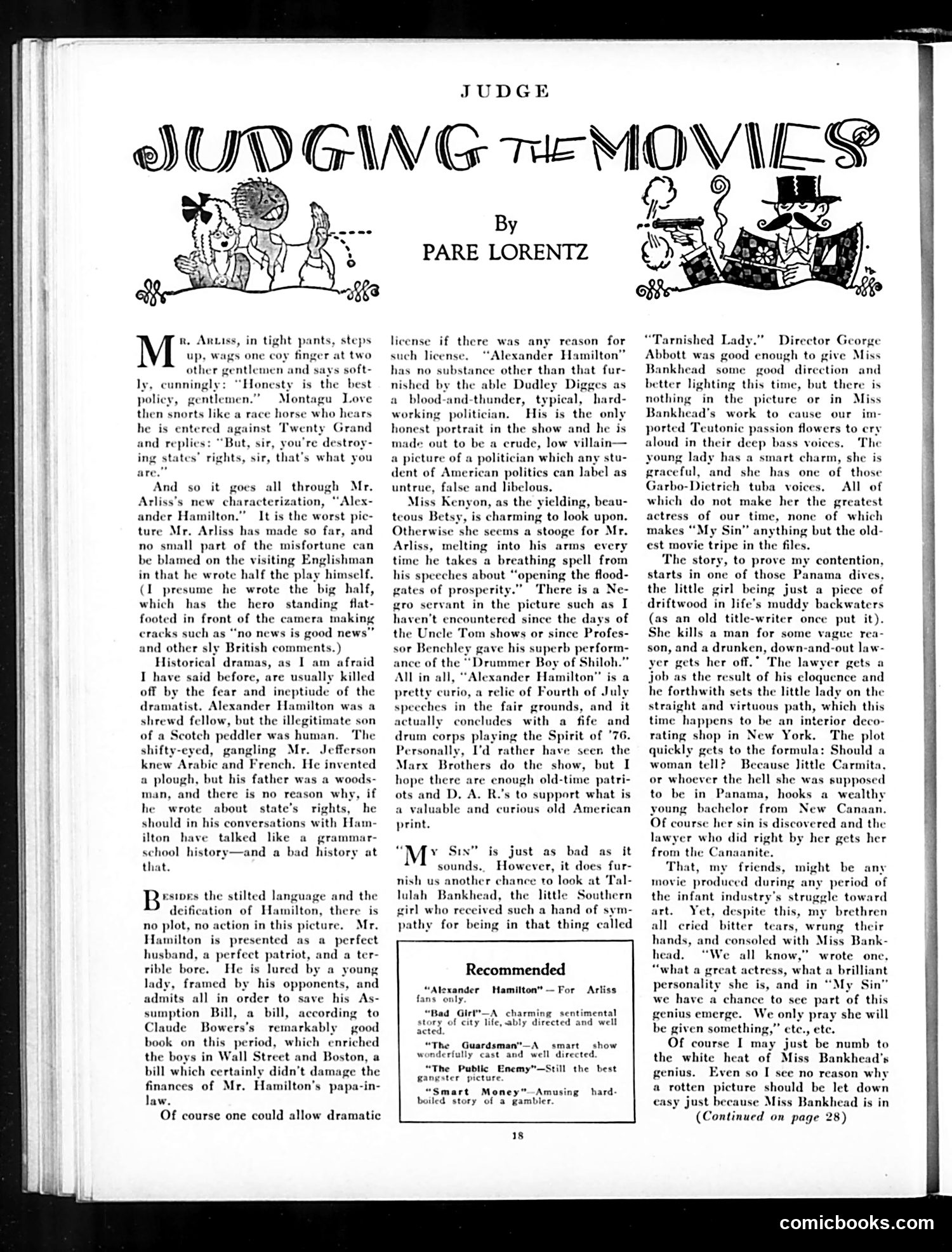
A restored page from Judge, 1931-10-10. Page through the whole issue in the reader above.
📄 Transcribed text from this page (OCR, searchable)
Machine-transcribed from the original scan — historical spelling and the odd misread are preserved.
JUDGE JUVGWG TeEMOY’ LS n. Antiss, in tight pants, steps "ap, wags one coy finger at two other gentlemen and says soft- ly, cunningly: “Honesty is the best policy, gentlemen.” Montagu Love then snorts like a race horse who h he is entered against Twenty Grand and replies: “But, sir, you're destroy- ing states’ rights, sir, that's what you all through Mr. ation, “Al And so it goes Arliss’s new characteriz ander Hamilton.” It is the worst pic- ture Mr. Arliss has made so far, and no small part of the misfortune can be blamed on the visiting Englishman in that he wrote half the play himself. (1 presume he wrote the big half, which has the hero standing flat- footed in front of the camera making cracks such as “no news is good news” and other sly British comments.) Historical dramas, as I am afraid I have said before, are usually killed off by the fear and ineptiude of the dramatist. Alexander Hamilton was a shrewd fellow, but the illegitimate son of a Scotch peddler was human. The shifty-eyed, gangling Mr. Jefferson knew Ar. nd French, He invented a plough, but his father was a woods- man, and there is no reason why, if he wrote about state’s rights, he should in his conversations with Ham- ilton have talked like a gramn school history—and a bad history guage and the amilton, there is no plot, no action in this picture. Mr. Hamilton is presented as a perfect husband, a perfect patriot, and a ter- le bore. He is lured by a young lady, framed by his opponents, and admits all in order to save his As- sumption Bill, a bill, according to Claude Bowers’s remarkably good book on this period, which enriched the boys in Wall Street and Boston, a bill which certainly didn’t damage the finances of Mr. Hamilton's papa-in- law. Of course one could allow dramatic By PARE LORENTZ license if there was any reason for such license, “Alexander Hamilton” has no substance other than that fur- nished by the able Dudley Digges as a blood-and-thunder, typical, hard- working politician. His is the only honest portrait in the show and he made out to be a crude, low villain— a picture of a politician which any stu- dent of American politics can label as untrue, false and libelous. “nyon, as the yielding, beau- s charming to look upon. wise she seems a stooge for Mr. Arliss, melting into his arms every time he takes a breathing spell from his speeches about “opening the flood- tes of prosperity.” There is a Ne- gro servant in the picture such as I haven't encountered since the days of the Uncle Tom shows or since Profes- sor Benchley gave his superb perform- ance of the “Drummer Boy of Shiloh.” All in all, “Alexander Hamilton’ pretty curio, a relic of Fourth of July »s in the fair grounds, and it ally concludes with a fife and drum corps playing the Spirit of '76. Personally, I'd rather have seen the Marx Brothers do the show, but I hope there are enough old-time patri- ots and D, A. R.’s to support what is a valuable and curious old Ame print. Sin” is just as bad as it sounds.. However, it does fur- nish us another chance to look at ‘ lulah Bankhead, the little Southern girl who received such a hand of sym- pathy for being in that thing called Recommended lexander — For fans only, “Bad Girt"—A charming sentimental story of city life, ably directed and well acted. “The Guardsman"—A smart show wonderfully cast and well directed. “The Public Enemy”—Still the best gangster picture. Smart Money”—Amusing boiled story of a gambler. Hamilton” Arliss hard- “Tarnished Lady.” Director George Abbott was good enough to give Miss Bankhead some good dircction and better lighting this time, but there is nothing in the picture or in Miss Bankhead’s work to cause our im- ported Teutonic passion flowers to cry aloud in their deep bass voices. The young lady has a smart charm, she is graceful, and she has one of those Garbo-Dietrich tuba voices. All of which do not make her the greatest actress of our time, none of which makes “My Sin” anything but the old- est movie tripe in the files. The story, to prove my contention, starts in one of those Panama dives. the little girl being just a piece of driftwood in life’s muddy backwaters (as an old title-writer once put it). She kills a man for some v re son, and a drunken, down-and-out |. yer gets her off.’ The lawyer gets a job as the result of his eloquence and he forthwith sets the little lady on the straight and virtuous path, which this time happens to be an interior deco- rating shop in New York. The plot quickly gets to the formul P woman tell? Because little Carmita, or whoever the hell she was supposed to be in Panama, hooks a wealthy young bachelor from New Canaan. Of course her sin iscovered and the lawyer who did right by her gets her from the Canaanite. That, my friends, might be any movie produced during any period of the infant industry's stru art. Yet, despite this, my brethren all cried bitter tears, wrung their hands, and consoled with Miss Bank- “We all know,” wrote at a great actress, what personality she is, and in we have a chance to see part of this genius emerge. We only pray she will be given something,” cte., ete. Of course I may just be numb to the white heat of Miss Bankhead’s genius. Even so I see no reason why a rotten picture should be let down easy just because Miss Bankhead is in (Continued on page 28) one, comicbooks.com