
Judge, 1931-09-12 · page 18 of 36
Judge — September 12, 1931 — page 18: what you’re looking at
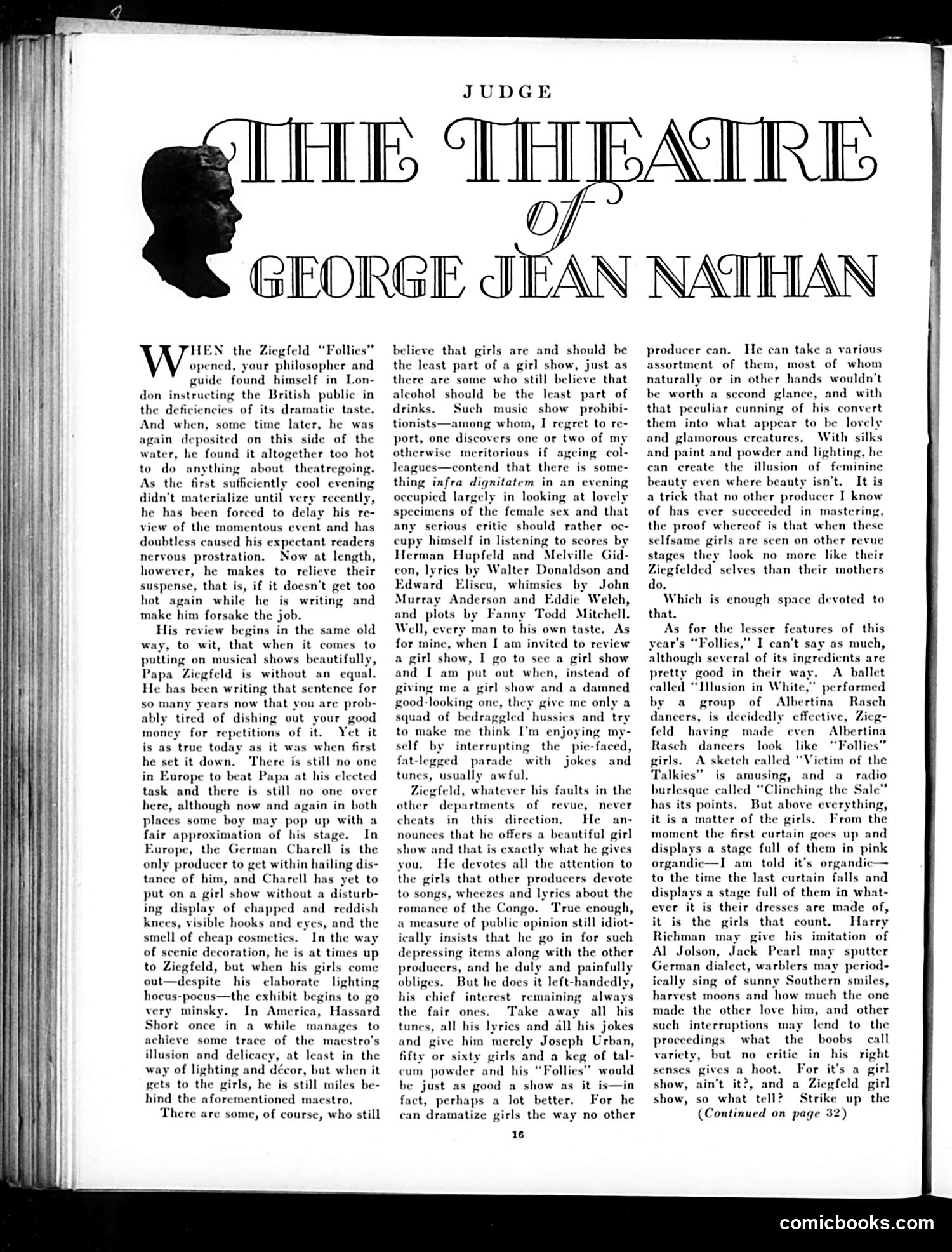
A restored page from Judge, 1931-09-12. Page through the whole issue in the reader above.
📄 Transcribed text from this page (OCR, searchable)
Machine-transcribed from the original scan — historical spelling and the odd misread are preserved.
HEN the Ziegfeld ‘Follies” opened, your philosopher and guide found himself in Lon- don instructing the British public in the deficiencies of its dr: ic taste. And when, some time later, he was again deposited on this side of the ater, he found it altogether too hot to do anything about theatregoing. As the first sufficiently cool evening didn’t materialize until very recently, he has been forced to delay his re- view of the momentous event and has doubtless caused his expectant readers nervous prostration. Now at length, however, he makes to relieve their suspense, that is, if it doesn’t get too hot again while he is writing and make him forsake the job. His review begins in the same old way, to wit, that when it comes to putting on musical shows beautifully, Papa Ziegfeld is without an equal. n writing that sentence for years now that you are prob- ly tired of dishing out your good money for repetitions of it. Yet it is as true today as it was when first he set it down. There is still no one in Europe to beat Papa at his elected task and there is still no one over here, although now and again in both places some boy may pop up with a fair approximation of his stage. In Europe, the German Charell is the only producer to get within hailing dis- tance of him, and Charell has yet to put on a girl show without a disturb- ing display of chapped and reddish knees, visible hooks and eyes, and the smell of cheap cosmetics. In the of scenic decoration, he is at times up to Ziegfeld, but when his girls come out—despite his elaborate lighting hocus-pocus—the exhibit begins to go very minsky. In America, Hassard Short once in a w manages to achieve some trace of the estro’s illusion and delicacy, at least in the way of lighting and décor, but when it gets to the girls, he is still miles be- hind the aforementioned maestro. There are some, of course, who still JUDGE kb GEORGE J O believe that girls are and should be the least part of a girl show, just as there are some who still believe that alcohol should be the least part of drinks. Such music show prohibi- tionists—among whom, I regret to re- port, one discovers one or two of my otherwise meritorious if ageing col- leagues—contend that there is some- thing infra dignitatem in an evening occupied largely in looking at lov specimens of the female sex and that any serious critic should rather oc- cupy himself in listening to scores by Herman Hupfeld and Melville Gid- con, lyrics by Walter Donaldson and Edward Eliscu, whimsies by John Murray Anderson and Eddie Welch, and plots by Fanny Todd Mitchell. Well, every man to his own taste. As for mine, when I am invited to review a girl show, I go to see a girl show and I am put out when, instead of ing me a girl show and a damned good-looking one, they give me only a squad of bedraggled hussies and try to make me think I'm enjoying my self by interrupting the pie-faced, fat-legged parade with jokes and tunes, usually awful. Ziegfeld, whatever his faults in the other departments of revue, never cheats in this direction. He an- nounces that he offers a beautiful girl show and that is exactly what he gives you. He devotes all the attention to the girls that other producers devote to songs, wheezes and lyrics about the romance of the Congo. True enough, a measure of public opinion still idiot- ically insists that he go in for such depressing items along with the other producers, and he duly and painfully obliges. But he does it left-handedly, his chief interest remaining always the fair ones. Take a all his tunes, all his lyrics and all his jokes and give him merely Joseph Urban, fifty or sixty girls and a keg of tal- cum powder and his “Follies would be just as good a show as it is—in fact, perhaps a lot better. For he can dramatize girls the way no other 16 ATRE | NATHAN producer can. He can take a various assortment of them, most of whom naturally or in other hands wouldn't be worth a second glance, and with that peculiar cunning of his convert them into what appear to be lov and glamorous creatures. With and paint and powder and lighting, he can create the illusion of feminine beauty even where beauty isn’t. It is a trick that no other producer I know of has ever succeeded in mastering, the proof whereof is that when these selfsame girls are scen on other revue stages they look no more like their Ziegfelded selves than their mothers do, Which is enough space devoted to that. As for the lesser features of this year’s “Follies,” I can’t say as much, although several of its ingredients are pretty good in their way. A ballet called “Mlusion in White,” performed by a group of Albertina Rasch dancers, is decidedly effective, Zieg- feld having made Albertina Rasch dancers look like “Follies” led “Victim of the Talkies” is ng, and a radio burlesque called “Clinching the . its points. But above everything, sa matter of the girls. From the moment the first curtain goes up and displays a stage full of them in pink organdie—I am told it's organdie— to the time the last curtain falls and displays a s full of them in what- ever it is their dresses are made of, it is the girls that count. Harry Richman may give his imitation of Al Jolson, Jack Pearl n sputter German dialect, warblers may period- ically sing of sunny Southern smiles, harvest moons and how much the one made the other love him, and other such interruptions may lend to. the proceedings what the boobs call variety, but no critic in his right senses gives a hoot. For it’s a girl show, ain't it?, and a Ziegfeld girl show, so what tell? Strike up the (Continued on page 3: comicbooks.com