
Judge, 1931-09-12 · page 15 of 36
Judge — September 12, 1931 — page 15: what you’re looking at
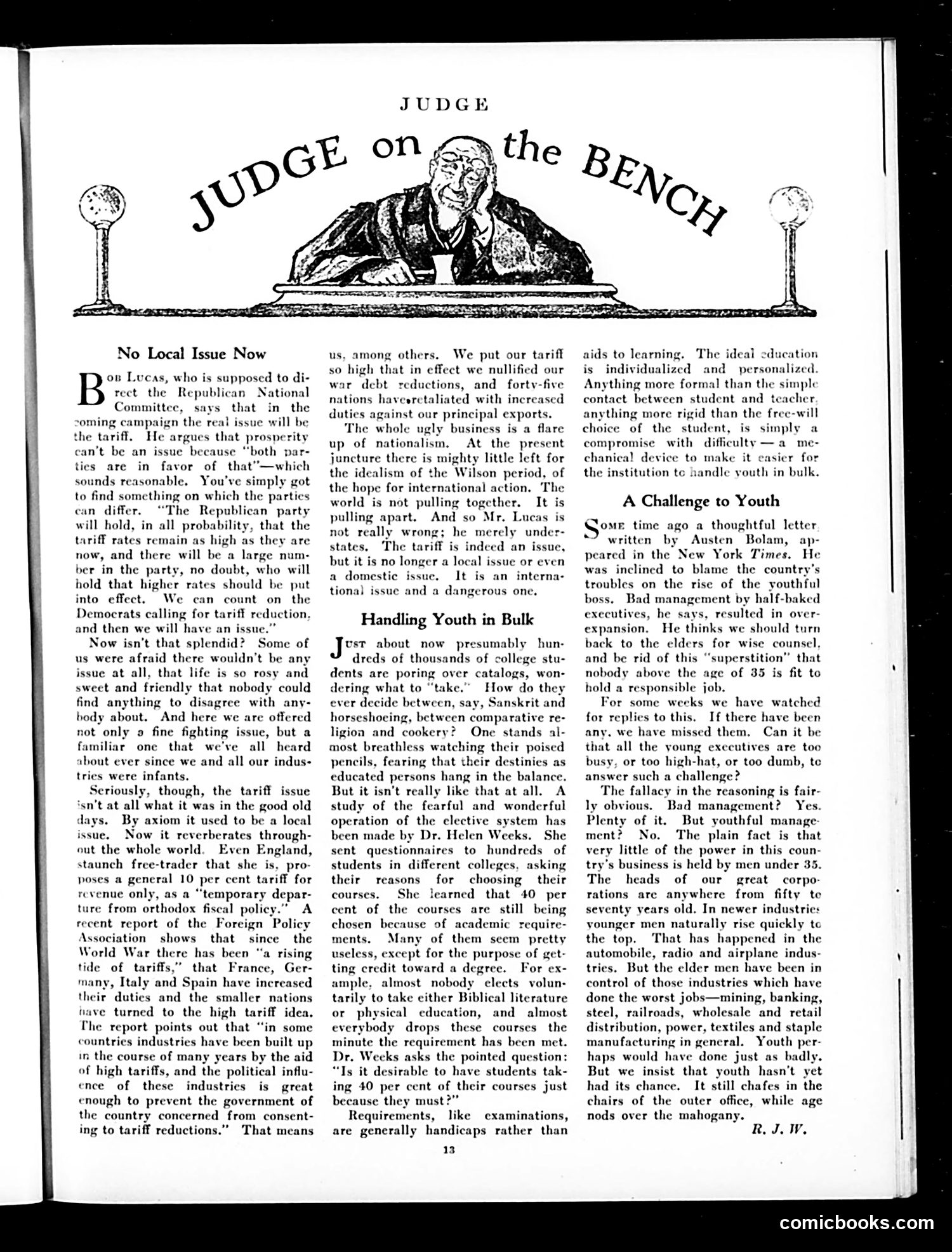
A restored page from Judge, 1931-09-12. Page through the whole issue in the reader above.
📄 Transcribed text from this page (OCR, searchable)
Machine-transcribed from the original scan — historical spelling and the odd misread are preserved.
JUDGE No Local Issue Now ob Lucas, who is supposed to di- B rect the Republican National Committee, says that in’ the -oming campaign the real issue will be the tariff. He argues that prosperity can't be an issue because “both par- are in favor of that’—which sounds reasonable. You've simply got to find something on which the parties can differ. “The Republican party will hold, in all probability, that the tariff rates remain as high as they are now, and there will be a large num- ber in the party, no doubt, who will hold that higher rates should be put into effect. We can count on the Democrats calling for tariff reduction, and then we will have an issue.” Now isn’t that splendid? Some of us were afraid there wouldn't be any issue at all, that life is so rosy and sweet and friendly that nobody could find anything to disagree with any- body about. And here we are offered not only 9 fine fighting issue, but a familiar one that we've all heard about ever since we and all our indus- tries were infants. Seriously, though, the tariff issue isn’t at all what it was in the good old days. By axiom it used to be a local issue. Now it reverberates through- out the whole world. Even England, staunch free-trader that she is, pro- poses a gencral 10 per cent tariff for revenue only, as a “temporary depar- ture from orthodox fiscal policy.” A recent report of the Foreign Policy Association shows that ince the World War there has been “a rising tide of tariffs,” that France, Ger- many, Italy and Spain have increased their duties and the smaller nations ave turned to the high tariff idea. Che report points out that “in some countries industries have been built up in the course of many years by the aid of high tariffs, and the political influ- ence of these industries is great enough to prevent the government of the country concerned from consent- ing to tariff reductions.” That means ties us, among others. We put our tariff so high that in effect we nullified our war debt reductions, and forty nations haveerctaliated with incre: duties against our principal exports. The whole ugly business is a flare up of nationalism. At the present juncture there is mighty little left for the idealism of the Wilson period, of the hope for international action. The world is not pulling together. It is pulling apart. And so Mr. Lucas is not really wrong; he merely und states, The tariff is indeed an issue, but it is no longer a local issue or even a domestic issue. It is an interna- tional issue and a dangerous one. Handling Youth in Bulk J about now presumably hun- dreds of thousands of college stu- dents are poring over catalogs, won- dering what to “take.” How do they ever decide between, say, Sanskrit and horseshoeing, between comparative re- ligion and cookery? One stands al- most breathless watching their poised pencils, fearing that their destinies as educated persons hang in the balance. But it isn’t really like that at all. A study of the fearful and wonderful operation of the elective system has been made by Dr. Helen Weeks. She sent questionnaires to hundreds of students in different colleges, asking their reasons for choosing their courses. She learned that 40 per cent of the courses are still being chosen because of academic require- ments. Many of them seem pretty useless, except for the purpose of get- ting credit toward a degree. For ex- ample, almost nobody elects volun- tarily to take either Biblical literature or physical education, and almost everybody drops these courses the minute the requirement has been met. Dr. Weeks asks the pointed question: e to have students tak- ing 40 per cent of their courses just because they must?” Requirements, like examinations, are generally handicaps rather than 13 aids to learning. The ideal education is individualized and personalized. Anything more formal than the simple contact between student and teacher hing more rigid than the free-will choice of the student, is simply a compromise with difficulty — a me- a 1 device to make it easier for the institution te handle youth in bulk. A Challenge to Youth Somer time ago a thoughtful letter written by Austen Bolam, ap- peared in the New York Times. He was inclined to blame the country’s troubles on the rise of the youthful bo Bad management by half-baked executives, he says, resulted in over- expansion. He thinks we should turn back to the elders for wise counsel, and be rid of this “superstition” that nobody above the age of 35 is fit to hold a responsible job. For some weeks we have watched for replies to this. If there have been any. we have missed them. Can it be that all the young executives are too busy, or too high-hat, or too dumb, te answer such a challenge? The fallacy in the reasoning is fair- ly obvious. Bad management? Yes. Plenty of it. But youthful manage ment? No. The plain fact is that very little of the power in this coun- try’s business is held by men under 35. The heads of our great corpo- rations are anywhere from fifty te seventy years old. In newer industries younger men naturally rise quickly tc the top. That has happened in the automobile, radio and airplane indus- tries. But the elder men have been in control of those industries which have done the worst jobs—mining, banking, steel, railroads, wholesale and retail distribution, power, textiles and staple manufacturing in general. Youth per- haps would have done just as badly. But we insist that youth hasn't yet had its chance. It 1 chafes in the chairs of the outer office, while age nods over the mahogany. R,JILW. comicbooks.com