
Judge, 1931-08-22 · page 6 of 36
Judge — August 22, 1931 — page 6: what you’re looking at
What you’re looking at
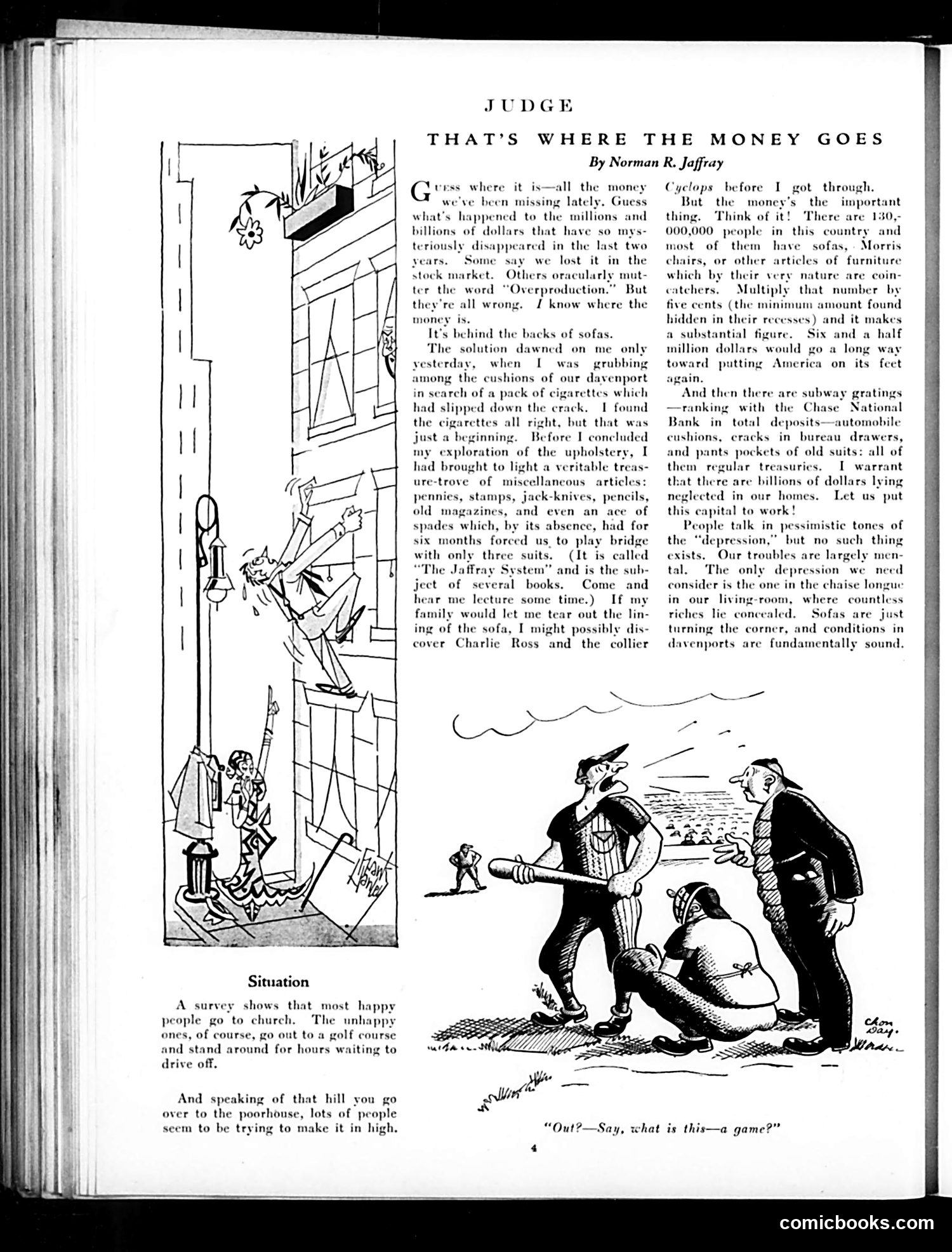
# Judge Magazine Satire Analysis This page satirizes wealth inequality and hidden consumer spending during economic hardship. The article "That's Where the Money Goes" by Norman Hapley uses humor to explain where America's "missing" money went—not lost in stock markets or overproduction, but hidden in household goods. The left cartoon shows a person discovering accumulated possessions (furniture, goods, magazines) crammed behind a sofa—a visual metaphor for frivolous consumer spending. The bottom cartoon depicts wealthy businessmen playing baseball while a small figure (likely representing common workers or the poor) struggles with the game, captioned "Out?—Say, what is this—a game?" This suggests the economic system is rigged or unfair for ordinary people. The satire critiques both conspicuous consumption by the wealthy and structural economic inequality of the era.
📄 Transcribed text from this page (OCR, searchable)
Machine-transcribed from the original scan — historical spelling and the odd misread are preserved.
Situation A survey shows that most happy people go to church. The unhappy ones, of course, go out to a golf course and stand around for hours waiting to drive off. And speaking of that hill you go over to the poorhouse, lots of people seem to be trying to make it in high. JUDGE THAT’S WHERE THE MONEY GOES By Norman R. Jaffray Gres where it is—all the money we've been missing lately. Gu what's happened to the millions and billions of dollars that have so mys- teriously disappeared in the last two years. we lost it in the stock market. Others oracularly mut- ter the word “Overproduction they're all wrong, J know where the money is. It's behind the backs of sofas. The yesterday, Some say solution dawned on me when [was grubbing among the cushions of our davenport rch of a pack of cigarettes which slipped down the crack. I found tes all right, but that was ginning. Before I concluded my exploration of the upholstery, I had brought to light a veritable treas- ure-trove of miscellaneous articles: pennies, stamps, jack-knives, pencils, old magazines, and even an ace of spades which, by its absence, had for six months forced us, to play bridge with only three suits. (It is called “The Jaffray System” and is the sub- ject of several books. Come hear me lecture some time.) family would let me ing of the sofa, I m cover Charlie Ross only and If my ar out the lin- t possibly dis- and the collier Cyclops before I got through. But the money's the important thing. Think of it! There are 130,- 000,000 people in this country and most of them have sofas, Morris chairs, or other articles of furniture which by their very nature are coin- thers. Multiply that number by fi nts (the minimum amount found hidden in their recesses) and it makes a substantial figure. Six and a half million dollars would go a long way toward putting America on its feet again, And then there are sub —rank with the C d Bank in total deposits—automobile cushions, cracks in bureau drawers, and pants pockets of old suits: all of them regular treasuries. I warrant that there are billions of dollars lying neglected in our homes. Let us put this capital to work! People talk in pessimistic tones of the “depression,” but no such thin exists, Our troubles are largely men- tal. ‘The only depression we nee consider is the one in the chaise lon in our living-room, where countless riches lie concealed. Sofas are just turning the nd conditions in davenports « comicbooks.com