
Judge, 1931-07-25 · page 18 of 36
Judge — July 25, 1931 — page 18: what you’re looking at
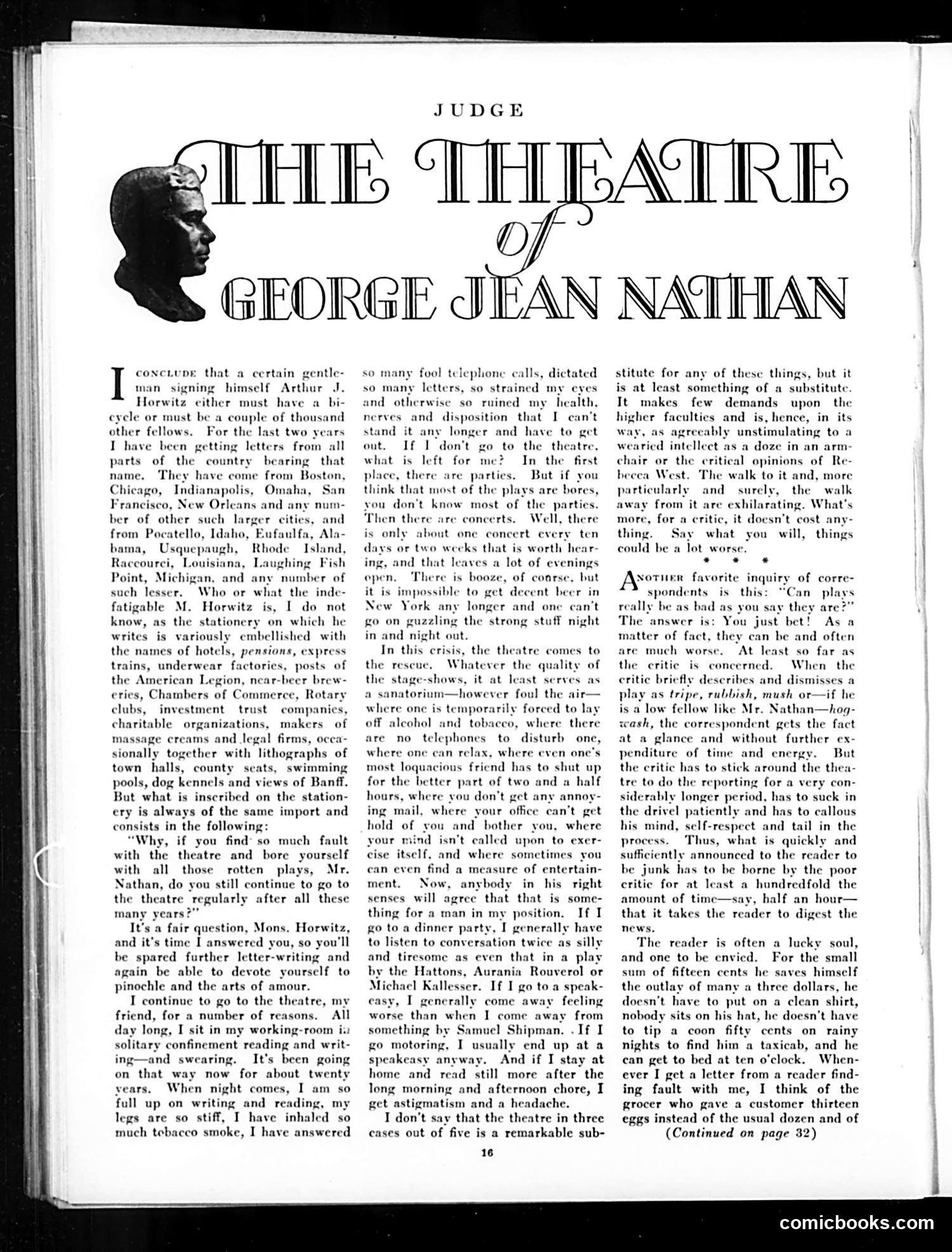
A restored page from Judge, 1931-07-25. Page through the whole issue in the reader above.
📄 Transcribed text from this page (OCR, searchable)
Machine-transcribed from the original scan — historical spelling and the odd misread are preserved.
concLupe that a certain ge I man signing himself Arthur J. Horwitz cither must have cycle or must be a couple of thous: other fellows. For the last two y I have been getting letters from parts of the bearing They hi ndianapolis, Oma y Orleans and ber of other such larger cities, and from Pocatello, Idaho, Eufaulfs bama, Usquep Rhode Raccourci, Louisian ighing Fish Point, Michigan, and any number of such lesser. Who or what the inde- fatigable M. Horwitz I do not know, as the stationery which he writes is variously embellished with the names of hotels, pensions, express trains, underwear factories, posts of the American Legion, near-beer bre Chambers of Commere investment trust com charitable organizations, makers of massage creams and legal firms, ocea- sionally together with lithographs of town halls, county seats, swimming pools, dog kennels and views of Banff. But what is inscribed on the station- ery is always of the same import and consists in the following: “Why, if you find’ so much fault with the theatre and bore yourself ith all those rotten plays, Mr. Nathan, do you still continue to go to the theatre regularly after all these many years? It’s a fair question, Mons. Horwitz, and it's time I answered you, so you'll be spared further letter-writing and again be able to devote yourself to pinochle and the arts of amour. I continue to go to the theatre, my friend, for a number of reasons. All day long, I sit in my working-room i: solitary confinement reading and writ- ing—and swearing. It's been going on that way now for about twenty years. When night comes, I am so full up on wri' and reading, my that ce come from Boston, ‘ountry San clubs, legs are so stiff, I have inhaled so much tebacco smoke, I have answered FORGE J so many fool telephone calls, dictated so many letters, so st and otherwise so ruined my health, nerves and disposition that I can't stand it any longer and have to get ned my eyes out. If I don't go to the theatre. what is left for me? In the first place, there are parties. But if you think that most of the plays are bores, you don’t know most of the parties. Then there Well, there is only about one concert every ten days or two weeks that is worth hear ing, and that leaves a lot of evenings There is booze, of conrse, but it is impossible to get decent beer in New York any longer and one can't go on guzzling the strong stuff night in and night out. In this crisis, the theatre comes to the rescue. Whatever the quality of the stage-shows, it at least serves as a sanatorium—however foul the where one is temporarily forced to off alcohol and tobacco, where there are no telephones to disturb one, where one can relax, where even one's most loquacious friend has to shut up for the better part of two and a half hours, where you don't ¢ ing mail, where your office hold of you your r are concerts. open, n't get d bother you, where nd isn’t called upon to exer- cise itself, and where sometimes you can even find a measure of entertain- ment. Now, anybody in his right senses will agree that that is some- thing for a man in my position, If I go to a dinner party, I gene have to listen to conversation t > as silly and tiresome as even that in a play by the Hattons, Aurania Rouverol or Michael Kallesser. If I go to a speak- easy, I generally come away feeling worse than when I come away from something by Samuel Shipman. .If I go motoring, I usually end up at a speakeasy anyway. And if I stay at home and read still more after the long morning and afternoon chore, I get astigmatism and a headache. I don’t say that the theatre in three cases out of five is a remarkable sub- 16 NATHAN stitute for any of these things, but it is at least something of a substitute. It makes few demands upon the higher faculties and is, hence, in its ", as agrecably unstimulating to a ried intellect as a do ritic West. Th in an arm- 1 opinions of Re- » walk to it and, more particularly surely, the walk away from it are exhilarating. What's more, for a critic, it doesn’t cost any- thing. what and Say you will, things could be a lot worse. * * « NoTHER favorite inquiry of corre- spondents is this: “Can pl really be as bad as you say they ar The answer is: You just bet! matter of Asa they can be and often t so far as When the briefly describes and dismisses y as tripe, rubbish, mush or—if low fellow like Mr. han—hog- wash, the correspondent gets the fact at a glance and without further ex- penditure of time and energy. But the critic has to stick around the thea- tre to do the reporting for a very con- siderably longer period, has to suck in the drivel patiently and has to callous his mind, self-respect and tail in the process. Thus, what is quickly and sufficiently announced to the reader to be junk has to be borne by the poor critic for at least a hundredfold the amount of time— half an hour— that it takes the reader to digest the n are much worse. At the critic is concerned. The reader is often a lucky soul, and one to be envied. For the small sum of fifteen cents he saves himself the outlay of many a three dollars, he doesn’t have to put on a clean shirt, nobody sits on his hat, he doesn’t have to tip a coon fifty cents on rainy nights to find him a taxicab, and he can get to bed at ten o'clock. When- ever I get a letter from a reader find- ing fault with me, I think of the grocer who gave a customer thirteen eggs instead of the usual dozen and of (Continued on page 32) comicbooks.com