
Judge, 1931-07-18 · page 18 of 36
Judge — July 18, 1931 — page 18: what you’re looking at
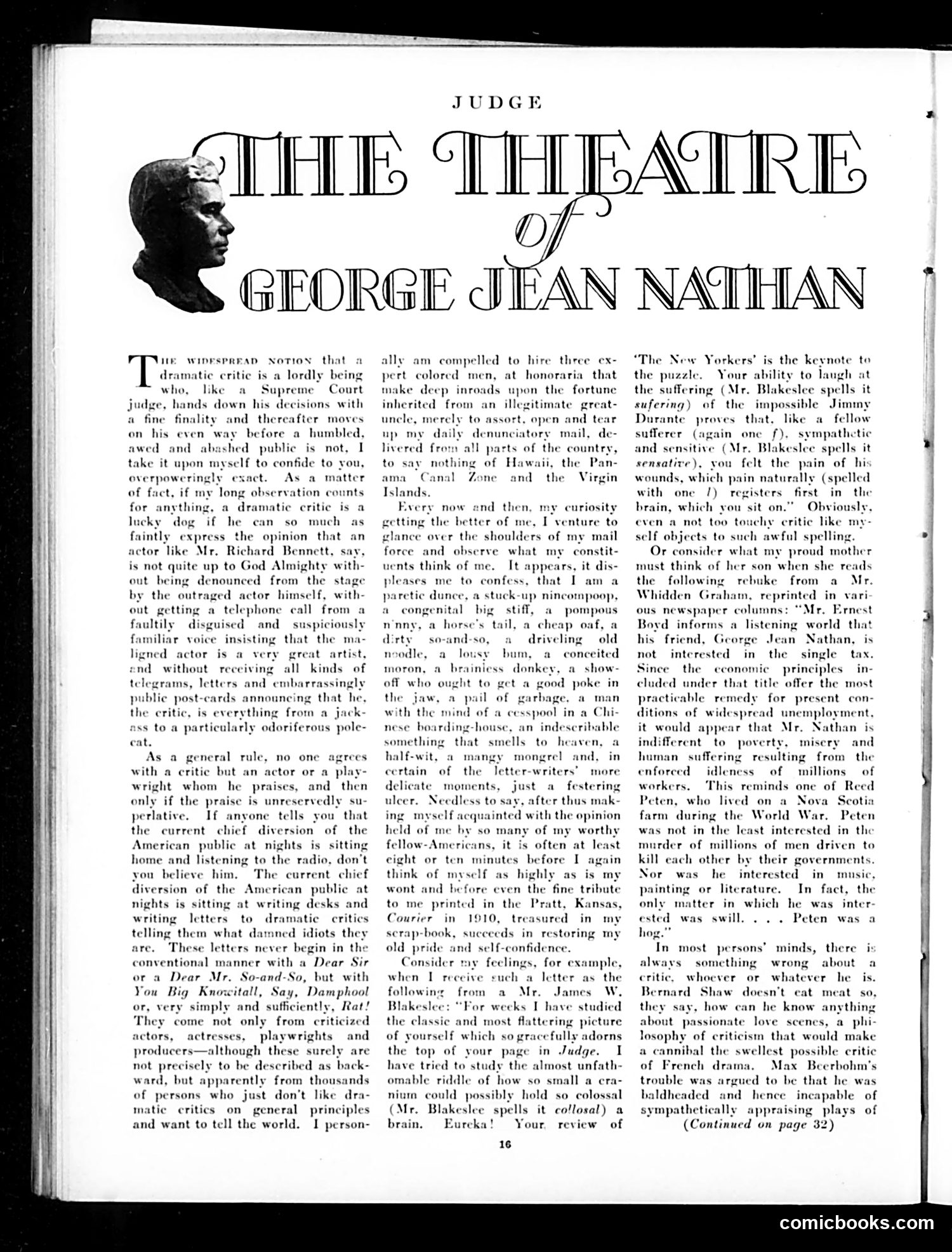
A restored page from Judge, 1931-07-18. Page through the whole issue in the reader above.
📄 Transcribed text from this page (OCR, searchable)
Machine-transcribed from the original scan — historical spelling and the odd misread are preserved.
He WIDESPREAD NoTION that a dramatic critic is a lordly being who, like a Supreme Court judge, hands down his decisions with a fine finality and thereafter moves on his even way before a humbled, awed and abashed public is not, 1 take it upon myself to confide to you, overpowerir t. As matter of fact, if my long observation counts for anything, a dramatic critic is a lucky ‘dog if he can so much as faintly express the opinion that an actor like Mr. Richard Bennett, sa. is not quite up to God Almighty with- out being denounced from the stage by the outraged actor himself, with- out getting a telephone call from a faultily disguised and suspiciously familiar voic insisting that the ma- ligned actor is a very great artist, end without receiving all kinds of telegrams, letters and embarrassingly public post the critic, is everything from a ass to a particularly odoriferous pc cat. As a general rule, no one with a critic but an actor or a play- wright whom he praises, and then only if the praise is unreservedly su- perlative. If anyone tells you’ that the current chief diversion of the American public at nights is sitting home and listening to the radio, don't you believe him. The current chief diversion of the American public at nights is sitting at writing desks and ards announcing that he, k- le- agrees writing letters to dramatic critics telling them what damned idiots they are. These letters never begin in th conventional manner with a Dear Sir or a Dear Mr. So-and-So, but with You Big Knowitall, Say, Damphool or, very simply and sufficiently, Rat! They come not only from criticized actors, actresses, playwrights and producers—although these surely are not precisely to be described as back- ward, but apparently from thousands of persons who just don’t like dra- matic critics on general principles and want to tell the world. I person- JUDGE 0 GEORGE J ally am compelled to hire three ex- pert colored men, at honoraria that make deep inroads upon the fortune inherited from an. illegitimate great- uncle, merely to assort, open and tear up my daily denunciatory mail, de- livered from all parts of the country, to nothing of Hawaii, the ama "Canal and the Virgin Islands. Every now end then, my curiosity getting the hette roof me, I venture to over the shoulders of my mail force and observe what my constit- uents think of me. It appears, it dis- ple me to confess, that I am a a stuck-up nincompoop, glance stiff, a pompous n'nny, a horse's tail, a cheap drivelin noodle, a lousy bum, a conceited dirty so-and-so, moron, a brainiess donkey, a show- off who ought to get a good poke in the jaw, a pail of garbage, a man with the mind of a cesspool in a Chi- indescribable nese boarding something that smells to heaven, a half-wit, a mangy mongrel and, in certain of the letter-writers’ more delicate moments, just a fest ulcer. Needless to say, after thus m: ing myself acquainted with the opinion held of me by so many of my worthy fellow-Americans, it is often at least eight or ten minutes before I think of myself as highly as is my wont and before even the fine tribute to me printed in the Pratt, Kansas, Courier in 1910, treasured in’ my scrap-book, succeeds in restoring my in old pride and self-confidence. Consider my feelings, for example, when I receive such a letter as the following from a Mr. James W. Blakeslee: “For weeks I have studied the classic and most flattering picture of yourself which so gracefulls the top of your page in Judge. I have tried to study the almost unfath- omable riddle of how so small a era- nium could possibly hold so colossal (Mr. Blakeslee spells it collosal) a brain. Eureka! Your, review of 16 adorns AIRE: NATHAN ‘The New Yorkers’ is the ke: the puzzle. Your ability to laugh at the suffering (Mr. Blakeslee spells it sufering) of the impossible Jimmy Durante proves that, like a fellow sufferer (again one f), sympathetic and sensitive (Mr. Blakeslee spells it sensative), you felt the pain of hi wounds, which pain naturally (spelled with one /) registers first’ in. the Obviously. po my: brain, which you sit on.” even a not too touchy critic Ti self objects to such awful spelling. Or consider what my proud mother must think of her son when she reads the following rebuke from a = Mr. Whidden Graham, reprinted in va ous newspaper columns: “Mr. Ernest Boyd informs a listening world that his friend, George Jean Nathan, is not interested in’ the single ts ince the ceonomic principles cluded under that title offer the most practicable remedy for present con- ditions of widespread unemployment, it would appear that Mr. Nathan. is indifferent to poverty, misery and human suffering resulting from the enforced idleness of millions of workers. This reminds one of Reed Peten, who lived on a Nova Scotia farm during the World War, Peten was not in the least interested in the murder of millions of men driven to kill each other by their governments. Nor was he interested in music, r literature. In fact, the ter in which he was inter- 1 was swill. .. . Peten was a ns’ minds, there i wrong about a whoever or whatever he is. rd Shaw doesn’t eat meat so, they say, how can he know anything about passionate love scenes, a phi- losophy of criticism that would make a cannibal the swellest possible critic of French drama, Max Beerbohm’'s trouble was argued to be that he was baldheaded and hence incapable of sympathetically appraising plays of (Continued on page 32) n most pers always somethi s — comicbooks.com