
Judge, 1931-07-04 · page 18 of 36
Judge — July 4, 1931 — page 18: what you’re looking at
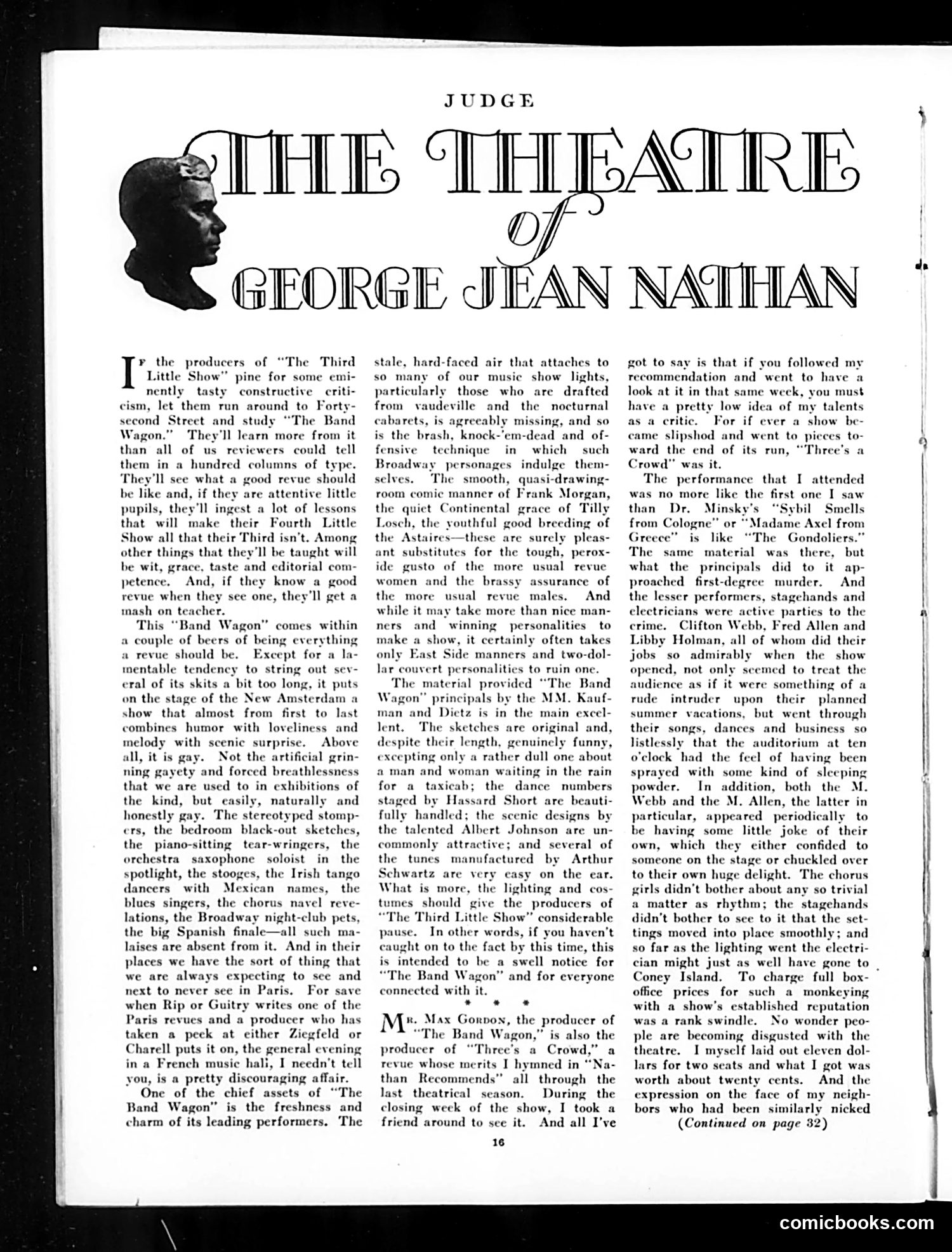
A restored page from Judge, 1931-07-04. Page through the whole issue in the reader above.
📄 Transcribed text from this page (OCR, searchable)
Machine-transcribed from the original scan — historical spelling and the odd misread are preserved.
the producers of “The Third Little Show” pine for some emi- nently tasty constructive cri cism, let them run around to Forty- second Street and study “The Band gon.” They'll learn more from it IL of us reviewers could tell m in a hundred columns of type. They'll see what a good revue should be like and, if they are attentive little pupils, they'll ingest a lot of lessons that will m. their Fourth Little Show all that their Third isn’t. Among other things that they'll be taught will be wit, grace, taste and editorial com- petence. And, if they know a good revue when they see one, they'll get a mash on t er. This “Band Wagon” comes within a couple of beers of being everything a revue should be. Except for a la- able tendency to string out sev- eral of its skits a bit too long, it puts on the stage of the New Amsterdam a show that almost from first to last combines humor with loveliness and melody with scenic surprise. Above all, it is gay. Not the artificial grin- ning gayety and forced breathlessness that we are used to in exhibitions of the kind, but easily, naturally and honestly . The stereotyped stomp- ers, the bedroom black-out sketches, the piano-sitting tear-wringers, the orchestra saxophone soloist in the spotlight, the stooges, the Irish tango dancers with Mexican names, the blues singers, the chorus navel reve- lations, the Broadway night-club pets, the big Spanish finale—all such ma- laises are absent from it. And in th places we have the sort of thing that we are always expecting to see and next to never see in Paris. For save when Rip or Guitry writes one of the Paris revues and a producer who has taken a peck at either Zic Charell puts it on, the gene in a French music hali, I needn't tell you, is a pretty discouraging af One of the chief assets of Band Wagon” is the freshness a charm of its leading performers. The JUDGE O stale, hard-faced air t sor attaches to any of our music show lights, particularly those who are drafted from vaudeville and the cabarets, is agreeably missin is the brash, knock-'em-dead and of- fensive technique in which such Broadway personages indulge them- selves. “The smooth, quasi-drawing- room comic manner of Frank Morgan, the quiet Continental grace of Tilly Losch, the youthful good breeding of the Astaires—these are surely pleas- ant substitutes for the tough, peros ide gusto of the more usual revue women and the brassy the more usual revu while it ms ners and make only assurance of . And y take more than nice man- winning personalities to show, it certainly often takes ast Side manners and two-dol- lar couvert personalities to ruin one. The material provided “The Band on” principals by the MM. Kauf- 1" is in the main excel- lent. The sketches are original and, despite their length, genuinely funny, excepting only a rather dull one about a man and woman wai for the in numbers re beau! y handled; the scenic designs by the talented Albert Johnson are un- commonly attractive; and several of the tunes manufactured by Arthur Schwartz are very easy on the ear. What is more, the lighting and cos- tumes should give the producers of “The Third Little Show” considerable pause. In other words, if you haven't ht on to the fact by this time, this nded to be a swell notice for “The Band Wagon” and for everyone connected with it. * 8 « M:,Max Gonnos, the producer of ‘The Band Wagon,” is also the producer of “Three's a Crowd,” a revue whose merits I hymned in a- than Recommends” all through the last theatrical season. During the closing week of the show, I took a friend around to see it. And all I've 16 HAO SARAH PORGE J NATHAN got to say is that if you followed my ommendation and went to have a look at it in that rk, you must have low idea of my talents as a For if ever a show be- came slipshod and went to pieces to- ward the end of its run, “Three's a Crowd” was it. The performance that I attended was no more like the first one I saw than Dr. Minsky’s “Sybil Smells from Cologne” or “Madame Axel from is like “The Gondoliers.” he same material was there, but what the principals did to it ap- proached first-degree murder. And the lesser performers, stagehands and electricians were active parties to the crime. Clifton Webb, Fred Allen and Libby Holman, all of whom did their jobs so admirably when the show opened, not only scemed to treat the audience as if it were something of a rude intruder upon their planned summer vacations, but went through their songs, dances and business so listlessly that the auditorium at ten o'clock had the feel of having been sprayed with some kind of sleeping powder. In addition, both the M. Webb and the M. Allen, the latter in particular, appeared periodically to be having some little joke of their own, which they either confided to someone on the stage or chuckled over to their own huge delight. The chorus Is didn’t bother about any so trivial a matter as rhythm; the stagehands didn’t bother to see to it that the set- tings moved into place smoothly; and so far as the lighting went the elect cian might just as well have gone to Coney Island. office prices for such a monkeying with a show's established reputation was a rank swindle. No wonder peo- ple are becoming disgusted with the theatre. I myself laid out eleven dol- lars for two ts and what I got was worth about twenty cents. And the expression on the face of my neigh- bors who had been similarly nicked (Continued on page 32) To charge full box-~ a —————— comicbooks.com