
Judge, 1931-07-04 · page 15 of 36
Judge — July 4, 1931 — page 15: what you’re looking at
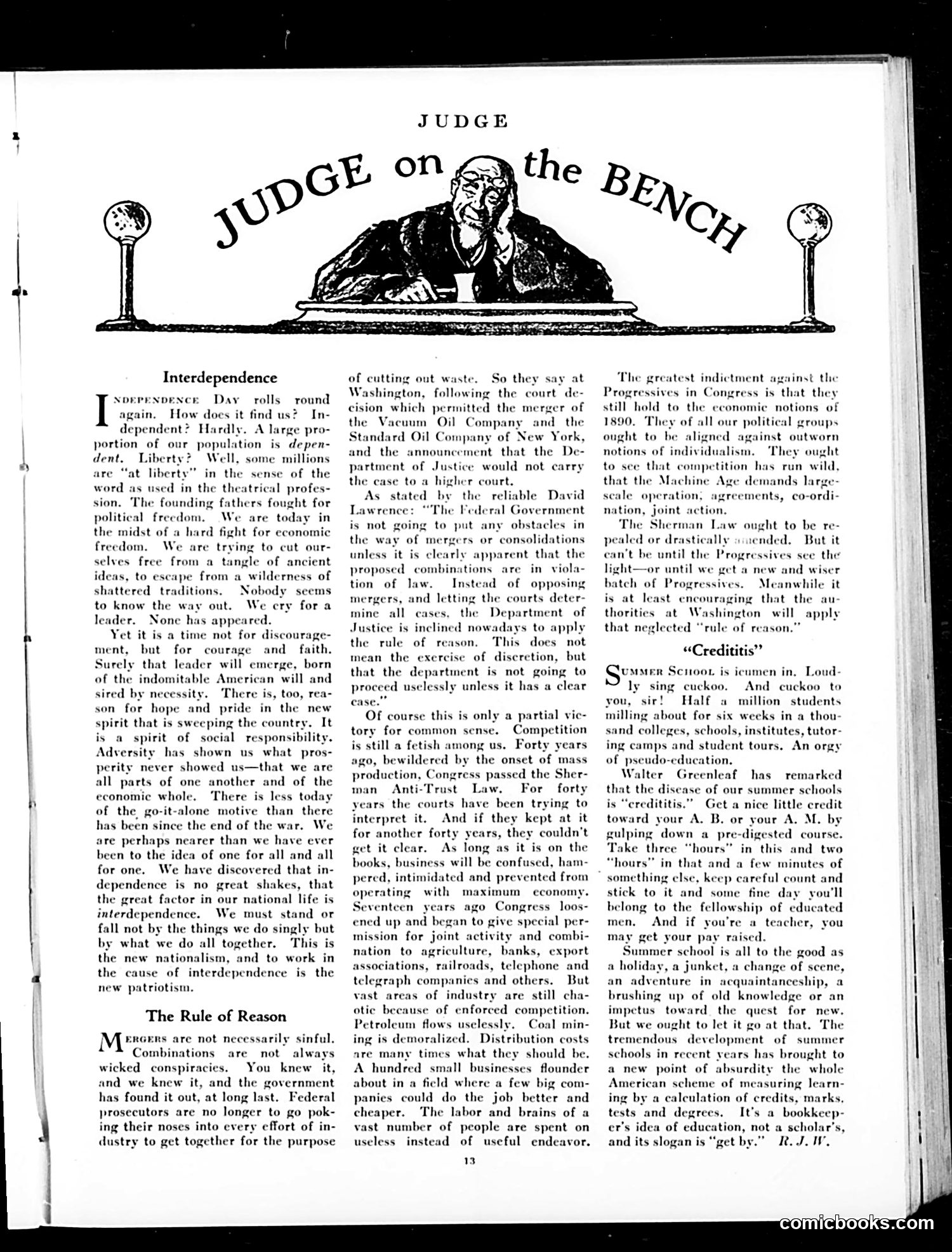
A restored page from Judge, 1931-07-04. Page through the whole issue in the reader above.
📄 Transcribed text from this page (OCR, searchable)
Machine-transcribed from the original scan — historical spelling and the odd misread are preserved.
h Interdependence NoereNnpence Day rolls round in. How does it find us? In- dependent? Hardly. A large pro- portion of our population is depen- dent. Liberty? Well, some millions are “at liberty” in the sense of the word as used in the theatrical profes- sion. The founding fathers fought for political fr the midst of freedom. We Jom. We are today in hard fight for economic try ng to cut our- selves free from a tangle of ancient ideas, to escape from a wilderness of shattered traditions. Nobody seems to know the way out. We ery for a leader. None has appeared. Yet it is a time not for discourage- ment, but for courage and faith. Surely that leader will emerge, born of the indomitable American will and sired by necessity. ‘There is, too, rea- son for hope and pride in the new spirit that is sweeping the country. It is a spirit of social responsibility. Adversity has shown us what pros- perity never showed us—that we are all parts of one another and of the economic whole. There is less today of the g one motive than there has been since the end of the war. We are perhaps nearer than we have ever been to the idea of one for all and all for one. We have discovered that in- dependence is no great shakes, that the great factor in our national life is interdependence. We must stand or fall not by the things we do singly but by what we do all together. This is the new n nd to work in the cause of interdependence is the new patriotism. The Rule of Reason Mf ercens are not necessarily sinft {N21 Combinations are not alw wicked conspiracies. You knew it, and we knew it, and the government has found it out, at long last. Federal prosecutors are no longer to go pok- ing their noses into every effort of in- dustry to get together for the purpose of cutting out waste. So they say at Washington, following the court de- cision which permitted the merger of the Vacuum Oil Company and_ the Standard Oil Company of New York, and the announcement that the De- partment of Justice would not carry the case to a higher court. by the reliable David ral Government iny obstacles in is not going to put the w of mergers or consolidations unless it is clearly apparent that the proposed combinations are in. viola- tion of law. Instead of opposing mergers, and letting the courts deter- mine all cases, the Department of Justice is inclined nowadays to apply the rule of reason, This does not mean the exercise of discretion, but that the department is not going to proceed uselessly unless it has a clear case.” Of course this is only a partial vie- tory for common sense. Competition is still a fetish among us. Forty years ago, bewildered by the onset of 1 production, Congress passed the Sher- man Anti-Trust’ Law. For forty years the courts have been trying to interpret it. And if they kept at it for another forty years, they couldn't get it clear. As long as it is on the books, business will be confused, ham- pered, intimidated and prevented from operating with maximum economy. Seventeen years ago Congress loos- ened up and began to give special per- mission for joint activity and combi- nation to agriculture, banks, export associations, railroads, telephone and ph comp: nd others. But 1s of industry are still cha- otic because of enforced competition. Petroleum flows uselessly, Coal min- ing is demoralized. Distribution costs are many times what they should be. A hundred small businesses flounder about in a ficld where a few big com- panies could do the job better and cheaper. The labor and brains of a vast number of people are spent on useless instead of useful endeavor. 13 inst the essives in Congress is that they still hold to the economic notions of 90. They of all our political groups ed against outworn lism. They ought Prog notions of individ . to see that competition has run wild, that the Machine Age demands lar; ation, agreements, co-ord nation, joint action. The Sherman Law ought to be re- pe: vended. But it ran’t be until the Progressives see the t—or until we get a new and wiser tch of Progressives. Meanwhile it is at least encouraging that the au- thorities at Washington will apply that neglected “rule of reason.” “Credititis” Soosen Scitoot is icumen in, Loud- ly sing cuckoo. And cuckoo to you, sir! Half a million students milling about for six weeks in a thou sand colleges, schools, institutes, tutor- ing camps and student tours. An orgy of pseudo-education. Walter that the dis is “‘credititis. ed or drastically sreenleaf has remarked se of our summer schools set a nice little credit toward your A. B. or your A. M. by ilping down a pre-digested course. e three “hours” in this and two “hours” in that and a few minutes of something else, keep careful count and stick to it and some fine day you'll belong to the fellowship of educated men, And if you're a teacher, you may get your pay raised. Summer school is all to the good as a holiday, a junket, a change of scene, an adventure in acquaintanceship, a brushing up of old knowledge or an t for n impetus toward the qu ow, But we ought to let it go at that. The tremendous development of summer schools in recent years has brought to a new point of absurdity the whole American scheme of measuring learn- ing by a calculation of credits, marks, tests and degrees. It’s a bookkeep- er's idea of education, not a scholar’s, and its slogan is “get by.” 2. J.